
JOHNSON – How ‘notwithstanding’ has become a ticking legislative time bomb
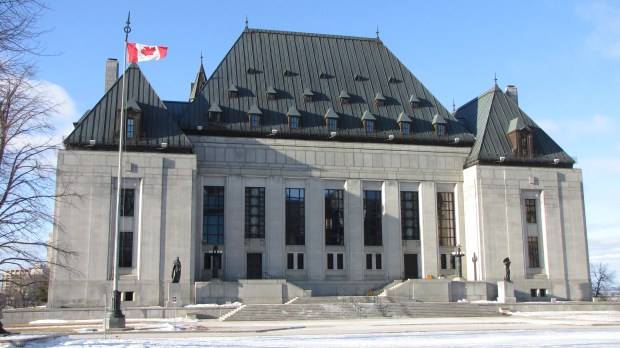
Supreme Court of Canada. (Image: Wikimedia Commons)
THE SUPREME COURT of Canada is to hear a case that affects the rights of all Canadians.
It’s a battle about who should have the last word when it comes to fundamental rights and freedoms; the courts or elected legislatures.
 This case is about whether our current system protects the rights and freedoms, even in how we define ourselves as Canadian. But to get to the case at hand, first a bit of catch up.
Everyone knows how the Canadian Charter of Rights and Freedoms is a foundational part of the Constitution of Canada that guarantees our individual freedoms — expression, religion, assembly, the right to vote, mobility rights, and equality rights.
Most people also know that there is a clause within the Charter that can allow provinces to bypass certain sections, and this is known as the ‘notwithstanding clause.’
I know, I know … the quintessential Canadian eyeroll word.
Fewer words in Canadian culture, lore and law makes more lawyers, politicians and regular people shudder as violently as the mere utterance of that one word … notwithstanding.
First, let’s parse how this clause is intertwined in this case, then move on to its effect.
Quebec’s secularism law Bill 21. That’s the one that prevents some civil servants from wearing religious symbols. What some people don’t know or forgot in the news hub bub in 2019 when Quebec passed this bill, is why they did this in the first place.
At the time, it wasn’t to be racist, it wasn’t to be ethnically exclusionary, it wasn’t to harm the large Quebecois immigrant population … it was about turning the Quebec government and its services into a laicity state based on four principles: the separation of state and religions, the religious neutrality of the state, the equality of all citizens, and freedom of conscience and freedom of religion.
Anyone who has spent much time in Quebec, or has been in any government or public building there, will know that the Roman Catholic Church and its iconographic imagery was firmly embedded in the fabric of Quebec public life. Crosses, Virgin Marys and scripture were everywhere you turned.
Quebec decided to separate this entrenchment, and has for years worked on taking down visual Catholic icons from government spaces, as well as slowly replace policies, processes and legislation at every level to reflect this general choice towards laicity.
Bill 21 was designed to do this; separate the Catholic Church from the state … but it was realized at the same time that it meant that they also had to include ALL religions equally in this legislation.
Now we come to the problem that blew up in 2019. To stop crosses from being hung on the walls of the provincial services offices or schools, or the courts … all religious iconography needed to be addressed equally. To stop crosses, hijabs also fell into the target, as did turbans, and any other religious symbolism.
We know what happened next — protests, rallies, lots of news coverage. Where there was no problem removing crosses from walls, when the object was physically and emotionally attached to a person’s individual identity, and a visual structural part of how they present to the world, it’s not so simple.
This was about seven years ago.
Since then, running on their success, Quebec has moved to strengthen state secularism further; Bill 9 dubbed “secularism 2.0”, and here this justification became lost in the weeds of power.
Bill 9 extends the ban to the wearing of any religious symbols; to staff in subsidised daycares, and a bar on prayer in public spaces such as parks (because of instances of Palestinians gathering to pray), and prevent students and staff from wearing face coverings in daycare all the way through to post-secondary education, and impose a limit on the offering of religion-based menus, like kosher and halal meals in public institutions.
This is where it turned from removing the Catholicism imbed in public culture to now being about ethnicity and race, intended to control the rights of individuals that are different than the original francophone cultural base.
Any argument Quebec had to remove Catholic iconography from government walls is now completely destroyed. The Charter’s number one job is guaranteeing the freedom to pray in a park and that food choices are in alignment with individual belief.
Quebec used the notwithstanding clause to make all this unchallengeable law, therefore actually enshrining what appears to be racism … into law.
The Supreme Court case today is not really about whether the province can prevent teachers from wearing hijabs, it’s how Quebec used the Constitution to do it in the first place.
The focus of this case is how Quebec’s CAQ government did something unexpected when it passed Bill 21 and now Bill 9 into law, not just using the notwithstanding, but how they did it:
Back in 1981, when the fed was negotiating with the provinces to create the Charter, some provinces were worried that it would give too much power to the courts.
So, there was a compromise; A kind of a legal escape hatch. If courts strike down a law because it violates Charter rights, provinces can invoke the clause and just keep the law anyway. The notwithstanding clause was born. The original intention was to only use it in the most extreme situations where the judges have gone perhaps too far and the fundamental ability of the legislature to fill its most critical function had been stymied.
The idea was for voters to get a chance through elections to change governments if they want to go a different route — the natural cross check to misuse of the notwithstanding clause.
The difference with what Quebec did with Bill 21 was that instead of passing a bill, and waiting for a court challenge and legal ruling, Quebec decided to just invoke the clause from the start, right in the text of the Bill 21 itself.
In theory, protect it from court challenges and allow the government to implement the law right away. No one had ever tried that before, and it worked. Bill 21 has survived lower court challenges, and then the expected result; other provinces are trying the exact same thing.
In 2022, Ontario pre-emptively invoked the notwithstanding clause to try to stop a school strike, but eventually backed off.
In 2023, Saskatchewan used it to enact a law that requires parental consent for anyone under 16 to alter their gender identity at school.
More recently, Alberta did the same in a broader effort to limit the rights of trans people.
Some say it’s getting out of control, and has brought up fundamental questions — if you can withdraw Charter protected freedoms with a non retractable clause, what freedom have we got at all?
It’s a fair question.
The province’s main defense for using the notwithstanding clause in this new way
is that there was nothing written in the charter that says they can’t.
And this is the thing. This has become the biggest failure of the charter, not by what IS in the charter … but what ISN’T.
The section surrounding the notwithstanding is short, incomplete, with no clear guidance, rules or boundaries as to its use. Considering how it has been used, and how this affects the very freedoms of average Canadians, it’s obvious that a foundational part of our constitutional law was literally left unwritten.
This clause was never meant to be used pre-emptively to stop the courts before a case is even brought forward. The problem is that this detail is not written down anywhere in the charter itself. This is a complete legislative failure.
Back in the ’80s they relied on good conscience and calm future dispute resolution at the provincial and federal level. Unfortunately, the world changed, and we are in times that when it comes to legislation, that if you don’t put limits expressly in there, future governments or future parliaments will take full advantage of it … and Quebec did.
And that’s the heart of this Supreme Court case.
The groups challenging Bill 21 focus on the pre-emptive use of the notwithstanding clause and know their case is a long shot, but they have a backup plan. They want the courts to still be able to rule on the constitutionality of these individual pieces of legislation. Even if legal rulings will not strike down these laws, the court would still consider the evidence and make rulings about whether or not Charter rights had in fact been violated.
This way, the public would have the benefit of weighing that judicial pronouncement when making decisions at the ballot box. The hope being a cooling effect, reconnecting provincial governance with the fear of losing the next election.
This Supreme Court case is huge and the stakes are high. The Quebec government, other provinces, the federal government, civil rights groups, teachers, and more than 50 other organizations are taking part. Arguments before the Supreme Court begin March 23, 2026.
The outcome is not only about Bill 21 but how provinces create future laws that might threaten Charter rights. The reality is we can’t change or remove or update the notwithstanding clause because to alter the Constitution and Charter needs an overwhelming number of signatures … and you can bet the provinces don’t want to change this at all.
At the end of the day, the notwithstanding clause with the holes it has, has proven to be a terrible decision, a ticking legislative time bomb that is now exploding in our faces.
In black and white, our rights and freedoms don’t really mean anything anymore.
We are only a step away from legislating a silencing or outlawing of media critical of government, sliding into an actual modern version of a democratic fascist state.
“Oh, they wouldn’t do that” we want to say … but we didn’t think Quebec would outlaw someone’s dinner, or the right to pray, yet that’s exactly what they did.
David Johnson is a Kamloops resident, community volunteer and self described maven of all things Canadian.

 ArmchairMayor.ca
Good article David. Under the BNA Act 1867 responsibility for education demanded by Quebec to protect Quebec culture and language, was given to the provinces which has created many of the issues that you discuss. The Charter protects us against Government laws while other protections are in Human Rights Codes.
Section 93 of the Constitution Act, 1867 (formerly BNA Act) assigned education to provinces, enabling Quebec to safeguard French language and culture through policies like Bill 101, but this federal-provincial division has fueled ongoing debates over national unity, minority rights, and funding equity. The Charter (1982) limits government infringements on fundamental freedoms, while provincial human rights codes address private-sector discrimination, creating a layered rights framework with occasional overlaps and conflicts.
The notwithstanding clause (Section 33) is controversial because it lets governments override key Charter rights (like freedom of expression, religion, and equality), potentially undermining protections against abuse of power, eroding minority rights, and normalizing populist overrides of judicial rulings. It can theoretically override freedom of expression (Section 2) to enable laws suppressing criticism of government, as the Charter doesn’t explicitly prohibit this use, though political backlash often deters it, and Quebec has invoked it for expression-restricting language laws.
Section 1 of the Canadian Charter of Rights and Freedoms, known as the “reasonable limits” clause, states that Charter rights are guaranteed “subject only to such reasonable limits prescribed by law as can be demonstrably justified in a free and democratic society.”
This allows governments to limit rights (e.g., freedom of expression under Section 2) without invoking the notwithstanding clause (Section 33), but only if the limit passes the Oakes test: it must pursue a pressing objective, be rationally connected, minimally impair the right, and have proportional effects.
For example, laws restricting hate speech or defamation can limit criticism of government if justified, but courts scrutinize them rigorously to prevent abuse
LikeLike
We truly are a step away from being a truly failed society/country. The more I look around, the more I read the news and the opinions of the “influencers”, the more I get depressed thinking of the vaned enthusiasm I once had for Canada.
LikeLike