
NATIONAL PULSE – Would U.S. absorb Alberta and Quebec if they separate?
Third of three in a series looking at the separation movements in Quebec and Alberta
By ANGUS REID INSTITUTE
February 23, 2026 – The likelihood of Canada losing either Alberta or Quebec from its federation appears low for now – given that a strong majority of residents in both provinces say they have no interest in the idea – but it certainly has the rest of the country talking, and alive to the potential consequences of separation.
New data forming the last of a three-part series from the non-profit Angus Reid Institute on national unity and separation finds Canadians saying that losing either Alberta or Quebec would be a negative if not significantly problematic economic hit to the nation.
Other releases in this series:
In the case of Alberta, two-in-five (41%) say the loss would be overwhelmingly negative, as that province’s oil and gas sector drives a large portion of that nation’s economy. In fact, that number is twice as many as say the same of losing Quebec (20%). While losing either would be presumably catastrophic for Canada, Quebec is responsible for one-fifth of the nation’s GDP, while Alberta’s economy represents 15 per cent.
The well-trodden argument from Albertans, which is believed by both those who wish to leave and stay, is that the province gives out more than it gets as a part of confederation. For many, this is a fair critique.
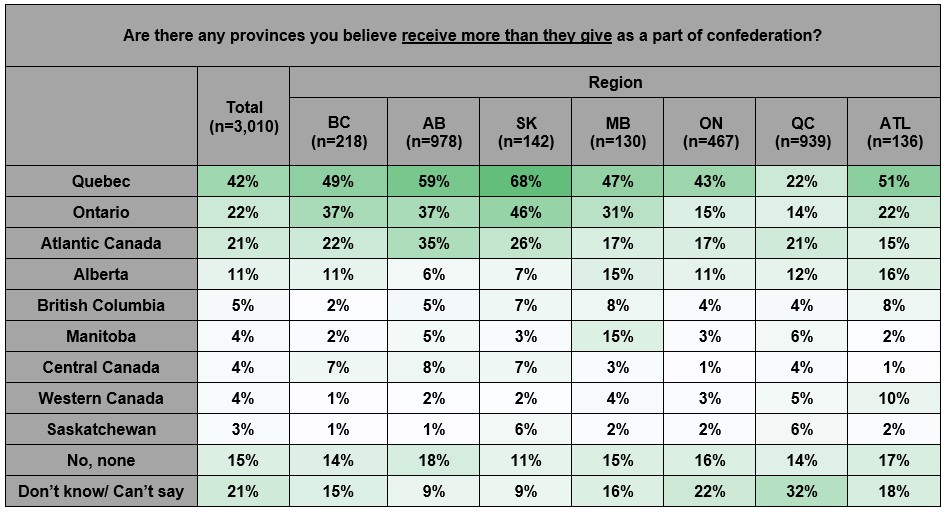
Indeed, 29 per cent of Canadians say Alberta gives more than it gets, well ahead of any other province or region, with Saskatchewan second at 13 per cent. On the other side of the equation, Canadians are most likely to say that Quebec benefits more than others (42%), well ahead of second place Ontario (22%).
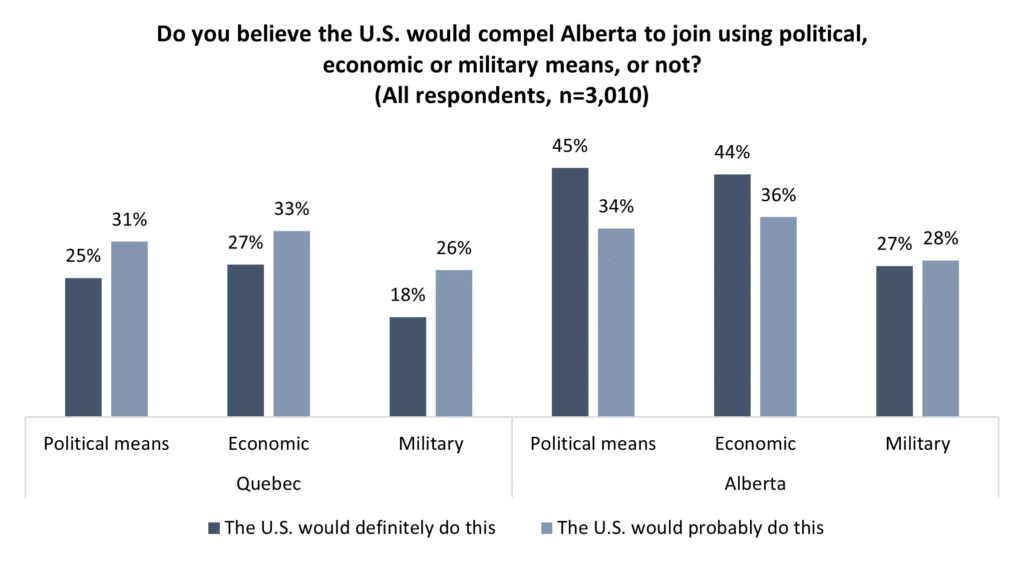
If either were to separate, the common sentiment is that the United States would apply significant pressure to absorb or influence the new independent nation.
Nearly half say they U.S. would “definitely” try to economically and politically pressure Alberta to join as a new state. Another one-third say this would “probably” happen. Canadians are less sure this would happen to Quebec, but half feel it is likely.
Notably, the vast majority of the country has little interest, evidently, in losing either province. Seven-in-10 say if they had a vote, they would block Quebec from leaving (71%) while four-in-five (79%) would do the same to Alberta. Notably, Quebecers are much more likely to want to block Alberta separatism than the other way around.
While they may not have a direct vote on the matter, a constitutional amendment for provincial separation would need the approval of at least seven provinces representing at least 50 per cent of the population.

More Key Findings:
- Pride in country has dropped again after peaking in the early days of Donald Trump’s annexation threats. Last March, 47 per cent said they were very proud, which has dropped to 39 per cent.
- One-quarter of Canadians (24%) say Alberta’s provincial economy would improve with separation, while three-in-five (61%) say the impact would be negative.
- Fewer (10%) say that Quebec’s economy would improve, while three-quarters (75%) say it would worsen

 ArmchairMayor.ca
Leave a comment