
THE ‘215’ – Search for burial sites rules out some areas but not others
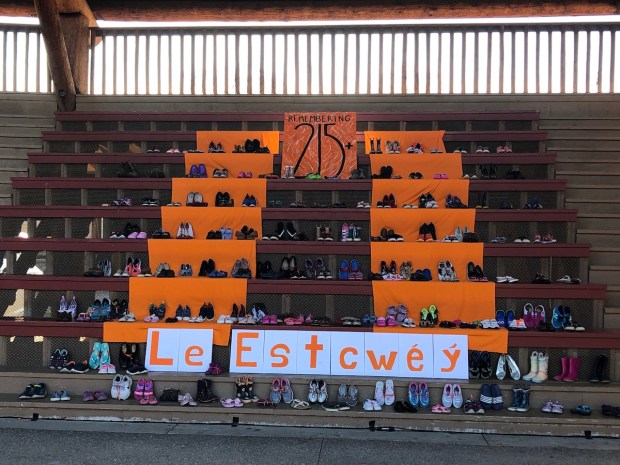
(Image: Mel Rothenburger)
The search for possible grave sites at the Kamloops Indian Residential School has ruled out some areas but continues in others, Tk’emlups te Secwepemc Kúkwpi7 Rosanne Casimir said today (Feb. 17, 2026).
Her statement was the first update on progress since the announcement in May 2021 that a study using ground penetrating radar technology had revealed up to 215 potential burial sites in the school’s former orchard, some containing children as young as three. Descriptions of the finding have devolved from suspected “mass graves” to “anomalies” and — in Casimir’s statement today — “potential burials.”
Casimir said that, in addition to GPR, LiDAR scanning (a remote sensing method used for scanning the Earth’s surface) and human-remains detection dogs have been used on an effort to further the search. As well, the Band continues to pursue access to archival records from the federal and provincial governments and the Roman Catholic Church, she said.
Data and findings overlap in several areas, according to Casimir, and those areas will become the primary focus of further research.
Results so far appear to be mixed. “Some areas were ruled out as burials, while others cannot confidently be ruled out,” said Casimir, and “signatures that resemble burials were found in some areas.”
Perhaps significantly, the radar and laser scanning ruled out the presence of utility lines and clay tiles in the locations that overlap. Clay tiles used in old sewage lines have been raised in the past as a possible explanation for the anomalies.
Casimir’s statement — she said she will not give media interviews about it — raised the possibility that excavation may be ruled out to confirm the presence of human remains.
“Each Nation upholds its own cultural and spiritual protocols for how ancestral remains must be treated,” the news release says. “We also understand that full consensus may never be achieved. Possible future outcomes could be to preserve the orchard as a Sacred Site — a place of memory and healing — or excavate.
“Any remains would need to be repatriated to their home communities, an extremely complex and sensitive process involving extensive consultation with the Nations, DNA analysis, forensic expertise, and adherence to appropriate laws and protocols.”
She said, “While the investigation has been more complex than we initially thought, we are making progress and will continue adapting our methodologies and information as it advances.”

 ArmchairMayor.ca
Leave a comment