
JOHNSON – Curling, cheating and the controversy about ‘double touching’
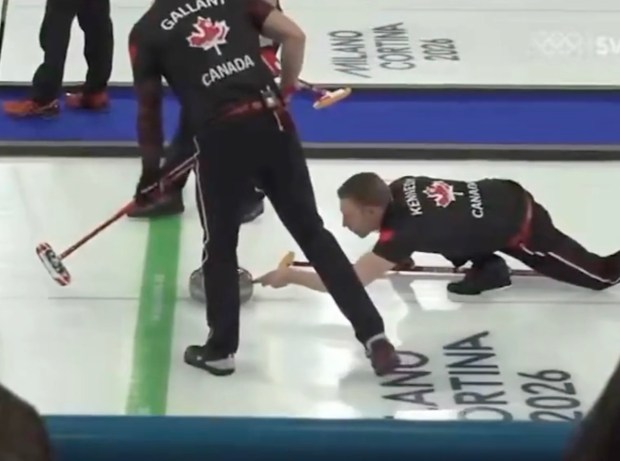
Swedish television video shows Canadian Marc Kennedy’s delivery.
ONE WOULD NOT really consider curling the bastion of sport controversy … but this is oddly where we find ourselves. Curling a very long time ago was known as a past time … like shuffleboard or darts … but as time went on, it became a popular team vs team sport competition, then exploded in popularity in the ’50s – ’70s and again after year 2000, where it really became a sport with skill, stars and yes … was established to the point where you can get controversy.
 And here we are.
Debate is swirling at the Winter Olympics and it’s all centring on whether the mighty Canadian team is cheating. Both men’s and women’s teams have now been accused of the same infraction — double-touching the curling stone after it is released.
On Friday, Swedish curler Oskar Eriksson accused Canadian curler Marc Kennedy of breaking the rules by touching the rock again after initially releasing it down the sheet of ice. Kennedy blew up, launching an expletive-laden outburst.
That was before video appearing to show a clear double-touch by Kennedy circulated on social media. In the video, he releases the handle, and then touches the stone itself … a clear rule violation. The video was taken by Swedish public broadcaster SVT.
Still, he maintained innocence, but did sincerely apologise for his poor language on the ice.
In response to the controversy, World Curling stationed two umpires to monitor the four sheets of ice, watching all deliveries starting on Saturday afternoon. It didn’t take long for one of them to intervene.
Rachel Homan, the skip of the Canadian women’s team, ran afoul against Switzerland when an umpire had her stone removed from play. Homan looked shocked and denied the allegation, calling the decision “unbelievable,” and questioned the skills of the umpire.
Again, video spread on social media appearing to show her double-touch.
After the uproar, World Curling clarified that double-tapping is not allowed, but the controversy widened Sunday as the British men’s team was ruled for the same alleged violation that burned the Canadians two days in a row.
SEE ALSO: ROTHENBURGER – How curling was ruined by trying to make it better
Why this is such a big story.
For other team or even individual sports, the function of play may be handled by officials, referees, umpires, track officials, swimming judges … etc. Imagine a sport and consider the job of its officialdom to either getting the ‘game’ started or keeping it going within the stated rule book. Often their job is to instantly make a decision — the baseball pitch being a ball or strike, the soccer/football offside rule.
As well, it’s often some officiating staff’s responsibility to set up and do the functionary work to keep the game, race or event going — the official responsible for resetting downhill skiing flags for example, or cones at the speed skating rink.
Curling is different.
It is the responsibility of the players to set up and remove rocks, organize play and begin a game. The officials specifically sit in a box and keep track of scores as observers, and don’t normally interact with players. Usually, officials enter the ice when the measuring device is requested to determine a moment when one rock or the other may be closer to the center of the ‘house’ … the circles at the end … or a team declare that their opponents broke a rule, and it requires adjudication.
Otherwise from an official’s perspective, the curling ice is generally hands off.
And that’s about it. Everyone knows the rules, a big part of curling is the culture of fair play, and following an established rule book. There really isn’t a lot of interpretation of these rules.
Where other sports have judges, umpires, referees and the like that are heavily trained in the function of their job within the sport, with the authority to interpret rules to the situation at hand … that doesn’t really come up in curling.
So, it sticks out when there are allegations of cheating.
One would not think that cheating in curling was even possible.
Yet we find ourselves here, and Canadians are in the crossfire.
This doesn’t mean there haven’t been scandals before – see Broomgate, a broom material design headache that World Curling believes it solved last June. Theres a great CBC podcast that details the saga.
Canada is the top nation in curling, easily its biggest market and where the biggest non-Olympic competitions tend to take place. They are taking it personally that their integrity is coming under attack in front of a global audience at the Olympics, which touts the values of respect and friendship.
The athletes playing for Canada and Sweden used to be close off the ice — huge rivals, sure, but admiring of each other’s skills. Now there’s clear animosity between the teams, which is intriguing for the casual viewer but a sad blow to the curling community.
What’s next
Kennedy said, “We’ll make some adjustments, release-wise, if we have to” … well ya.
Here’s the thing.
Clearly some players; a couple Canadians and a UK player have taken to the habit of touching off on the stone, after release. Experienced commentators on TV have offered that such a touch will not alter the speed or trajectory of the stone, it’s just too heavy for that … nearly 42 lbs.
This means that a call out for cheating for performance gains, just isn’t reality.
But clearly, it’s a rule and rules are written to be followed. If players have gotten lazy with a rule like this, they need to snap to attention and heed to the details.
The second problem is officiating.
It was said that the umpires directed by World Curling to watch for this rule, and call out infractions, created a new problem. Players questioned the training and validity of the skills of these umpires. They may not have been specifically trained to observe and report infractions at the highest level … like a line umpire at an international tennis match, watching a 100 mile an hour serve and the fine line between good and foul. That takes training.
These potentially under-trained curling volunteers were thrown to the wolves, and were rebuked at the first call that they were told to make.
World Curling needs to sit down after these games and recognise that the avocational, relaxed, hands off approach to curling officiating has to end. At the world and Olympic level, the sport needs skilled personnel on ice capable of making correct and quick decisions — one per sheet, not two for the whole building, and the players need to learn to accept these decisions … even if they disagree.
Canadian coach Paul Webster believes Sweden’s complaints were valid, though he disagreed with World Curling’s attempt to address them partway through the sport’s highest-profile event, believing this issue should have been dealt with a long time ago.
“We have untrained people doing things they’ve never done before and we’re not at some bonspiel in Saskatchewan just trying things out. We’re at the Olympics. All 20 teams here, have done a really good job preparing for these Olympic Games. I would like our international federation to match that effort.” He’s not wrong.
There is also no video review in curling. Even if it existed, games are not filmed at an angle that would make double-touches easy to see on TV replay. Perhaps part of the answer is technical … install a pair of micro camera lenses in each side wall, at the point of the hog line, where these issues are happening.
All in all, maybe it’s time for curling to grow up.
Some say that because rules are team and player moderated, this is all Sweden’s doing by calling this out loudly and formally, instead of other more curling centric ways.
But … as they say, once the cat’s out of the bag, the system has to respond.
Let’s see how the rest of the Olympic competition goes.
World Curling reversed its deployment of the two umpires before the Sunday evening draw in Cortina. Officials returned to only monitoring potential violations at the request of teams.
Hopefully everyone will calm down and the news will be about winners/ losers and scores, not cheating, and next year we will hear reports about the system changing to join the rest of top tier sport, including proper and provable adjudication.
The question then will be … will something culturally … be lost?
David Johnson is a Kamloops resident, community volunteer and self described maven of all things Canadian.

 ArmchairMayor.ca
Thanks for clarifying this. I asked a friend who is a curler about this. He had a differnt spin defending our team, saying the skips know each other for 20 years they will have a beer and get over it. Olympics are hypocritical because they claim to be apolitical, above politics, and all about “peace, unity, and fair play” yet they’re drowning in selective politics, double standards, and money. It’s “sports above politics” until politics serves the IOC. Classic virtue-signaling farce.
LikeLike
Curling is so boring that a little “spicy controversy” is probably a good marketing tactic Walt.
LikeLike