
JOHNSON – The challenge with native land claims, UNDRIP and conservatism
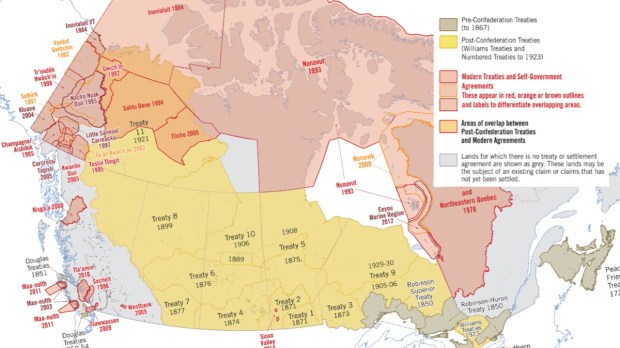
(Image: University of Toronto, Department of Geography)
LET’S TAKE A PEEK at the unresolved matter of the parts of Canada that have never been ceded by treaties or modern land agreements. Note in the map above that shows all historical and modern treaties … note the grey parts, which have never been rectified by treaty, and how B.C. lags behind almost in its whole.
 By the way, the following does not opine on the existence of children’s graves near residential schools, or the appropriateness of historic or modern treaty situations in B.C. or across the country or lack thereof, or the propriety of any claims by any subset of Canadian culture; indigenous, immigrant or immigrant descendance, regarding land use or ownership.
This is a discussion piece, intended to elucidate nuanced thought. That is all.
Last year a B.C. judge ruled that the Cowichan Nation should be granted full ownership of a chunk of Richmond, based on their argument that they never fully surrendered it to anyone.
That ruling has caused considerable freakout because of the obvious question regarding what it now means for a First Nation to own land in an absolute sense, as opposed to co-managing it in some way, which is how indigenous sovereignty has traditionally played out.
This is a fair reaction, the type that can happen when the stoic tunnel-visioned rules of constitutional federal parliamentary democracy rooted in the Westminster tradition … i.e. … Canadian law, bumps hard into indigenous traditional legal orders which on their own are complex, diverse, and deeply rooted systems of social ordinance, governance, and conflict resolution, which predate European colonization by a very, very long time.
We should not be surprised that the collision did not go well.
The very concept of absolute ownership of the sort established by this decision, is definitely something that’s been sought by many native rights activists lately. Some activists even argue that some existing treaties should be repealed altogether, because they were signed under duress or not properly understood by the native leaders who signed them.
And to be clear, we know that there were times where colonial negotiators took heavy advantage of past native leaders’ ignorance of Westminster style law creation, and rammed agreements through that would never pass legal or ethical muster today.
This is a legacy that conservatives and all Canadians need to not ignore.
There is now a reaction to this controversy where a lot of people find all of this stuff just woke and annoying. This is something you read endlessly about in the conservative press in Canada, in which all of this focus on the plight of the Turtle Island native is basically a way of denigrating this country and its colonially preferred history.
You know, the twisting of history that makes Canada seem like this fundamentally wicked, racist, imperialist, genocidal place that’s never done anything right. A reaction to this comes forth when situations like pipeline blockades or residential school histories come to light.
It feels like a lot of conservatives are starting to get pretty hardhearted about this subject in particular, and reactions from them happen as a result of constantly being told their ancestors did wrong, when today all they do is raise families, go to work, pay taxes and try to do right by the society of which they are a part. They didn’t personally decide to separate family structures, didn’t scoop kids and didn’t even vote for those who did.
But at the same time, they can’t disagree that we are all perpetuating the legacy … that word again … by following the system created by these colonial actions, especially land absorption.
In the early 2020s, there were a lot of stories about mass graves at residential schools.
And when it later came out that some of the reporting on this had been sensationalized and misleading (which, face it … that’s what the media does), you started to see a lot of right-wing backlashes to the idea that these schools were even bad at all.
The left and First Nations kneejerk to this led to calls that denying the history of the residential schools should be criminalized, as the Germans do with Holocaust denial.
And then you add on to that the fact that the modern indigenous rights movement in Canada tends to be bound up with a lot of other progressive causes like environmentalism and anti-racism and LGBT rights and even anti-capitalism.
Intertwined with any activism regarding pipelines, northern oil sea routes, land rights, two spirit identification or any other calls for advocacy, is the boomerang consideration of it being just another part of the inherent racism against First Nations.
From that perspective, the whole issue of native rights starts to become just one more polarizing issue in the right versus left culture war.
When you ask conservatives what they would like to see the government do differently, It feels like you don’t tend to get a lot of clear answers. It seems like a lot of people on the right in Canada may be pretty intimidated by the degree in which so much of the status quo is entrenched by the Constitution or court rulings.
It’s become one of these things where a lot of people don’t like the way things are going, but also don’t know enough about the issue to offer clear counter arguments.
So, what you get can easily be interpreted as hate … and let’s be clear; there is an amount of that on the right … but some is just reactions from a place of ignorance as the depth of the issues really are that entwined and complex. When it’s this intricate and convoluted, sometimes all we can do is to debate it from our general ideological perspective and sidestep the labyrinthine quagmire that is land claims law.
Repealing UNDRIP, however, is certainly one tangible goal that seems to be gaining a lot of steam. Even our local MLA, Mr. Milobar, hass climbed on this rhetoric channel as a talking point towards his Conservative leadership bid. Conservatives like to grab onto palpable weights like this and attach themselves to purveyors of their ideology … it earns votes to say this, whether there is any logic to it or not.
In reality, UNDRIP as a fact does not need to be repealed, its interpretation in its connection to B.C. and, potentially, Canadian law, needs to be amended, possibly legislatively … drawing clear lines regarding existing land ownership, especially in urban regions. Blatant calls to repeal it in B.C., is only for political attention and votes, not a function that solves anything.
More universally, it seems that indigenous rights will probably prove to be one of these issues where we see a bit of a pendulum swing in the coming years.
It feels like it’s the native NIMBY angle more than anything else that is really starting to exasperate a fairly broad cross-section of politicians and business leaders in Canada these days, emboldening conservatives and frightening the general left into confusion; wanting to support, but need to honestly ask; ‘who owns my house’?
Indigenous leaders for their part will often be quick to say that they are not opposed in theory to being partners of projects. They just want proper protocols to be followed before they award what the bureaucrats now often refer to as FPIC or Free, Prior and Informed Consent, as provided by UNDRIP. That’s not unreasonable, if they stopped there.
The question is whether the pursuit of FPIC is a process that actually aspires to arrive at a clear yes or no, or is just something that exists to generate more timewasting court cases to clarify increasingly fine grain legal questions at the expense not just of Canada’s economic growth but the lives of the indigenous peoples themselves, who despite it all still remain some of the poorest and least healthy people in this country.
A contradiction that everyone should protest on both sides of the argument.
The unknown, as of yet, is if the FPIC complies with the Constitution at all, which is above our pay grade today, but we can still consider whether we see it as a tool for meaningful partnership or a mechanism for stalling development.
Today … it feels like its just justification for unending court cases, being used by anti colonial activists to scrape as much legal precedent as possible before we even figure out how to use these tools and agreements properly. Cowichan shows that this is the reality.
Mark Carney’s recent legislation; The Build Canada Act, sets aside previous Canadian laws on the books to allow a long list of major infrastructure work. These are clearly projects that First Nations litigants will likely use in the courts to stop unauthorized use of their lands.
So, this subject and future economic fortunes for Canada are tied up in this.
So, take this conversation to your peers and watch where they are at. Do they default to expected right/left polarized ideologies and wrap Indigenous issues within that framework, or is there a more introspective understanding of the complexities, which indicates as tactile exacerbation … i.e. they don’t get it, and don’t know what to do?
Probably a place many of us find ourselves in.
David Johnson is a Kamloops resident, community volunteer and self described maven of all things Canadian.

 ArmchairMayor.ca
I would like to know what the regulations say and how the regulations define all this.
LikeLike
I find Mr. Johnson’s letter here to be in bad taste. Talking about the ‘right’ and about the ‘conservatives’ indicate to me, his opinion is political and not fixed on a nonpartisan point of view.
He is absolutely right as the the end result of this problem. And could escalate to a very serious situation. We cannot allow this to happen.
This current path that our politicians have created, will never allow progress. Canada will not be able to move forward into the future when there are multiple governing areas in Canada. The discussion about the Alberta pipeline going through existing native lands, and the refusal to allow this, is a clear indication of our future in Canada. And how does this work? Forget about any large projects. Forestry? Mining? Ranching? Who would want to invest in Canada?
And what about our homes and where we work?
And currently the value that Canada holds dear! In regards to equality between all citizens, is no longer available . And all efforts to date only continues to separate our societies. Mr. Johnson’s article clearly sums this up.
To my way of thinking there is only one way to correct this problem. Canada’s way. The fact is the majority of natives currently live off native lands. Therefore they have rejected the notion of living on their lands. If the vast majority have done this, then why not hold a series of surveys to determine how to buy out these ‘rights’. What is the value here?
How about the modern way. A payment with both cash and land transfer. Lets end this problem once and for all.
LikeLike
Having an unelected and unaccountable government of multiple small “Nations” that has veto power and siphons substantial dollars away from public and private projects and enterprise sure sounds like something we all voted for…
There is too much woke BS in BC. It’s even turning into a safety issue when the police put gender identity politics above public safety (active shooter is a female wearing a dress). We can all spot a trans woman a mile away. So if we are hoping to avoid an active shooter, why did you not tell us the facts? First of all it’s not a female. Female is biological sex and is immutable. Is this a crime recorded in the statistics as being carried out by a woman? How do biological women feel about one of the worst shootings in Canada being perpetrated by a woman? The killer is a biological man.
Even CBC has refused to accurately reflect the facts. Canada and BC particularly are more concerned with narratives and identity/gender politics than facts. It’s OK if the shooter was trans and it’s OK to say that. Isn’t that what we are supposed to do? Affirm the gender identity? Yet here is CBC and others knowingly refusing to do that. Recall that professors and teachers were fired from their jobs for exactly that. And this is a news agency. We should be deeply concerned when the news and police aren’t putting objective facts at the top of the totem pole of truth. It becomes very difficult to juggle this nonsense when real life enters the chat.
We are on a dangerous path when numerous groups are deliberately obfuscating the truth, and when someone does speak the truth or objective facts, they are seen as the problem. It should be quite the other way. This is some kind of sickness and largely maintained by leftist woke acolytes. Truth and fact used to be the great thing that brought us together.
CBC is quick to trumpet gender identity when it’s a good story. But then hides it when it’s a bad story. Why? CBC can say that a white male shooter did X, but refuses to say a trans woman shooter did X? You know who else likes to hide bad things and parrot good things? Trump. Putin. Autocrats. Dictators. CBC has more in common with them than it would like to admit. CBC is actively engaged in biased reporting and at worst is a propaganda arm for woke BS.
BC needs a framework to resolve the land issues, but we are not going to do that until the games stop and we can all speak facts and truth without repercussions from the fascist woke left that prefers narratives and victim complex over facts.
LikeLike
In 2007 at the UN (Canada, USA, Australia and New Zealand ) voted against UNDRIP while144 were for with some abstaintions was deeply influenced by colonial legacies in all four countries, which share histories as British settler colonies where Indigenous lands were seized, treaties were often broken or ignored, and Indigenous self-governance was systematically undermined through doctrines like “terra nullius” (land belonging to no one) in Australia or the “Doctrine of Discovery” (granting European powers sovereignty over “discovered” lands) in the others. .
In all cases, colonial legacies embed settler majorities with veto power over changes, while Indigenous populations (often 2–5% of the total) lack the numbers for direct influence. Fears of economic disruption (e.g., to mining or logging), legal uncertainty, or national “division” fuel resistance.
LikeLike
In regard to the claims of mass child graves, the Tk’emlúps band recently and quietly removed the webpage off their website which contained that claim.
In regard to BC land claims, we are considering leaving the province. I don’t think it will come to private property being impacted on a massive scale like the Cowichan decision, but there’s clearly a made in BC problem here that doesn’t impact the rest of the country to this extent.
What I think will happen is a conveyor belt of taxpayer money going toward either First Nations compensation, or compensation to impacted land owners. Combined with the event issue with the Kamloops property owner on the hook for $200K because First Nations claim ghosts are floating around their property and we have had enough and aren’t willing to take the risk any longer with our largest asset. The taxes and cost of living is bad enough. Adding all this other stuff on top is not appreciated. BC is in deep deep debt thanks to the NDP, and this land issue is a tornado of their own making. Go woke go broke.
Haida is not a solution for private property owners and that’s been a mess for them. It’s just as confusing and uncertain as the Cowichan decision. It’s no surprise we face declining and stagnant quality of life and economic growth compared to our peers. Canada and especially BC are experts and shooting ourselves in the foot before the race even begins.
LikeLike
They never understood the Westminster system and we still don’t understand the very diverse, non-written rules and traditions that existed before Europeans came over. There is also the question of First Nation government(s) accountability towards their own members. Why is it that despite all the money that has been transferred to them over the decades there is still so much misery amongst First Nation people? We will never reconcile once and for all until all the questions have been answered clearly and completely from all sides.
LikeLike