
CHARBONNEAU – Canada leads search for fast radio bursts
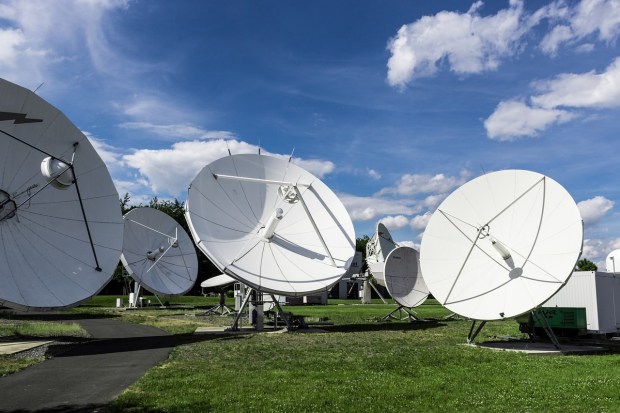
(Image: TheoLeo, Pixabay)
NESTLED IN THE HILLS above Penticton, an observatory has discovered about 90 per cent of all fast radio bursts. It’s a perfect spot, away from the electrical and radio noise of the valley.
 I spoke to Dr. Michael Rupen via Zoom about the new antennas being installed at the site. The antennas, six metre dishes, are being made on site using fibreglass mould. They are currently making two dishes a week, eventually producing three every two days.
Eventually there will be an array of 512 dishes, making Canada a world leader in the discovery and analysis of fast radio bursts.
What are fast radio bursts (FRBs)? Well, they are fast, traveling at the speed of light. They are in the radio spectrum at around one gigahertz (for comparison, microwave ovens operate at 2.45 gigahertz). They are bursts, lasting only a fraction of a second.
And they are very powerful. FRBs typically give off as much energy in one second as the sun does in a month.
The origin of FRBs was a mystery when first discovered by Prof. Duncan Lorimer in 2007.
Since then, FRBs have been identified closer to home in our Milky Way galaxy, explained Dr. Rupen. In 2020, astronomers detected an FRB-like burst from a magnetar inside our Milky Way, confirming at least one source.
Magnetars are neutron stars with unbelievably strong magnetic fields. Sudden magnetic “starquakes” can release enormous energy as radio bursts.
Magnetars are an extreme kind of neutron star, a city-sized remnant left behind when a massive star dies in a supernova. A magnetar’s magnetic field can be so strong that approaching within 1,000 kilometers of one would disrupt your body’s atomic nuclei and electrons, causing you to effectively dissolve.
But magnetars are just one possible source. Some FRBs repeat and others appear to be one-off cataclysmic events.
Regardless of their source, what was once a curiosity is now a powerful probe of the universe.
As FRBs pierce the universe from sources billions of light years away, they collect information.
When they arrive, they can be analysed as a drill core would be. When a core of the earth is analyzed, the samples at the lower end reveal the composition of the earth from millions of years ago.
When a FRB arrives, it holds clues of the age and structure of the universe.
The age is indicated by the red shift of the signal.
That happens because the universe is expanding. Radio and visible light is shifted to lower frequencies. What started off as 1.5 gigahertz could end up as half that: 750 megahertz.
While the red shift of FRBs can’t be directly measured, it can be inferred by comparing them with red shifted visible light in a nearby galaxy.
The structure is revealed by the “smearing” of the signal.
What starts off as a single signal, is broadened as it passes through matter that is otherwise invisible.
This turns FRBs into a precision tool for cosmic cartography that could solve the problem of the missing matter in the universe. This inter-galactic missing matter is out there somewhere and the analysis of FRBs can help pinpoint its location.
It’s exciting times in the use of FRBs to probe the universe.
David Charbonneau is a retired TRU electronics instructor who hosts a blog at http://www.eyeviewkamloops.wordpress.com.

 ArmchairMayor.ca
A great article, David.
In Grade 13, physics was my favourite subject. Your article brought back some good memories. It’s not often I read about bursts of RF energy, Doppler shift, parabolic antennas, the speed of light and light years to express vast distances.
I built a parabolic reflector made from copper wires soldered together for the frame and construction paper glued on in sections to make the dish. The focal point was a bit in front of the dish so that I could have one ear at the focal point. It was very effective in allowing me to hear the conversations of other students at the far end of the main hallway on the first floor of SHDHS in Exeter, Ontario.
And last but not least, I have the assurance indeed that the earth does not revolve around Councillor Newsmaker and she is not the centre of the universe……..
LikeLike
It is great to hear about supernovas and magnetic fields, this is science. It is a break from deciphering mixed signals from an imploding orange blob that does not understand basic science. 😀
LikeLike