
JOHNSON – Rethinking the purchase of the F-35 fighter jets
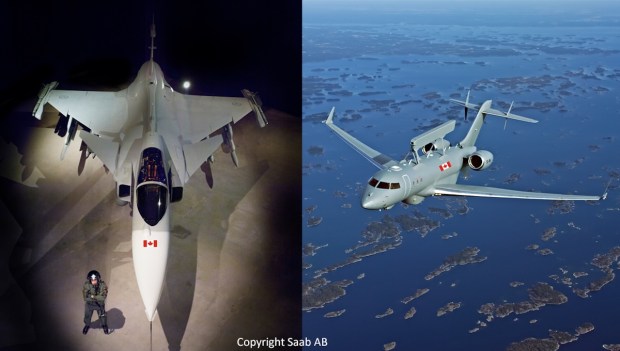
THE U.S. HAS warned Canada, “Buy the F-35 or else.”
Canada didn’t ask for a fighter jet buy to be wrapped up in a sovereignty crisis, but that’s more or less what we’ve been handed.
 On Jan. 14, CBC News reported that Saab formally proposed a deal to Ottawa.
Seventy-two Gripen fighters and six Saab GlobalEye, the well-known fighter and airborne early warning & control (AEW&C) platform. The deal would support roughly 13,000 Canadian jobs with assembly, sustainment and long-term support, rooted inside Canada.
It’s not a subtle pitch.
It’s geared directly at America, saying the 88 F-35 deal from Lougheed Martin just does not suit Canada anymore, and suggests a better option now that the existing deal is buckling under ballooning costs and political pressure.
Then the United States dumped jet fuel on it.
The U.S. ambassador to Canada warned that if Ottawa cancels the F-35 deal, Washington may fly American fighters more frequently in Canadian airspace and rewrite NORAD.
The message was simple, Canada — buy American or accept less control over your own skies.
Under NORAD, the U.S. and Canada already have the ability to fly in each other’s airspace for defense, tracking, and intercept missions. What ambassador Pete Hoekstra did, was take the NORAD concept and weaponize it as leverage in a corporate sales fight. He directly implied that if Canada buys fewer than 88 F-35s, Washington will alter NORAD itself.
That’s a big deal.
The terms of how both countries manage air defense, and how American fighters operate in Canadian airspace, and who calls the shots when stuff goes hot, is no longer stable.
It drags a procurement decision into the command-and-control architecture of continental defense. Now layer in the politics of a Trump administration creating Peace Boards where only he is chairman and ultimate decision maker, and his obvious desire to be “King of the World.”
All this becomes very distasteful to Canadians; our reaction is to back out and look elsewhere.
Canada started this review because the F-35 program cost has risen sharply to around $27.7 billion, up from $19 billion three years ago, a 46 percent increase.
This is a massive increase for a program that doesn’t include future financial maintenance and armament costs, all controlled by an American administration that deals in ‘we will make you do what we want’ power trips.
Adding that to the trade, Davos and tariff tensions between Carney and Trump and you’ve got a situation where Ottawa isn’t just reviewing a fighter purchase, but realizing how little strategic independence it could have left if they didn’t.
Enter Saab. A proposal that really is about offering Canada a complete air power ecosystem with its own supply and labour chain.
The Gripen E is a 4.5 generation fighter built for countries that don’t enjoy the luxury of unlimited budgets. It’s fast enough with a top speed around Mach 2 with a better range, the modern Raven ES05 radar, and infrared search and track system plus it’s designed for data sharing.
Gripen is part of a network, passing targets between aircraft, ground sensors, and command nodes in near real time. Gripen’s ability to operate from shorter and soft temporary runways makes it a perfect aircraft for mobile and nimble ground services. It operates when turnaround speed and remote cold use matters more than prestige.
Now, include the GlobalEye AEW&C system and the proposal gets much more interesting.
GlobalEye systems consists of a suite of sensors using Saab’s Erieye ER (Extended Range) mission system, installed along the back spine of Bombardier’s Global 6500 long-range jet.
Paired with maritime, air and ground surveillance, it can monitor multiple targets hundreds of kilometers out, and stay airborne for 11 hours. Ground based radars can only see so far; GlobalEye extends that horizon at an affordable price. As well as detect aircraft, it also helps coordinate and manage responding assets, and cues fighters long before a threat gets close enough to cause concern.
For a country like Canada with enormous maritime approaches, this persistence fills a real world gap with factual information to ensure arctic sovereignty, for a fraction of the cost of some undetermined American Global Dome $500 billion system, that a Trump administration may choose to NOT protect Canada with.
The Gripen and the Global Eye pairing starts to look less like a consolation prize and more like a coherent doctrine. GlobalEye sees and directs, Gripen intercepts … and Canada owns all of it; all initial hardware, all repair and parts manufacture, all software systems and all support structures surrounding it and armament is available from multiple source markets.
There is no kill switch, no solitary moody other government in control of parts, repair and armament, tweeting all night that our stuff won’t work if he doesn’t want it to.
Contrast this package with the F-35, which stealth, speed and armament are impressive. IF Canada was deploying in international hot spots tasked with getting and holding air superiority, and needing to link up with American counterparts … the F-35 is the way to go.
But … Canada doesn’t do that. We just don’t go into Iraq or other political theatres unless ordered to by NATO or the UN. Canada’s daily concerns are the defense of our own regional air, land, sea and ice. We don’t invade.
From this new view, we now see the gap between Canada’s goals and America’s expansionary Trumpkin attempts to scoop up Greenland, Canada, Gaza and any other country it seems to want. The question becomes … is this a relationship we want?
The U.S. ambassador has publicly floated the idea of routinely violating Canadian airspace because Ottawa dared to review a procurement decision. Is that OK?
This is an important tonal change moment.
When a U.S. official implies that choosing a non-American fighter would justify deeper U.S. intervention in Canadian airspace, that stops sounding like alliance management and starts sounding like leverage.
This does not sit well with Canadians. Canada has realized we don’t actually have to kowtow to anyone who just wants to use us.
Saab is smartly leaning hard into this sovereignty angle. Gripens would be assembled in Canada with long-term sustainment handled domestically. Partners include IMP Aerospace, CAE, GE Aviation, and Peraton and facilities would be based in Ontario and Quebec.
GlobalEye will be built in partnership with Bombardier using Canadian airframes. The Canadian military would be flying Canadian aircraft … been a while since we have said that.
Saab sat back and realized that Canada wants jobs, control and flexibility, so created an offer to turn defense spending into domestic industrial capacity, rather than a long-term foreign dependency. This opens up tantalizing strategic positioning.
Public opinion polling in Canada shows stronger support for Gripen or mixed fleets than for an all F-35 solution, with a lean toward a hybrid approach. Canada has realized that it could do both. This means taking the 16 F-35’s we have already paid for, cancel the rest of the Lougheed Martin contract, and fill the rest of the fleet with Gripens and throw in a GlobalEye package as well … all for much less money.
The U.S. argument is that anything short of the F-35 ‘degrades NORAD interoperability’. We already know that Gripen is NATO interoperable, integrating with the Link 16 network with planes that load all NATO armament, so we know that once we manage our own arctic approaches, this argument falls flat.
The Saab offer asked whether Canada wants maximum integration with the U.S., or greater control over its own defense industrial complex. This is putting action to Carney’s Davos call for medium-sized allies to navigate an increasingly transactional American foreign policy, and forge their own path together.
For decades, NORAD symbolized shared trust. Right now, that trust is being used as a bargaining chip, to control Canada. That should worry Canadians far more than whoever’s receipt is stapled to the tail of our next fighter jet.
In the past, many (including myself) have supported the idea of buying the F-35, as we have already put money into its development, so we might as well get something out of it, and the deal the Trudeau Liberals made was pretty good at the time.
Today, in this new world we are in, walking away from the F-35 seems on balance to be a better long-term option if America is not an ally, something we didn’t think about before.
Maybe we really should accept that we are on our own on this side of the pond, so let’s take care of Canada first.
David Johnson is a Kamloops resident, community volunteer and self described maven of all things Canadian.

 ArmchairMayor.ca
The F35 has sensors and avionics which the Gripen does not have. These sensors are useful in that any potential enemy cannot see you coming. If we were intending on invading the airspace of an aggressor then these would be useful. For air defense it makes less sense.
Canada has already paid for 16 airframes so, if the Gripen is also chosen we will have two frontline combat jets, each with its own supporting infrastructure, and increased costs, not to mention increased training costs for pilots and ground crews.
Unfortunately Canadian dithering in aircraft procurement is nothing new. In 1959 the Avro Arrow was abruptly cancelled and the RCAF was left scrambling to find a suitable replacement. Instead of purchasing the excellent F4 phantom Canada opted for a mixed fleet of F104 Starfighters, largely pressed into service as strike aircraft as part of Canada’s commitment to NATO in Europe. and the license-built CF5 Freedom Fighter. Both of these aircraft were inferior to the F4.
Every computer model, not to mention actual fly-offs puts the F35 as superior to all 4.5 generation aircraft with the exception of dogfighting.
I spoke with an RCAF pilot a few years ago and asked him which aircraft he would want to go to war in and he did not hesitate – the F35.
LikeLike
So, if I may … you’re basically agreeing with me. Go ahead with the 16 F-35’s already paid for and use in situations that require the stealth, as you suggest … in the limited situation where Canada is aggressing towards another (as discussed, a rare situation). We will have there for this job if it comes up.
Obviously they are ‘superior’ to 4.5 class jets, but the real question was whether the F-35 or Gripen covers the majority of use case scenarios in the north … the obvious future region of concern? The reality is … we dont need stealth up there, we need coverage and visible pressure on potential aggressors.
Then add the political quagmire of buying a product from a country that could decide to not honour its maintenance, armament or utility contracts … and its a situation where I am happy to spend what it takes to keep both planes in the air as you suggest.
So we dont find ourselves grounded, because the white house decided to.
I’ll stand by my assertion to have both.
LikeLike
F-35 was always a stupid choice. The wars Canada might be involved in aren’t going to require the capabilities of that machine, nor does Canada need the expense and gremlins associated with that fighter (if you fly too fast, the anti-radar paint peels off, low payload capacity etc).
The Gripen and other competitors always made more sense to me. Canada will be dogfighting Soviet planes not doing international stealth bombing runs on Iranian nuclear targets.
We should shift to a European supplier and strengthen logistical ties while doing so.
LikeLike