
NATIONAL PULSE – Canadians more open to trade opportunities in China

Our attitude towards China was much less favourable in 2019 when the Two Michaels were being detained. (Image: Mel Rothenburger.)
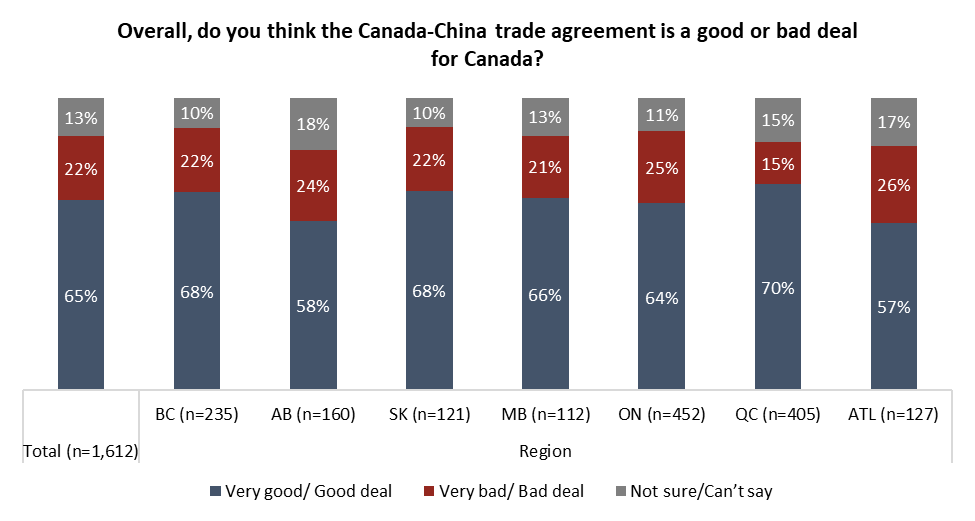
Most view Canada’s recent deal with China as a good one (65%) rather than a bad one (22%)
By ANGUS REID INSTITUTE
January 29, 2026 – Political economy isn’t a zero-sum game, but relationships ebb and flow. The best evidence of this in 2026 is Canada’s re-engagement with China as the traditional foundation of economic cooperation with the United States becomes more tenuous.
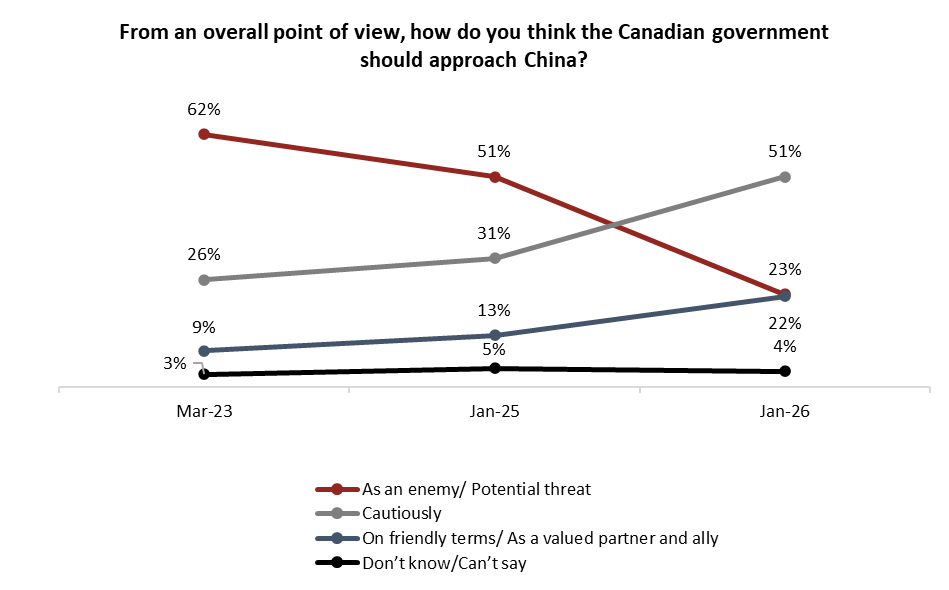
New data from the non-profit Angus Reid Institute finds Canadians, much like their government, more open to economic opportunities with China than they have been in recent years. Consider that the proportion who say China should be treated as an “enemy” or “threat” by Canada has fallen from 62 per cent in 2023 to 23 per cent. This, while the number who say they would approach the relationship with cautious engagement has doubled from 26 to 51 per cent. One-in-five (22%) would engage with China as a friend or ally.
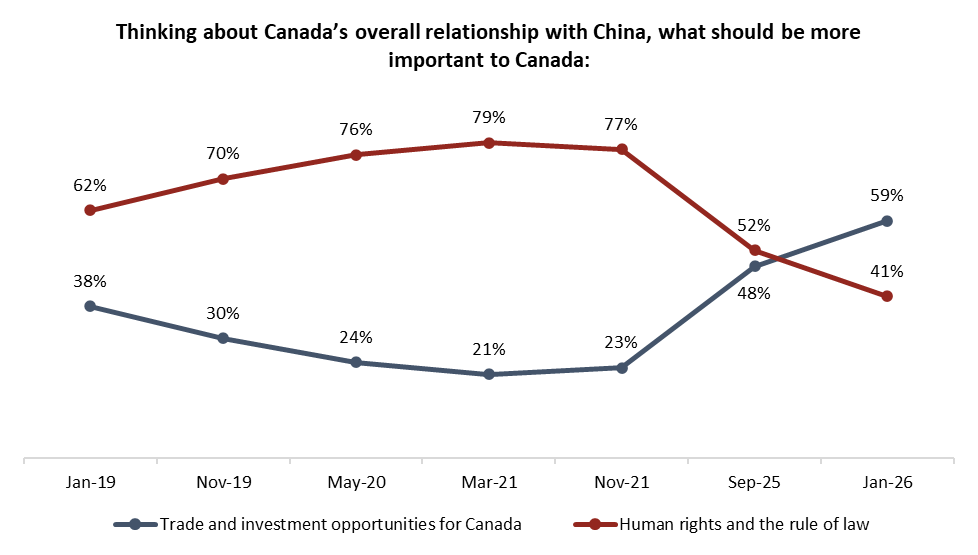
Concerns over China’s history of human rights violations has long coloured Canada’s approach to the country. It took on a renewed focus in during and after the 1,019-day long detention of two Canadians, Michael Kovrig and Michael Spavor. From 2019 to 2022, the vast majority of Canadians said if they had to make a choice between two priorities, they would rather Canada focus on China’s record on human rights and the rule of law rather than pursuing trade and investment opportunities. In 2025, that proportion was divided near evenly, as threats of tariffs from Donald Trump rattled Canadians. Now, after Carney’s trip to China, the first from a PM since 2017, three-in-five (59%) prioritize the economic aspect of this equation.
As for the deal signed by Carney, which saw Canada reduce tariffs on Chinese electric vehicles and increase the allowable import of these vehicles to 49,000 in exchange for reduced Chinese tariffs on many Canadian agricultural products, three-times as many Canadians call it a good one (65%) than a bad one (22%), with the potentially most affected provinces Saskatchewan and Ontario largely agreeing.
More Key Findings:
- Canadians’ favourability of China has risen 11 points compared to last January, from 16 to 27 per cent. There has been no change in favourability since October, however, suggesting this recent trip to China did not impact Canadians’ views.
- In March 2021, no more than 26 per cent of CPC, Liberals, NDP, or Bloc Québécois voters said that they prioritised trade and investment over human rights and the rule of law. Now, no fewer than 49 per cent among all groups hold this view.

 ArmchairMayor.ca
Leave a comment