
CHARBONNEAU – If you dig it up in your yard, cover it up and forget about it
(Image: Pixabay.com)
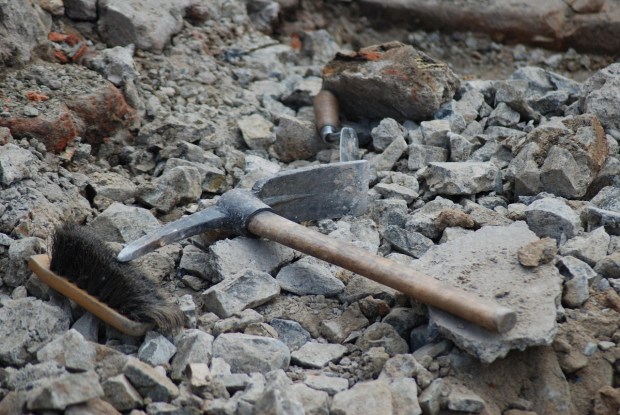
IF YOU’RE DIGGING around in your yard and you find something that may have some archaeological significance, leave it where you found it and don’t tell anyone.
It’s not the right thing to do but it’s the prudent thing to do.
 The problem is the vagueness contained in B.C.’s Heritage Conservation Act (HCA) as to what is sacred to First Nations.
B.C. Premier Eby acknowledged that the HCA needs to be overhauled. He referred to a Kamloops case where property owners paid over $100,000 and had their land essentially seized.
“If you’re digging in your garden and you have the misfortune of uncovering an ancient Indigenous archeological site, there are going to be consequences,” Eby said.
The Kamloops property owner in question did the right thing and all it did was bring them grief. It all started last June when the owner decided they wanted to build a small garden on the empty lot, which they’d purchased in 2004, for residents of a neighbouring seniors facility.
Almost immediately, two skulls were unearthed. That’s when their grief began.
The work stopped immediately. Police and Tk̓emlúps te Secwépemc were notified.
Seven months after the initial finding, the owner had racked up $130,000 in bills; $50,000 in archaeological fees and $88,000 in legal costs.
Kúkwpi7 (Chief) Rosanne Casimir said: “These are our relatives, and our laws and cultural protocols obligate us to care for them with dignity and respect.”
They may be someone’s relatives but just whose relatives is not certain.
An independent archeologist, hired by the property owner, preliminarily concluded that the two skulls were not from undisturbed ancient burial ground.
Rather, the archaeologist concluded they were likely contained in imported sand fill (mixed with concrete, brick, and plastic debris) that were dumped onto the site, possibly before 2004, and did not originate there as part of an ancient burial.
The lot now is in limbo. It cannot currently be developed without going through the B.C. archaeological regulatory process which is stalled.
The HCA was an attempt by the B.C. government to define First Nations rights under the United Nations Declaration on the Rights of Indigenous Peoples.
The problem with the HCA is the use of the word “intangible” which doesn’t define what’s sacred or not.
Cori Ramsay, UBCM president said her group wants to see a good system for preserving heritage but intangible could mean expanding protection to many more properties.
As well, the language was vague about who would ultimately make decisions about what land was sacred.
A lot has changed since the HCA was first proposed.
The public outcry over the B.C. Supreme Court decision that recognized Aboriginal title for the Cowichan on lands in Richmond this past summer has soured the public mood over reconciliation.
And a New Brunswick court ruled that private property cannot be given to First Nations as part of a settlement — the rights of all citizens must be considered in reconciliation.
Grand Chief Stewart Phillip, head of the Union of British Columbian Indian Chiefs, recognizes the shift in public opinion. “It’s an incredibly hostile environment now. I don’t think it’s so much the NDP as what’s happening globally,” he said.
David Charbonneau is a retired TRU electronics instructor who hosts a blog at http://www.eyeviewkamloops.wordpress.com.

 ArmchairMayor.ca
Anytime, attempts are made to separate people into groups, there will always be problems. And our politicians have done this admirably. Forget Canada’s values.
All people have a heritage. And some promote that very well. And that is a good thing. It is done within Canada’s existing framework.
There can be only one way to solve this. And that is to create a system where all citizens have the same rights. Anything else will ultimately fail. The current pipe line from Alberta is a classic example.
As a side note: The majority of natives live off the reserve. I think they have already decided what is best.
Gary Warman
LikeLike
Throwing everything at the wall and seeing what sticks is a shotgun litigation approach which is being employed by Kúkwpi7 (Chief) Rosanne Casimir. This has become a common legal maneuver in western society, particularly in areas where the law is vague or changing. It’s incumbent of any large organization to fight for rights of its constituency and when laws are vague things can get messy, as in this case. This is not a FN’s thing, it’s not them vs us, but rather an unintended consequence of an imperfect law.
Sadly the grand chief is right, “It’s an incredibly hostile environment now.”
LikeLike
A rare reasonable take that isn’t pandering to libtard ideals. If you dig up anything, you immediately send the boys out to pick up some beers, get your black plastic garbage bags and toss the entire haul in the Thompson. That is the realistic result earned by the grifters. Your other option is to pay upwards of $100K+ because someone claims ghosts are floating around your property and religious/spiritual ceremonies are required (even if you and your property don’t ascribe to those religious and spiritual views). It seems to me that if a third party wants to hold religious ceremonies on your property, it should be the third party that not only has to pay, but also seek permission. You know, like how permission must be sought from First Nations to do everything between access public land and hold a soccer tournament (don’t forget the millions in a briefcase when you make your request).
The Grand Chief is correct. The shift in public opinion has been dramatic. But it can’t be said that the shift should come as a surprise. Secret dealings with the NDP and nations. Race-based laws that confer privilege based on your race. A race-based veto system that is effectively taxation without representation. The NDP scrambling to make changes after realizing their own legislation is a complete gong show (seems to be a pattern with them). A reconciliation industry taking boatloads of money after making wild claims that they still refuse to investigate properly.
One of the most odd observations is that Libtards get wildly upset should you ask questions and seek evidence for the claims made in Kamloops. They become furious when someone says there isn’t conclusive evidence of any graves to date. Shouldn’t the statement that no children have been found in mass graves in Kamloops elicit feelings of joy and relief? Instead, libtards seem to want, to need there to be atrocities there. They need the bodies to be there.
Reconciliation could never be an endless process where boatloads of money are transferred perpetually to bands and nations, but that’s what it turned into. This is seen less as a process to resolve outstanding issues and more of a grift. Reverse racism and what is arguably turning into an apartheid system was never going to play with the public. I’m not sure this catastrophe can be walked back. Tremendously damage has been done to the good will of people who were sympathetic, and simply put – the current course is not only unsustainable, but has become bitterly unpalatable for the general public.
LikeLike
Not only a boat load of money is continuously being given but any notion of asking for a bit of clarification about where the money is going is met with the most of hostile of reaction. It cannot continue like that!
LikeLike
It’s OK to ask questions in a democracy. It’s OK for taxpayers to demand answers on how money was spent and where it went. I cannot trust a group or individuals who think these basic concepts are offensive.
LikeLike