
ARMCHAIR ARCHIVES – A visit to Auschwitz provides a stark reminder
(Image: Mel Rothenburger)
Today is International Holocaust Remembrance Day, and the anniversary of the liberation of Auschwitz-Berkenau in 1945. An estimated 1.1 million people, mostly Jews, perished there. About six million Jews in total were murdered during the Holocaust. I visited Auschwitz-Berkenau in 2023, and wrote the following column a few days later, on Remembrance Day, Nov. 11, 2023.
SATURDAYS ARE BUSY at Auschwitz.
Eighty years ago, people came by freight train. Most never left. Now they come by car or bus for a few hours, reservation tickets in hand.
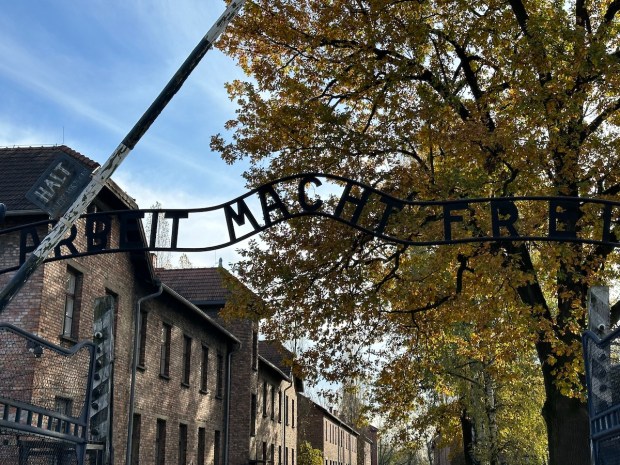
 Visitors are divided into groups and assigned guides who tour them through the notorious concentration camp run by the Nazis during World War II. They walk under the ARBEIT MACHT FREI (Work Sets You Free) metal letters that still hang over the gate to the main camp.
The groups are supposed to give each other space but the guides hurry them along, often bumping into and even passing the group in front, saturating the tight spaces inside some of the buildings.
Ludwig Vesely. (Image: Auschwitz-Birkenau State Museum)
They jostle with each other for cellphone photos, listen to their guides with their Vox Boxes, and look at photos of those who died there.
Many who visit the site remark on the massive scale of it — 346 acres, 300 buildings, 10 miles of barbed wire. By the time it was shut down, the complex that includes the neighbouring Birkenau death camp held the equivalent of the entire population of Kamloops.
At Birkenau, they enter the wooden barracks where so many died from disease, overwork, brutality or starvation, and walk the tracks to the train platform where Jews were disembarked and separated into two rows, one for those deemed young enough and strong enough to work, and one for those who would be sent straight to the gas chambers — the elderly, frail, disabled, pregnant women and mothers with children or babies.
More than a million people were killed at Auschwitz-Birkenau, by far most of them Jews as part of Hitler’s “Final Solution.” But there were political prisoners, non-Jewish Poles, Romani (Gypsies), pacifists, gays and prisoners of war, too.
You can feel the presence of ghosts there, can hear the screams of children, the cries of the doomed as they begged for mercy where there was none.
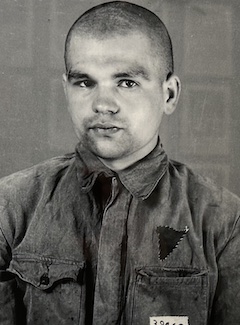
The year I was born, a 25-year-old Polish man named Ludwig Vesely, prisoner number 38169, perished at Auschwitz. I knew nothing about him when I found his photo hanging on a wall with a few hundred others in one of the original Auschwitz buildings — I was curious about him only because of when he died.
Crematorium 1. (Image: Mel Rothenburger)
He stares expressionless at the camera, his head shaven, his prisoner number stitched onto his shirt below a triangle patch. Interestingly, the shirt is not the usual striped cloth of the camp uniform.
A bit of diligent online research shows that he was a member of the Austrian resistance who had been imprisoned in the Dachau concentration camp in Bavaria before Auschwitz. Two years after his “deportation,” that is, incarceration, in Auschwitz, he and some other resistance members planned an escape but were betrayed and tortured. On Dec. 30, 1944, 28 days before Auschwitz was liberated, they were hanged in the roll call square.
His last words on the scaffold were recalled by survivors as, “Heute wir, morgen ihr!” or “Today us, tomorrow you!”
Many of the death books kept by the SS (Schutzstaffel, the Nazi Party’s political soldiers) were destroyed before the camp was liberated and many prisoners weren’t afforded even the small dignity of a recorded death anyway, being sent to the gas chambers the day they got there.
On the way out of Auschwitz, we see the gallows to which SS Officer Rudolph Hoess, the longest-serving camp commandant, was sent after testifying at Nuremburg, acknowledging days before his execution that he had “sinned gravely against humanity.” Ludwig Vesely’s final words turned out to be prophetic but so many other members of the SS who were guilty of atrocities were never brought to justice.
I think about the fact that, as I was beginning life, Ludwig Vesely and six million others in Hitler’s many Holocaust camps were losing theirs in such terrible ways. How lucky I am to have been born and lived in a democracy that values the life and freedom of the individual above all things.
Today, on Remembrance Day, we’re supposed to remember and cherish those who fought to free the world from all that is represented by the horrors of Auschwitz. Instead of demolishing this place of cruelty and death, Poland preserved it as the Auschwitz-Birkenau State Museum to remind us not to let it happen again.
Yet, incredibly, rallies and radicals are renewing the call for the extermination of Jews with chants like “gas the Jews” and “F— the Jews.” Antisemitism is soaring in Canada and elsewhere, especially since Hamas.
Philosopher George Santayana is credited with the famous saying, “Those who cannot remember the past are condemned to repeat it.” I have to wonder, could Auschwitz happen again?
Mel Rothenburger is a former regular contributor to CFJC-TV and CBC radio, publishes the ArmchairMayor.ca opinion website, and is a recipient of the Jack Webster Foundation Lifetime Achievement Award, and a Webster Foundation Commentator of the Year finalist. He has served as mayor of Kamloops, school board chair and TNRD director, and is a retired daily newspaper editor. He can be reached at mrothenburger@armchairmayor.ca.

 ArmchairMayor.ca
Dale Bass should be ashamed of herself for her “concentration camp” analogy to a recovery centre in Rayleigh. If the Mayor and Council of the day had any intestinal fortitude whatsoever, they should have asked for her resignation from City Council.
Even today would be a good day for her to resign from public office.
LikeLike