
CHARBONNEAU – B.C.’s beautiful decriminalization failure
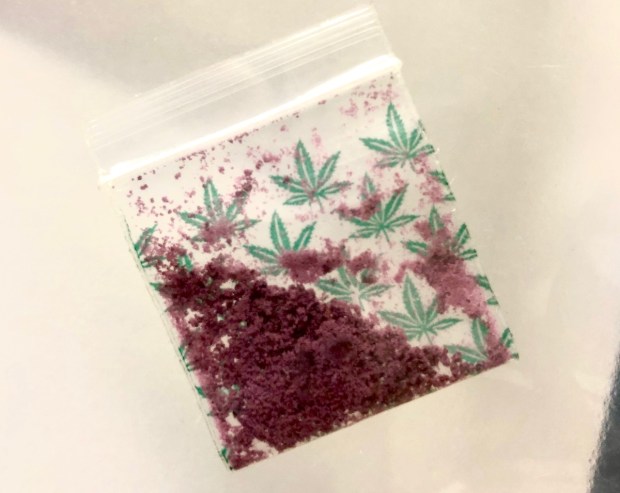
Suspected opioid package found at park. (Image: RCMP file phot0)
IT WAS A WONDERFUL attempt to reverse a century of criminalization but political reality and toxic drugs got in the way.
The election cycle of four years leaves little time for decriminalization to have any effect.
 B. C. Premier David Eby understands the political reality. His popularity has dropped even as the opposition is in disarray.
It’s over. Eby says public drug use will not be permitted when the province’s contentious decriminalization trial ends. “It didn’t work and we ended that,” he admitted.
With decriminalization, we’ll stumble along with criminalization – which has failed miserably to reduce deaths from drug use.
But drug death prevention never was the intent of criminalization. The target was marginalized groups.
Drugs used by those in positions of power, such as tobacco, alcohol and caffeine, were never considered for criminalization.
The intent of the Opium Act of 1908, and those acts that followed, was to suppress marginalized and racialized groups and to save good white women from lives of debauchery. The laws were meant to protect the morals of European Canadians from corruption.
Emily Murphy, a.k.a. “Janey Canuck,” made it clear. She wrote tales of how white women from “good families” were being lured into Chinese opium dens.
Other marginalized groups were not spared in Murphy’s racist rants, such as Black porters on trains who were accused of selling drugs.
But didn’t criminalization save society from dangerous drugs? Weren’t opiates and cocaine more dangerous than the drugs used by the rich and powerful?
Not really. Opiate-related deaths from morphine, heroin, and opium were rare. Deaths were lower in both absolute numbers and per capita compared to today’s synthetic opioid overdoses, particularly those involving fentanyl.
Meanwhile, the serious effects of alcohol abuse and tobacco are well documented.
And while the Opium Act targeted marginalized groups of society, upper and middle class members freely used them. There was little stigma attached to drug use; opiates were even prescribed.
Back then, women often managed households, family responsibilities, and social lives while addicted. They bought private supplies through doctors, and their use was discreet and socially tolerated.
Working-class users consumed cheaper forms like laudanum (opium tincture) as an alternative to alcohol, integrating it into routines without losing jobs.
In the U.S., some physicians continued to practice medicine while dependent on opiates. Self-addiction rates estimated at 6-8 per cent at the peak.
Legal drugs are hard to quit.
Alcohol withdrawal can be life-threatening with seizures, delirium tremens (DTs). Withdrawal from cocaine is intense but rarely fatal.
Nicotine’s constant accessibility, social integration, and persistent cravings make it notoriously hard to quit long-term. Many former users (including those in recovery from alcohol or cocaine) report that cigarettes are the toughest habit to break.
The American Heart Association says, from a scientific standpoint, nicotine is often as hard or harder to quit than heroin.
Criminalization has led to more toxic drugs.
A lethal dose of heroin is around 30 milligrams. For fentanyl, it’s as little as 2 to 3 milligrams. Some fentanyl analogs, such as carfentanil, are up to 10,000 times more potent than morphine.
B.C.’s attempt at decriminalization was admirable but public safety from brain-addled street people is an obvious concern.
David Charbonneau is a retired TRU electronics instructor who hosts a blog at http://www.eyeviewkamloops.wordpress.com.

 ArmchairMayor.ca
The NDP and their crony ideologues purposely chose to ignore overwhelming evidence from cities, states and countries around the world that tried a similar thing and failed dramatically while ruining their communities.
They thought they could try the same thing that failed elsewhere and somehow have a different result. Any reasonable person understood that allowing crackheads to use drugs without consequences would never lead to an increase in them seeking treatment. They did what we all knew they would do – use, go wild and commit crimes to support their habit.
What’s worse, is that this regime encouraged organized crime to set up their shops and factories to get product to a massive base of newly legal customers. Think of the impacts to communities in Mexico and other South American drug states who continue to face cartel violence, rapes, child forced labour and all types of evils, while BC sat there and said “yea, send us your meth and crack cause we’re having a party up here”.
There was never empirical evidence to support the claims that were made by the NDP. The author of the article brings up alcoholics. Does he think giving alcoholics unfettered access to booze and letting them drive their cars drunk is a solution? That’s what the NDP told us would fix the drug crisis.
This was the sorriest and stupidest thing seen in a long time. The costs were astronomical, and nothing got better. In reality, things got worse for everyone. Imagine what we could have done with those wasted billions upon billions that were spent on fueling a crack and meth binge in our streets.
You have to be some kind of liberal ideologue to ignore the deleterious impacts this had on all of us, including the diversion of pills into the hands of children, which you yourself claimed wasn’t happening in articles on this topic. Liberals are so full of shit on this issue it was remarkable to see the spin over the last three years. And still you’re trying to argue this is the approach we need to take. Unreal.
How can you look at the last 3 years and call that admirable? All you had to do was look at Portland and California to see what the result was going to be. Give your head a shake man.
LikeLike