
ROTHENBURGER – Bringing property owners into all the land claims talk
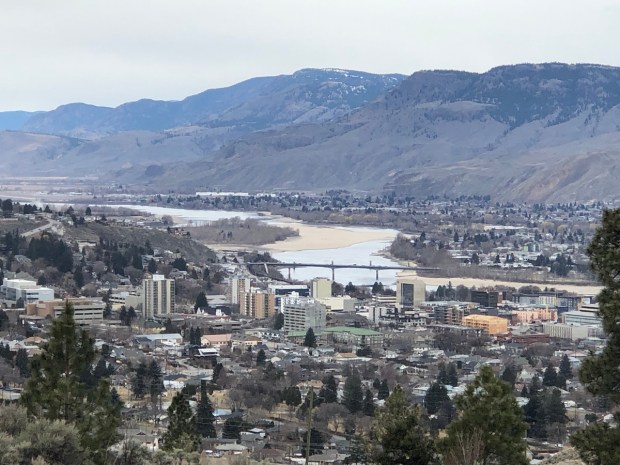
(Image: Mel Rothenburger)
SHANE GOTTFRIEDSON is a well-known local businessman. Back in 2015, he was chief of the Tk’emlúps Band, and was one of two signatories to a lawsuit demanding aboriginal title to all of Kamloops, Sun Peaks and in between.
 “Chief Ron Ignace and Chief Shane Gottfriedson, on their own behalf and on behalf of all other members of the Stk’emlupsemc te Secwepemc of the Secwepemc Nation” filed a civil claim against the province, KGHM Ajax and the attorney general of Canada.
That claim, which is still current, seeks aboriginal title “to all or part of the Stk’kempusemc te Secwepemc Territory” as well as aboriginal rights to the same area.
It asks for damages for past and continued infringement on those rights and title. While the claim is specific to the Ajax mine site at Jacko Lake, it also applies to the much broader area. (I can find no media reference, at the time the suit was filed, to the extent of land covered. It was all about Ajax.)
A news release from Gottfriedson and Ignace in September of 2015 was headlined “Title Case for Ajax Project” and led with a review of Ajax and the Secwepemc Nation’s rights and title to the mine site.
“We have never ceded, surrendered or given up any of our lands or interests. We have a sacred responsibility to protect and assert jurisdiction over our territory and it is imperative that we stand up and protect our natural resources for the next generations,” Gottfriedson stated in the release.
No one, then, has better insight into the lawsuit than does Shane Gottfriedson. Coincidentally, he’s known the current mayor of Kamloops, Reid Hamer-Jackson, for some 40 years, going back to when they played fastball together in their early 20s.
It‘s suddenly Hamer-Jackson’s job to deal with the concerns of private property owners over the implications of aboriginal title in Kamloops and area brought on by the SSN land claim. He hears from them pretty much every day, he says.
The Kamloops concern, of course, has been generated in the wake of the Cowichan decision this year in which a B.C. Supreme Court judge ruled that the Cowichan own title to 300 hectares of land in Richmond. And while a lot of reassurances are being offered that private fee simple property isn’t at risk, the worry remains, as reflected in the opinion of B.C. lawyer and King’s Counsel Barry Kirkham: “While some commentators have belittled the significance of the Richmond decision, they are dead wrong. Let there be no mistake. Aboriginal title now trumps fee simple title.”
All the Province has said so far is that private property rights must be upheld.
Gottfriedson and Hamer-Jackson have been talking about it and figure the only way to meet all the concern is through a broad public discussion outside the court system. Gottfriedson notes the long positive relationship between City Hall and the Tk’emlúps Band and the resolution of various land issues in the past.
He gives as an example Softball City near Rayleigh, which was made possible by a land-for-land deal in 2007. “There’s a long, rich history of working together,” he says. “We’re very good business partners.”
And he points to the Tsilhqot’in land title decision of 2014 as reassurance of the integrity of fee simple land. That Supreme Court of Canada decision confirmed Tsilqot’in Nation title on 1,700 square kilometres of Crown land in the Chilcotin, but it’s my understanding the claim, similar to the Cowichan decision, didn’t aim at private lands.
The SSN suit — which covers a massive 1.25 million hectares — does include private property but is described as not intending to displace homeowners. Still, the question remains about whether aboriginal title supercedes fee simple.
“It’s business as usual,” said Gottfriedson of the Tsilhqot’in/ Chilcotin decision. But he understands people’s fear of the unknown, especially when questions are raised about something they’ve put their life savings into.
He doesn’t, however, buy into a suggestion by Hamer-Jackson that he lead a withdrawal of the SSN lawsuit. “The writ that was filed for that title case had enough merit to continue. I’m not going to withdraw our interests in that lawsuit.”
To Hamer-Jackson’s position that withdrawal would be a good starting point for discussions on the land issue, Gottfriedson says, “Why can’t we work together now, when it’s on the table?”
The mayor accepts that but says, either way, clarification is needed. “I want to get it more out in the open. We should try to work together, keep it out of the courts.”
Working together, he says, requires the City, SSN, TNRD and provincial and federal governments to start talking. “A lot of people are worried about it.”
Some quiet talk has been going on between the Tk’emlúps Band and City Hall but so far nobody has publicly proposed anything in the way of either formal conversations among community leaders or a broad public discussion. Other than some vague media comments, TteS Kúkwpi7 Rosanne Casimir hasn’t explained the consequences of aboriginal title.
Gottfriedson stresses he’s no longer on the band council and has no intentions of getting back into politics but he sees the need for the public to become better acquainted with the issue.
At the moment, there are more questions than answers. Does aboriginal title trump fee simple or do they exist side by side? How is that possible? What are the “damages” of infringement on aboriginal title? What does a resolution look like? Massive payouts? A whole new tax system?
And, finally, the big question — when will all these leadership groups see the urgency of the need for clarity, bring the public into the room and start talking the talk?
Mel Rothenburger is a former regular contributor to CFJC-TV and CBC radio, publishes the ArmchairMayor.ca opinion website, and is a recipient of the Jack Webster Foundation Lifetime Achievement Award, and a Webster Foundation Commentator of the Year finalist. He has served as mayor of Kamloops, school board chair and TNRD director, and is a retired daily newspaper editor. He can be reached at mrothenburger@armchairmayor.ca.

 ArmchairMayor.ca
All I see in the future is an extremely bad time. How can any country keep up with the rest of the world when there are dozens or even hundreds of governments. Federal, Provincial, Municipal, Regional and now Native.
With Alberta needing oil pipe lines, the future has now been exposed.
An elected government can be replaced if needed.
Over 12 years ago the local paper of the time stated that there are approximately 110,000 natives in BC. Of this total 89,000 natives live off reserve. If this is true, then this problem is to entertain the remaining 11% of the natives. So the questions begin.
1: Are all natives Canadian citizens?
2: If so, then the federal government is entertaining discriminatory practices. Re; the Charter brought in by the liberal government.
3: Carney says a pipeline will happen. How? Force the issue? Open the door to sabotage when people are stepped on. Where are our Canadian Values there?
There must be, and can be, all people should be treated equally. As of today this is not happenning. The process currently in place can only create more problems.
As I see this problem, there is only one way to solve this.
A double referendum to determine if all of the citizens of BC are open to ending this issue with a payment to each native. This could be by cash or a land setlement.
As the vast majority of natives have already made their choice, I see this as a simple way to end a very complicated issue.
This process will allow governments of the future to govern effectively.
LikeLike
Your numbers are incorrect. As of the 2021 census, there are 290,210 Indigenous people in BC. Of these, 39% (113,182) live on reserve. Focus on Geography Series, 2021 Census – British Columbia
Land claims are not entertainment for Indigenous people. They are an attempt to reconcile a genocidal imperialist past. It’s justice, upheld by federal and provincial courts.
LikeLiked by 1 person