
CHARBONNEAU – America is not coming back for a long time
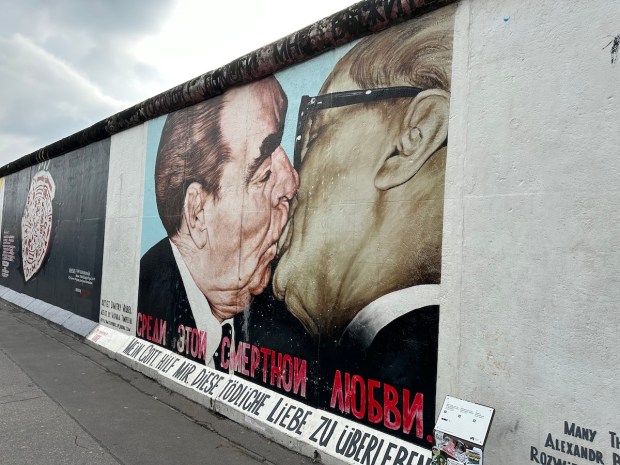
The fall of the Berlin Wall in 1989 was supposed to represent the victory of U.S. values over socialism and communism. The wall mural, called “the socialist kiss,” represents the Soviet Union’s Leonid Brezhnev and East Germany’s Erich Honecker. Image: Mel Rothenburger.)
STUNG BY GLOBALIZATION, led by a president tearing down the global institutions his predecessors helped build, America is not returning to the community of nations any time soon.
America emerged from isolationism 80 years ago.
 The dawn of optimism started with the nation’s reluctant participation in World War II. Before then, Americans believed that the U.S. should avoid involvement in overseas conflicts.
They believed the U.S. had been tricked into World War I by bankers and arms manufacturers. And The Great Depression heightened inward-looking priorities.
Before the World Wars, American policy focused on Manifest Destiny: the 19th-century belief that the U.S. was destined to expand across the continent. In this light, foreign conflicts were viewed as irrelevant to America’s historical mission.
Isolationists believed America had a special role to play but not one involving wars. A dominant belief at the time was moral exceptionalism: America should “stand apart” and serve as a model republic.
Exceptionalism included a moral component — that the U.S. was not just powerful but good.
The attack on Pearl Harbor in 1941 transformed American public opinion overnight from continental isolationism to global leadership.
While late in entering World War II, Americans celebrated their conquering heroes who had defeated evil.
This was the start of an American model that was outward looking. The United States played the central role in designing the modern economic order; the institutions, rules, and norms that eventually became globalization.
After World War II, America was a global powerhouse with most of the world’s industrial capacity, most of the world’s gold reserves, and the largest surviving economy.
They led the world by establishing the International Monetary Fund and the World Bank.
Under the Marshall Plan, the U.S. spent billions to rebuild Western Europe to keep the communists at bay and create strong future trading partners for American industries.
America rebuilt Japan and supported South Korea, Taiwan, Hong Kong, and Singapore.
The U.S. expanded industrial colonialism with American companies operating internationally. Protection of intellectual property, the global expansion of U.S. technology and entertainment media dominated the globe.
The U.S. military secured trade routes to protect the flow of oil and commerce. Globalization required secure trade and America provided it.
Globalization started to sour in the 1990s. Two dominant events moved the American mood in opposite directions.
The fall of the Berlin Wall in 1989 was interpreted as validation that American ideals were universal and historically destined to prevail. American values had won.
At the same time, Americans began to feel vulnerable. Sure, globalization increased wealth overall, but at the same time it hollowed out U.S. manufacturing regions, concentrated gains at the top and exposed workers to foreign competition.
Failed interventions in Afghanistan and the rise of global powers such as China shook American confidence. Many questioned whether U.S. ideals were still universal — or even still functional at home.
Now Americans just want to pull a security blanket ever the nation and make the world go away,
When (if) President Trump leaves office, a mood has settled over America that will be hard to shake.
David Charbonneau is a retired TRU electronics instructor who hosts a blog at http://www.eyeviewkamloops.wordpress.com.

 ArmchairMayor.ca
Mr. Charboneau there are endless examples which demonstrate that American wars can keep several million casualties on the other side of the ocean and then they put over on us, by omission like you do, that this was done for humanitarian reasons, rather than for views that you precisely despise.
Smedley Buttler, was a Major-General the most decorated Marine in U.S. history who participated in US wars for 33 years on three continents. “As a Marine, he organized military actions in the Philippines, China, Central America, the Caribbean during the Banana Wars, and France in World War One, and you call this isolationism. He stated “I spent most of my time as a high-class muscle man for Big Business, for Wall Street and the bankers. In short, I was racketeer, a gangster” adding that he was much better at gangsterism than Al Capone.
You write that “They led the world by establishing the International Monetary Fund and the World Bank”. USA refused to join the UN unless they controlled these two economic institutions. Both institutions are used by the USA as a carrot and a stick or the Trojan Horse of destabilization and war to further US interests.
You conclude “Now Americans just want to pull a security blanket ever the nation and make the world go away,” The security blanket are the 750 overseas bases maintained by the U.S. military. As far as Canada is concerned, we are just an extension of the US military.
LikeLike
The credibility of this article completely disappeared the moment it questioned whether Trump would leave office. That’s Trump Derangement Syndrome at its finest.
LikeLike