
GUEST COLUMN – The value of saving a cat through regulation
Barny, the Armchair Mayor’s feral barn cat who came in from the cold. (Image: file photo by Mel Rothenburger)
Why Kamloops residents are willing to pay for feline safety and wildlife protection
By PETER TSIGARIS and DENISE KING
Thompson Rivers University
IN A RECENT Armchair Mayor News column, we wrote about the outdoor cat dilemma in Kamloops. Many owners value the freedom to let their pets roam freely, but that freedom comes with risks such as car accidents, coyotes, and disease resulting in a dilemma.
Beyond this quandary, there’s the broader issue: free-roaming cats prey on local birds and small mammals. Our survey showed that people in Kamloops are aware of these concerns, but very little attention has been given to their regulation.
Now, we’ve taken the discussion one step further. Our latest peer-reviewed article, published in the Journal of Applied Animal Welfare Science, introduces a new concept: the Value of a Statistical Life of a Cat (VSLC). In plain language, this estimates how much people are willing to pay to reduce the chance that a cat might die from outdoor hazards.
This method is widely used in human health and safety policy to weigh the costs and benefits of measures like seatbelts, speed limits, or air-quality regulations. Nevertheless, very few studies we know of have estimated a VSL for pets, making this application a novel way to measure how strongly a community values protecting its animals.
How we measured it
We designed a survey where residents were asked to imagine a city program aimed at lowering the risk of death for outdoor cats. The measures could include things like containment systems, curfews, or leash requirements, like programs already adopted in other cities.
Respondents were told exactly how much the program would reduce annual mortality risk, say, by a few percentage points, and then asked whether they’d be willing to make a one-time contribution and, if so, how much.
From the responses, we calculated each person’s willingness to pay for the stated risk reduction and then scaled it up to estimate the VSLC. As with human VSL calculations, this doesn’t put a price tag on a single cat’s life. Rather, it reflects how much people are prepared to invest to reduce the risk of a cat dying prematurely.
Here’s a simple example. Suppose each year a cat has a one-in-a-thousand chance of dying from predators. If a safety program could remove that risk and every household was willing to pay just $5 for it, the combined value of those small payments would add up to about $5,000 for each cat life saved (Fig 1). If the program saved 100 cats in a year, the total benefit would be roughly $500,000.
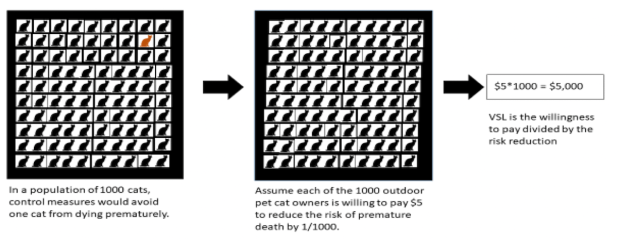
Figure. 1: The cat in red colour is saved by the control measures, one life out of 1,000. If each owner pays $5 for this 1/1,000 risk reduction, the value amounts to $5,000 per cat life saved.
How much do Kamloops residents value a cat’s life?
When we analyzed the responses, the VSLC averaged just over $8,000 among people who said they were willing to pay. If we include everyone, those willing and unwilling, the average falls to around $4,000. Most interesting, the figures were almost identical for indoor and outdoor cat owners. That suggests willingness to pay is less about whether you personally own a roaming cat and more about a broader community concern for feline welfare.
We also found some demographic patterns. Women, higher-income households, and residents who already support cat licensing tended to report higher willingness to pay. People who voiced strong concern about cats’ impacts on wildlife were also more likely to put money toward reducing cat deaths.
Why does this matter?
Values like these may help decision-makers judge whether the public is open to investing in cat safety. Options such as cat licensing, nighttime curfews, secure outdoor enclosures, or education campaigns could be weighed not only for their ecological benefits but also for whether residents are prepared to back them financially.
In other communities, such measures have reduced not just cat deaths from traffic, predators, and disease, but also pressure on local birds and small mammals (King & Tsigaris, 2025, Aug. 7).
To put the findings in perspective: if a program could prevent the deaths of 100 cats, our estimates suggest Kamloops residents might collectively value that outcome at about $800,000. That’s a substantial figure, enough to justify more ambitious control measures by city officials.
From values to action
Our earlier research showed that most residents already recognize the dangers roaming cats face – traffic, disease, predators – as well as the damage they can cause to birds and small mammals (King & Tsigaris, 2025, Aug. 7). What the VSLC adds is evidence that this concern isn’t just theoretical; it comes with an economic dimension.
Kamloops now has a chance to lead with policies rooted in both science and community values. That means reframing regulation not as punishment, but as an investment in animal welfare, environmental stewardship, and community harmony.
If people in our city are, on average, prepared to value a cat’s life at several thousand dollars, then the challenge ahead is to turn that commitment into practice. The conversation we started back in August was about awareness. This one is about action (King & Tsigaris, 2025, Aug. 7).
References
King, D., & Tsigaris, P. (2025). The value of a statistical life of a cat: Owner demographics and management practices impacting willingness to pay for welfare measures. Journal of Applied Animal Welfare Science, 1–13. Advance online publication. https://doi.org/10.1080/10888705.2025.2515856
King, D. S., & Tsigaris, P. (2024). Risk Perceptions about Outdoor Pet Cats in a Small City in the Interior of British Columbia. Pet Behaviour Science, 16, 21–44. https://journals.uco.es/pet/article/view/16724/15221
King, D., & Tsigaris, P. (2025, August 7). Guest column: Addressing the outdoor cat challenge in Kamloops. Armchair Mayor News. https://armchairmayor.ca/2025/08/07/guest-column-addressing-the-outdoor-cat-challenge-in-kamloops/

 ArmchairMayor.ca
Leave a comment