
EDITORIAL – Unmarked graves are unfinished business in the Truth and Reconciliation journey
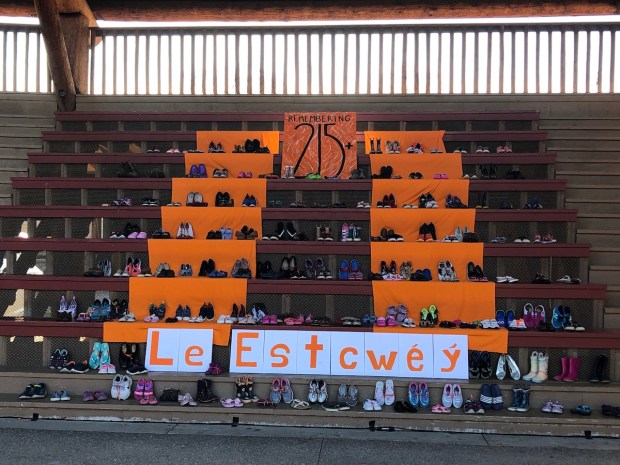
(Image: Mel Rothenburger)
An editorial by Mel Rothenburger.
THE NATIONAL DAY for Truth and Reconciliation and Orange Shirt Day are about honouring those impacted by residential schools, reflecting on harms caused, and celebrating the resilience and culture of Canada’s indigenous citizens.
An event at the Tk’emlups powwow arbour will capture those sentiments. But as we think about what’s commonly referred to as a “dark chapter” in Canada’s history, there’s much that’s unfinished when it comes to defining the details of that time.
Most notably, there’s the matter of what’s become known as “unmarked graves.” The discovery of suspected graves at the Kamloops residential school in 2021 gave rise to an explosion of national and international indignation about residential schools across the country.
The Kamloops announcement was followed by similar ones regarding sites elsewhere. Yet, today, there remains no physical proof that missing children were clandestinely buried at these sites.
Tk’emlúps te Secwe̓pemc Kúkwpi7 Rosanne Casimir continues to say that the long delay in excavation of suspected gravesites is due to “protocols.” Over time, TteS has adjusted the initial claim that 215 graves were definitely located to a description of the ground penetrating radar findings as “anomalies.” That’s a far cry from the “mass graves” initially, falsely, trumpeted by the media.
Here, and on a national level, anyone who questions, based on lack of empirical evidence, the reality of the gravesites is labeled a “denialist” and/ or a “racist.”
Why should there be such reluctance to challenge the truth of the “unmarked graves”? If excavations prove their existence, all doubt will be removed. If, on the other hand, it’s found through excavations that there are benign explanations for the “anomalies,” wouldn’t it be cause for national celebration?
There’s plenty of reason to condemn residential schools. That they existed, that many bad things happened at them, that they caused much trauma, isn’t in dispute. But the question of unmarked graves needs to be answered, however that might change the narrative.
Mel Rothenburger is a former regular contributor to CFJC-TV and CBC radio, publishes the ArmchairMayor.ca opinion website, is a recipient of the Jack Webster Foundation Lifetime Achievement Award, and a Webster Foundation Commentator of the Year finalist. He has served as mayor of Kamloops, school board chair and TNRD director, and is a retired daily newspaper editor. He can be reached at mrothenburger@armchairmayor.ca.

 ArmchairMayor.ca
When the site was first announced we were still in the midst of covid and a heat dome. People jumped to the most heinous negative conclusions without evidence because that’s what society does in the 21st century.
It’s been 4 years and the scab has yet to heal, although the temperature has cooled down considerably. Demanding the site be dug up sooner rather than later will only heat things up again. The site isn’t going anywhere, it’s not a hardship to allow the victims of hundreds of years of systemic genocide decide the time frame for the excavation, we just need to show some patients.
LikeLike
The one “truth” I subscribe to is that I don’t need any further proof that the native population has undoubtedly suffered a tremendous amount at the hand of the white man. But the new reality is we simply cannot be held hostages for a past injustice. The white man way of life can and does benefit the natives too at the present moment.
LikeLiked by 1 person
I so agree, and I think it is not a good look to keep delaying.
LikeLiked by 1 person