
GUEST COLUMN – Addressing the outdoor cat challenge in Kamloops

(Image: Mel Rothenburger file photo)
By DENISE KING and PETER TSIGARIS
Thompson Rivers University
THE IMPACT of outdoor pet cats on local wildlife, and the risks these pets face themselves, is a complex and pressing issue for many communities, including Kamloops.
To better understand local perceptions, we conducted a survey that received responses from 584 Kamloops residents. Our goal was to illuminate the many-sided nature of this issue and to highlight key differences in opinion among outdoor cat owners, indoor cat owners, and non-cat owners.
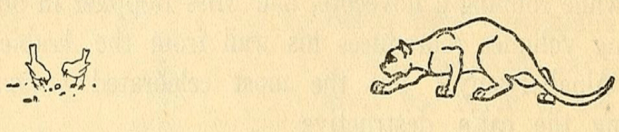
Figure 1: Cat stalking birds, 1916, The domestic cat, known for its predatory nature and ability to hunt birds and mice, is a threat to wildlife. However, there are ways to harness and manage its behavior. Author Forbush, Edward Howe, (1858-1929)
(Source: https://commons.wikimedia.org/wiki/File:Cat_stalking_birds.png)
Our study shows exactly what we expected, a clear contrast in perceptions. Outdoor cat owners often view their cats as natural predators of the rodent population and should have the freedom to roam freely outdoors. Meanwhile, indoor cats and non-cat owners express concern over the impact on birds and the potential for property damage.
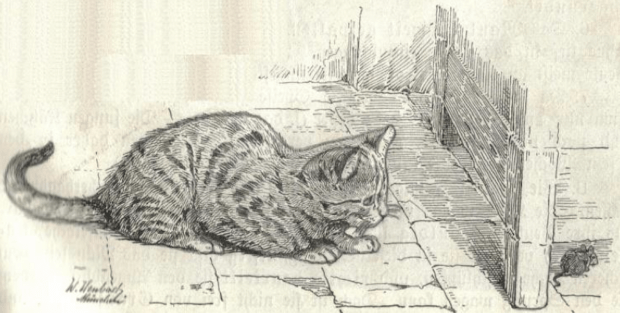
Figure 2: before 1924. Reproduction of a painting of a cat waiting to capture a rodent. Author: Walter Heubach (1865–1923). Https://commons.wikimedia.org/wiki/File:Heubach_cat.jpg
However, outdoor cats are not only hunters, they are also vulnerable. They face real threats from larger predators, disease exposure, and urban hazards such as traffic. Interestingly, our findings showed a broad consensus across respondent groups about these risks. This shared understanding provides a promising foundation for future discussions aimed at protecting both pet cats and local wildlife.
Our study also revealed that gender and education play a role in shaping these perceptions. Women and individuals with higher education levels are more likely to perceive outdoor environments as dangerous for cats. These insights suggest that any proposed policy changes or educational campaigns will need to consider how public attitudes vary across demographic lines.
It’s time to rethink our approach to outdoor cats. While dogs must be leashed or contained by law, cats often roam freely, putting birds, small mammals, and even damaging neighbours’ gardens. As voluntary measures only go so far, it may be time for Kamloops to consider regulations that limit unsupervised roaming, such as requiring cats to be kept indoors at night or only allowed outside during the day under supervision. Alternatives like leashes, secure outdoor enclosures, or even cat “backpacks” offer safe ways for pets to enjoy the outdoors without harming local wildlife.
This issue reaches beyond individual preferences. It touches on broader values of environmental stewardship, neighborly respect, and community well-being. By taking collective action, Kamloops can create an urban environment where wildlife thrives, and pets are safe and well cared for. The path forward lies in education, policy, and inclusive dialogue.
Many municipalities have already acted, ranging from 24-hour cat curfews to leash laws and full containment bylaws. For example, Whitehorse requires cats to stay on their owner’s property or be leashed outdoors, and enforces a night-time curfew from 8 p.m. to 6 a.m., along with requirements for microchipping and registration.
In Knox, Australia, a 24-hour cat curfew has been in place since April 2022. Recent polling shows that two-thirds of Australians support banning pet cats from roaming freely, though some public debate continues around how best to implement such policies.
Should cats be subject to the same outdoor regulations as dogs? We invite residents to reflect on this question and join the conversation.
Our full research findings are available in the peer-reviewed journal Pet Behaviour Science.
King, D. S., & Tsigaris, P. (2024). Risk Perceptions about Outdoor Pet Cats in a Small City in the Interior of British Columbia. Pet Behaviour Science, 16, 21–44.
https://journals.uco.es/pet/article/view/16724/15221
Further Reading and Resources
ACT Government. (2023). Cats in the ACT: Containment and responsible ownership. Transport Canberra and City Services. https://www.cityservices.act.gov.au/pets-and-wildlife/cats
BCSPCA (n.d.). Model municipal bylaws. https://spca.bc.ca/programs-services/working-for-better-laws/model-municipal-bylaws/
City of Knox. (2022). Cat curfew starts April 10. Knox City Council. https://www.knox.vic.gov.au/whats-happening/news/cat-curfew-start-april
City of San Francisco. (n.d.). Park Code Article 5: Animals. San Francisco Recreation and Park Department. https://codelibrary.amlegal.com/codes/san_francisco/latest/sf_park/0-0-0-262
City of Victoria (n.d.) Victoria Animal Control Services Ltd. CAT Regulations https://www.vacs.ca/bylaw-regulations/cats
City of Whitehorse. (n.d.). Animals. https://www.whitehorse.ca/our-government/community-service/animal/
City of Whitehorse. (n.d.). Cats. Whitehorse City Council. Retrieved August 7, 2025, from https://www.whitehorse.vic.gov.au/living-working/pets/cats
News.com.au. (2025, June 4). Two-thirds of Australians support banning pet cats from roaming. https://www.news.com.au/lifestyle/pets/twothirds-of-australians-support-banning-pet-cats-from-roaming/news-story/c6e56799c54553c06d2302b3dd0e017b
Stewardship Centre for British Columbia. (n.d.). Cats and birds: Protecting urban wildlife. https://stewardshipcentrebc.ca/cats-and-birds/

 ArmchairMayor.ca

Leave a comment