
CHARBONNEAU – Political polarization ends up being one pole: the far right
(Image: Wikipedia, Veronica Gagnon)
YOU OFTEN HEAR about how polarized politics has become. But polarization requires two poles. There has been growth in one area of politics but not the other. That’s not polarization.
 The right has become highly radicalized while the left remains pretty much the same.
This is especially true in America. The last U.S. election was routinely described as “the most polarized election in American history.”
The polarization model is not very useful. A political map that bulges dramatically to the right and little to the left is a better representation.
“The ideological map has become pear-shaped,” says columnist Doug Sanders. “During the mind-warping years of the pandemic and its social-media echo chambers, a lot of people became attracted to fringe ideas and conspiracy theories on the right, and the leaders who espouse them, but there hasn’t been any similar shift, of any significant scale, on the left (Globe and Mail, July 26, 2025).”
The American election of 2024 illustrates this bulge to the right.
Democratic presidential candidate Kamala Harris carefully avoided identity-politics ideas of the left, even when they might have been popular. She stayed clear of “woke” language, beyond those very widely embraced by mainstream Americans, such as marriage equality or abortion rights.
Donald Trump regularly referred to his predecessors Barack Obama and President Biden as far-left extremists, and repeatedly called Harris a “Marxist” or “communist.”
In Canada, Conservative Leader Pierre Poilievre used the same language to describe his Liberal opponents.
Canadians are not immune to the bulge to the right.
In his study, Polarization in the Canadian Public: a Myth?, Cary Wu from York University shows growth of the far right relative to the left.
“Another noticeable trend is that, over time, the rise of the political right has outpaced the growth of the political left,” says Wu. “In 2004, the share of the political left stood at 29.6 per cent, increasing to 34.5 per cent in 2021, representing a modest 17 percent increase. In contrast, the share of the political right increased from 33.9 to 45.8 per cent, which is a 35 per cent increase. This means that Canadians are polarizing, and they are polarizing toward the right more than toward the left.”
I take issue with the concept of “polarizing” for the reasons above but the accelerated growth of the political right is a reality.
I also have a problem with the use of the words “political right” to describe the views of conservatives.
Conservatives form political parties. What’s referred to as the right is actually a kind of populism –more accurately an “oppositional social movement.”
Such movements are organized to challenge, resist, or overturn dominant political systems.
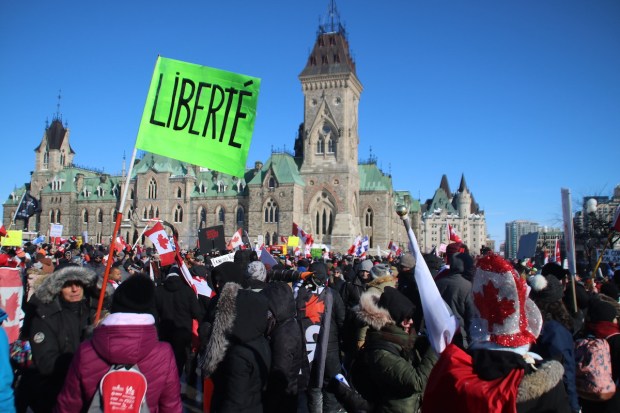
A good example of an oppositional social movement was the Freedom Convoy assault on Ottawa in 2022.
The Freedom Convoy was wilfully marginal: they deliberately took positions outside mainstream institutions.
They framed themselves as “Ordinary, freedom-loving Canadians” and governments, media, experts, and global institutions “Corrupt elites.”
Many embraced the labels of “fringe” and “deplorable” as a badge of their authenticity.
The growth of the “right” is not the growth of a political party, it is a movement fuelled by narratives that appeal to a sense of anger and discontent.
Thankfully, Canada has not been swallowed whole by this movement as it has in America.
David Charbonneau is a retired TRU electronics instructor who hosts a blog at http://www.eyeviewkamloops.wordpress.com.

 ArmchairMayor.ca
One of the most consistently biased writers I’ve seen.
LikeLike