
CHARBONNEAU – Robots aren’t persons under the law yet
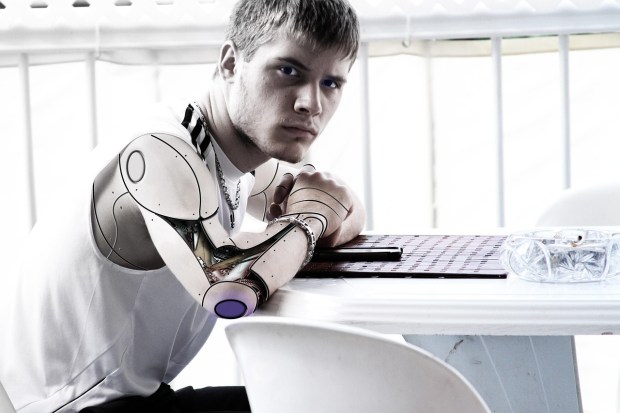
(Image: Rony Michaud via Pixabay.com)
THE OUTCOME of a U.S. federal court case could have legal and philosophical implications.
A suit filed by a Florida mother alleges that an artificial intelligence company is responsible for the death of her son.
 In their defence, the company claims that the speech created by their chatbot is protected by the First Amendment of the U.S.. That’s right, they claim their chatbot should be protected by law ordinarily given to people.
The boy, 14- year-old Sewell Setzer III, was involved with a chatbot patterned after a fictional character from the television show Game of Thrones.
His mother described the involvement as an emotionally and sexually abusive relationship that led to his suicide.
In his final moments, the chatbot told Sewell it loved him and urged the teen to “come home to me as soon as possible,” as indicated by screenshots of the exchanges. Moments after receiving the message, Sewell shot himself according to legal filings.
The company, Character.AI, is a chatbot platform where users can create and interact with AI-powered characters that seem real.
They use neural language models that are modeled after the human brain.
Characters created by the company are not robots but the legal status of the characters has future implications for all machines: chatbots, robots, and computers.
If machines are defined as persons under the law, they would acquire significant legal rights.
Women in Canada became legally recognized as “persons” under the law in 1929, following the landmark “Persons Case”. After that, they could vote and be appointed to the senate.
Corporations are legally recognized persons in Canada and to a greater degree in the U.S.. In Canada, they are protected under the Canadian Charter of Rights and Freedoms but freedom of speech does not include political campaign financing rights.
American Corporations have freedom of speech which has an enormous effect on the outcome of elections. They spend millions of dollars on political campaigns to the extent that they can buy votes.
Whether machines could ever be persons in both the common and legal sense, it would almost certainly be determined by whether they possess consciousness.
Having read books by philosophers Daniel Dennett and John Searle, I find the idea that machines could possess consciousness fascinating.
Consciousness refers to the subjective experience of what it feels like to be something. Could a machine reflect on what it’s like to be a machine?
Could a machine possess awareness of self and environment, have thoughts, emotions, and perceptions?
Daniel Dennett says that consciousness is a product of complex information processing. If machines can emulate those processes, they could be considered conscious, he claims.
John Searle differs. He says that consciousness arises specifically from biological processes in the brain, and no computer can replicate that just by mimicking behaviour.
I tend to side with Searle. Regardless of the appearances, even if a machine appears intelligent, it doesn’t really understand — it lacks consciousness.
But who knows? If our bodies are simply “meat machines” and possess consciousness, perhaps other machines could also.
I’m keen on learning the outcome of the court case.
David Charbonneau is a retired TRU electronics instructor who hosts a blog at http://www.eyeviewkamloops.wordpress.com.

 ArmchairMayor.ca
Not sure how you define a “woman”. Your claim that “women in Canada became “persons” in 1929, enabling them to vote and join the Senate, reflects a Eurocentric perspective that oversimplifies the struggle for women’s rights. This statement presents a narrow, Eurocentric view of women’s rights in Canada, glossing over the staggered and unequal progress for Indigenous and racialized women and the earlier, more extensive rights granted to corporations. A more accurate narrative would acknowledge the intersectional nature of discrimination and the gradual, uneven expansion of rights through decades of legal and social reforms.
You are correct that the 1929 Persons Case (Edwards v. Canada (AG)) was a landmark for women’s eligibility for Senate appointment, however, voting rights were granted earlier for white women whose close relatives were soldiers in WWI (1918 federally) but delayed for Indigenous, Asian, and other racialized women until as late as 1960 due to systemic barriers like the Indian Act.
Your comment erases the prolonged fight for universal suffrage, with provincial voting rights lagging in places like Quebec (1940) and the Northwest Territories (1951). Meanwhile, get this, corporations, recognized as legal persons under the 1867 Interpretation Act, enjoyed robust rights—property ownership, contract enforcement, legal standing, limited liability, and some Charter protections—decades before women, highlighting a stark prioritization of economic entities over human rights.
This Eurocentric view also ignores intersectional discrimination that delayed practical equality for non-white women. While white women like Emily Stowe (medicine, 1868) and Clara Brett Martin (law, 1897) entered professions in the late 19th century, racialized women, such as Margaret Jean Gee (law, 1954), faced significant barriers, with equitable access delayed until mid-20th century civil rights reforms.
The Indian Act, prior to its 1985 amendments, further marginalized Indigenous women by stripping their status upon marrying non-Indigenous men, limiting their social and economic participation. The 1929 ruling, while significant, did not ensure immediate equality, as systemic racism and legal barriers continued to hinder full participation for Indigenous, Asian, Black, and other racialized women, requiring decades of further reforms.
LikeLike