
A HOME AWAY FROM HOME: Rethinking International Student Housing at TRU

‘The Res’ at TRU.
By PETER TSIGARIS
Thompson Rivers University
THIS EDITORIAL is part of a book series I co-authored with senior undergraduate students, titled In the Shadow of the Hills: Socioeconomic Struggles in Kamloops, published by TRU Open Press. Chapter 5, authored by Kris Kadaleevanam, explores the accommodation challenges faced by international students at Thompson Rivers University.

Kris Kadaleevanam.
His research uses survey data with institutional analysis in order to assess the affordability, quality, and viability of different housing options. Below, I reflect on and summarize some of his key findings and offer some thoughts on the government’s recent immigration policy and the changing geopolitical economic landscape.
Housing as a Foundation for Well-Being
Kris’ chapter highlights that international students often struggle to find safe, affordable, and supportive housing. His survey of over 300 students reveals a stark financial reality: for many, monthly rent consumes nearly their entire income, leaving little for food, utilities, entertainment, or emergencies.
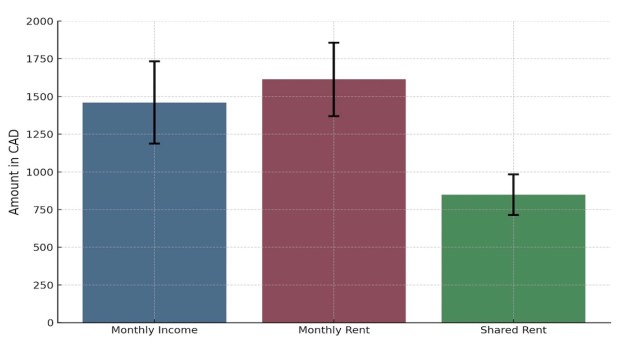
Figure 1: Average monthly income, rent and shared rent from survey of 300 international students.
A common strategy, with trade-offs, is to share apartments or rental houses. Kris’ data shows that the average shared rent is approximately $849 per month, significantly less than the $1,613 average for private rentals. While this reduces financial strain, it often comes at the cost of overcrowding, lack of privacy, and informal or insecure lease arrangements.
These conditions can contribute to stress, especially for students adjusting to life in a new country and academic system. For 74% of those surveyed, housing negatively impacted both their academic performance and personal well-being. The most common problems included poor maintenance, withheld deposits, threats of eviction, and even in some rare cases discrimination.
Homestay: An Underused Solution
One of the most underused yet promising options is TRU’s homestay program. Despite offering a fixed monthly cost that includes meals, utilities, and a private room, priced competitively at $1,200/month, only 3% of international students surveyed currently use this option. Kris rightly points out that the program has the potential to offer a more affordable, culturally enriching alternative, especially for first-year or ESL students transitioning to life in Canada.
My own family has hosted homestay students from Japan for the past four years, and the experience has been phenomenal, both ways. These students became part of our household, sharing meals, laughter, and holiday traditions. For them, it was a smoother entry into Canadian life. For us, it was a chance to learn about another culture. I have no doubt that homestays can ease the burden on students while enriching the lives of local families.
Policy Shifts and What Comes Next
When Kris conducted this research, housing pressures were severe and international enrollment was still rising. But recent federal policy changes have dramatically altered the landscape. The Canadian government has capped new international study permits at 360,000 for 2024, with BC’s allotment falling to just under 50,000. For TRU and other universities in the province, this means a significant drop in new international enrollments. In response to declining enrolments, TRU has announced plans to shut down some of its student accommodation, including the aging McGill Residence and the temporary West Gate dormitories, citing decreased demand and financial pressures.
Even after the reduction in TRU’s student accommodations, Kamloops may soon shift from a housing rental crunch to a surplus of rental units. While this could ease pressure on the local housing market, it raises serious economic concerns for landlords and businesses that rely on student spending.
A sharp decline in international student enrollment will reduce rental income for landlords, lower sales for businesses, and strain university finances. The impact will ripple beyond direct spending, as students support the local economy through housing, food, retail, and tuition that sustains jobs. Each dollar lost triggers a multiplier effect: income not earned by landlords, businesses, and employees leads to further rounds of lost spending.
A 2024 Lightcast study found that TRU contributes over $885 million annually to the regional economy, with international students responsible for $53.3 million of that. A $40 million direct reduction in student spending next year, with a conservative multiplier of 1.4, would cut Kamloops’ economy by $56 million a year, roughly $560 per resident . And the crisis does not end there: difficult times at TRU are expected to continue over the next few years, compounding the economic challenges for the university and the broader Kamloops community.
This downturn, from decline in international student enrolments, will be compounded by the larger geopolitical forces with the imposition of the new tariffs under the Trump administration. Canada’s economy will slow down further, reducing job creation and local investment. For Kamloops, already facing a drop in international students, this additional shock could deepen the local economic pain.
With elections looming, should we be asking our leaders whether limiting international students, and shrinking our economy, is truly the right path forward for Kamloops and elsewhere in Canada?
Your thoughts are appreciated.
References.
Blanchfield, M. (2025, April 16). Bank of Canada says Trump tariffs will hurt Canadian economy, boost inflation. POLITICO. https://www.politico.com/news/2025/04/16/bank-of-canada-trump-tariffs-00132296
Dawson, J. (2024, October 9). TRU adds $885 million to local economy, according to impact study. Castanet Kamloops. Retrieved from https://www.castanetkamloops.net/news/Kamloops/510846/TRU-adds-885-million-to-local-economy-according-to-impact-study
Canadian Broadcasting Corporation. (2024, March 14). TRU to close McGill Residence and West Gate dorms amid declining enrolment. Retrieved from https://www.cbc.ca/news/canada/british-columbia/tru-student-housing-closures-2024
Immigration, Refugees and Citizenship Canada. (2024, April 5). Minister Miller issues statement on international student allocations for provinces and territories [News release]. Government of Canada. https://www.canada.ca/en/immigration-refugees-citizenship/news/2024/04/minister-miller-issues-statement-on-international-student-allocations-for-provinces-and-territories.html
Robitaille, E., & Sivakumar, V. (2024, April 5). IRCC releases allocation of study permits for all provinces. CIC News. https://www.cicnews.com/2024/04/breaking-ircc-releases-allocation-of-study-permits-for-all-provinces-0443794.html
Thompson Rivers University. (2023). Economic impact study 2022–2023. Retrieved from https://www.tru.ca/economic-impact.html
Tsigaris, P., Awad, A., Forbes, C., Izett, P., Kadaleevanam, U., Mehta, G., Noor, S., Simms, O., & Thomson A. (2024). In the Shadow of the Hills: Socioeconomic Struggles in Kamloops. TRU Open Press. https://shadowofthehills.pressbooks.tru.ca/

 ArmchairMayor.ca
The assumptions behind this so-called “study” are fundamentally flawed. Suggesting that international students spend most of their income on rent, leaving little for groceries or other essentials, distracts from a key fact: students are granted study permits for Canada only after proving to visa officers that they have sufficient funds to support themselves throughout their education—without relying on part-time work.
Part-time jobs were never meant to be a primary source of income. In fact, if an applicant stated in their visa application that they planned to fund their living expenses through part-time work, their visa would be denied outright. So why does this narrative persist—that international students are somehow being shortchanged by limited work hours or lower wages? These were never guaranteed or promised as a means of survival. The intent of every international student is to study. This is the only reason their visa applications are approved. Part-time jobs are great for the experience, and the pocket money, but that is about all.
Yes, Canada’s cost of living can be high. But this is not hidden information—it’s readily available online. If it’s clearly unaffordable, why choose to study there in the first place? Worse still, if someone submits false financial documents just to get through the visa process, how can they then turn around and ask for sympathy from the Canadian public?
And finally, as a guest in another country, how reasonable is it to expect to influence national immigration policies because one didn’t plan adequately? A bit of perspective and personal accountability would go a long way in making this conversation more honest and constructive.
LikeLike
Thank you for your comment. It’s important to emphasize that this editorial is based on student-led, ethics-approved research published in In the Shadow of the Hills (TRU Open Press). Kris Kadaleevanam conducted a survey of over 300 international students at Thompson Rivers University and analyzed their reported income and housing costs using statistical methods. His findings are grounded in data, not opinion. The chapter makes no claims about Canada’s study permit system or visa screening process, those are important topics, but they fall outside the scope of this research.
Kris’s analysis simply shows that, once in Kamloops, many international students report that rent and housing costs consume the majority of their monthly income, often earned through legal part-time work. These are the real conditions students face while living here. The results speak for themselves: 74% reported that housing negatively affected their academic performance and well-being.
More broadly, my editorial highlights the wider economic consequences of Canada’s new international student policy. The federal cap on study permits could lead to a $40 million decline in student spending in Kamloops this year alone. Using a conservative economic multiplier, that translates into a $56 million annual loss for the local economy, roughly $560 per resident. And this is just the beginning. Since student enrolment is expected to drop further in the following two years, the total impact will only grow. These effects won’t just be felt by students, but by landlords, retailers, TRU itself, and the broader Kamloops community. That’s the deeper story behind the numbers.
Let’s not confuse responsible data-driven research with unrelated speculation about visa enforcement. Kris’s chapter does what research should do: reflect lived realities and inform public discussion with evidence.
LikeLike
Generally a well thought out and presented piece, kudos to our young author.
That said, one wonders if the direction of the flavour of this, is taking advantage of current forces to promote a pro international student lobby.
The summation here; “With elections looming, should we be asking our leaders whether limiting international students, and shrinking our economy, is truly the right path forward for Kamloops and elsewhere in Canada?”
… is an overt attempt to use the political situation, including trump … to advantage the international student lobby. This is fear raking.
We mustn’t forget that the feds dropped this limitation of student visa’s on international students, partly because of the lack of employment opportunities for Canadian born youth and students in the entry level employment categories.
Even when limited by the number of hours an international student is allowed to work … there were still less jobs available for Canadian youth in these markets, even if Covid played a larger role in under employment stats as well.
International students taking jobs usually filled by Canadian youth … is a real thing, and a new employment reality, and a problem. The counter argument obviously is Canadian youth not wanting to work at Timmies … but the convo is still fair.
In relation to this piece, readers may question the balance of the international student market, who is itself here, promoting a pro increased international student status … by using larger Canadian economic realities as justification.
This smacks of ‘sky is falling’ justification, and grasping at the largest, inarguable talking point to do so, and drags federal politics into it.
Speaking locally, markets will always reset; rental markets and retail sales spending markets as well as job markets will always fluctuate, and will always reset to match the reality of its own market size.
Yes, international students will not be here to spend the quoted dollars, but they weren’t here before, so the local economy will just once again reset. This is not a subject equal to a economic destroying calamity. The international student market is just not THAT large, even here in Kamloops.
Now, Im not saying that we want Canadian universities to lay off staff and teachers and cut programs and close residences due to lack of enrollment because of this … but one might think that this alone would be a more logical reason to promote increased student visa’s, than a general Canadian economic approach.
Again, a good piece, but strikes as angled towards a single sided, polarized attempt in its root direction … than a well balanced discussion of the reality of the market forces at play here.
Wheres the discussion of the other side?
LikeLike
Thank you for your thoughtful and civil comment. I appreciate that you took the time to read the piece carefully and to acknowledge both Kris Kadaleevanam’s research and the broader questions it raises.
To clarify, the central aim of the editorial, and the chapter it draws from, is present empirical findings on housing pressures that international students have faced in Kamloops, based on survey data collected through an ethics-approved study at TRU. Kris does not make claims about immigration policy. It focuses on housing affordability, quality, and well-being, and the potential of underutilized options like homestays. That’s the core of his research.
To clarify, the portion of the editorial that reflects on recent federal policy changes and their broader economic implications is my own analysis as a social science researcher. Kris Kadaleevanam’s chapter focuses specifically on the housing challenges faced by international students and is grounded in original survey data collected at TRU. While my commentary is informed by his findings, the broader economic reflections, including the discussion of enrolment caps, local spending, and the multiplier effect, go beyond the scope of his chapter and represent my own contribution to the policy discussion.
You raise an important counterpoint about employment access for Canadian youth. It’s a discussion worth having. But I’d caution against viewing labour markets through a strictly zero-sum lens. International students don’t just participate in the job market, they also stimulate it through spending, tuition, and housing demand, which in turn support local jobs and services.
As for the tone, I appreciate your concern. The goal isn’t to sound alarmist, but to surface real trade-offs. Reducing international enrolment may relieve some pressures (e.g., on housing), but it could also mean fewer academic programs, job losses, and a slower local economy. These are legitimate questions for policymakers and communities to weigh.
Again, thank you for engaging in good faith. These are exactly the kinds of conversations we need in a time of major policy shifts.
LikeLike
The first and foremost thing to remember is that governments, any government, regardless of color and philosophies cannot please everyone 100% of the time. It has never happened and will never happen that a government pleases everyone. For sure though government run by smart people can prevent unwanted crisis with well thought out policies. The flood gates to immigration were opened without much thought by the Trudeau government and the unintended consequences of those visceral decisions still reverberate years later.
LikeLike