
IN THE LEDGE – Carbon tax bill should have been brought forward earlier
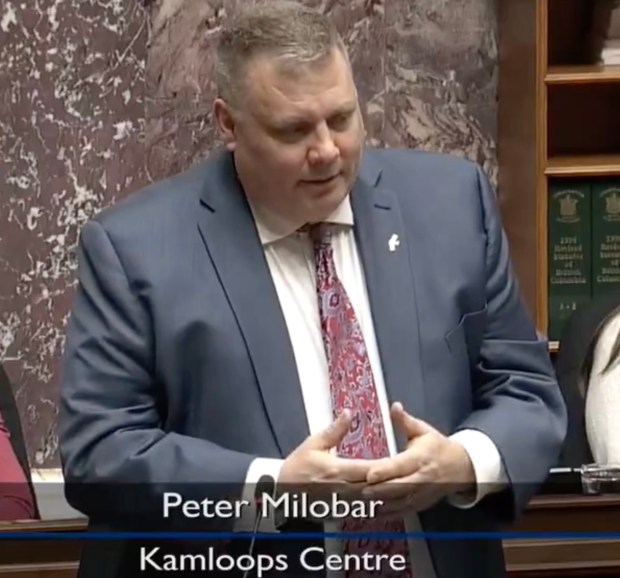
MLA Peter Milobar.
Comments by Kamloops Centre MLA Peter Milobar (Conservative) during debate in the B.C. Legislature today (March 31, 2025) on Bill 8, the Carbon Tax Amendment Act 2025 to set the carbon tax rate to zero dollars per tonne of emissions as of April 1, 2025.
Peter Milobar: The only thing extraordinary about this is how long it took the government to actually bring Bill 8 forward. It is certainly not urgent, or should not have needed to be urgent, had this government operated with any sense of urgency for the first four weeks that we sat in this Legislature, including when the budget was presented.
The Government House Leader brought forward several dates around March 15 when there was an OIC signed by the federal government. I would point out, however, that every federal politician that would reasonably be seen to be the prime minister or the next prime minister, from January 31 moving forward, had talked about removing the consumer carbon tax should they become prime minister, including our current prime minister. That was the first day that he started speaking about removing the consumer carbon tax.
Yet you spring forward to the beginning of March, when our budget was presented, and not only did this government not bring forward legislation like this, with an enabling clause to allow for things to be done by OIC so we could have debated this very technical bill over the last four weeks in this chamber…. In fact, they presented a budget that showed an ever-increasing carbon tax over the next three years, fully expecting — despite what all the federal leaders were talking about, of removing the consumer carbon tax — budgeting for and projecting consumer carbon tax to continue on in British Columbia.
I would also point out that the government had it within their powers to have recalled the Legislature any time over the last two weeks to deal with Bill 8. But yet, here we are, jammed up as an opposition — duly elected members of this Legislature — try to deal with a very technical piece of legislation as it relates to charts and fees around carbon tax.
The carbon tax bill itself is 83 pages of legislation. This is another six pages of legislation. I would point out that we have all sorts of government taxation policy right now in front of this chamber that is retroactive.
In fact, in Bill 5, which is the Budget Measures Implementation Act, which carbon tax was not mentioned in and any changes made there, we have section 3, January 1, 2013, a retroactive clause; section 4, January 1, 2018; section 7, January 1, 2022; section 8, March 28, 2023; section 9, January 1, 2024. We have some into the early parts of 2025: section 35, January 1, 2019; section 38, January 1, 2019.
This government has had a long history of bringing in retroactive tax changes around lots of things to do with income tax and other taxes in this.
I would also point out that part of the reason we’re here is this government hard-baked in the increases on a yearly basis, a couple of budget measure implementation bills ago, to match the march to $170 a tonne. At which time, about this time last year, the premier was very emphatic that B.C. would continue to go to $170 a tonne regardless of what happened provincially, and we have a budget that bears that out.
It was only in the fall the premier changed his tune, and it was only recently that this bill got presented — again, a technical bill.
Despite this, and despite very public proclamations by the premier last week that, in fact, this would be happening, there was no providing of the bill in advance to opposition to properly vet and read through and figure out exactly what is or is not going to happen both on the consumer and the industrial side of carbon tax. We are essentially left to spend a couple of hours trying to quickly cobble together a cognizant response to something that has been in the public conversation for quite some time.
If this is the government’s attempt at trying to exhibit urgency to a piece of legislation, it sorely misses the mark. Again, Standing Order 81 is meant to be for those issues that are of extreme urgent matters, not for government incompetence on bringing forward a legislative schedule of things for this House to work on. We could have very easily over the last four weeks been dealing with provisions in Bill 8 that would have actually had a commencement clause at the very end that said as federal laws change by order in council, we would allow ourselves to make the changes, and we would understand what those changes are.
It’s quite ironic that we are talking about these potential powers needed to be with the government, given the walk-back on Bill 7 that we’ve recently seen in terms of the all-encompassing powers, given how ham-fisted this has come forward with carbon tax.
In short, when you look at the dates, when you look at the precedents, when you look at legislation on the floor of this House right now to do with budget measures and implementation and you layer that with the actual budget document we have and the total disregard by this Premier and this government to take any substantive action on carbon tax until the very literally eleventh hour of the conversation nationally, this is an urgent matter because the government has created an urgency to it, not because they did not have the time to reasonably foresee what was going to be happening, nor the legislative tools available to them to try to be able to react to that.
I would suggest to you that the fact that the government has now fumbled this attempt would indicate that we do not need to have Standing Order 81 enacted today. We need to let this legislation flow through to its natural course in this chamber.
The Government House Leader insists that everyone in this chamber shall be afforded the opportunity to speak to Bill 8. Well, with half-hour time limits and an official opposition of 41, that would be 20½ hours. We would be well past April 1 by the time this bill got to committee stage, let alone debate, ending on second reading.
So the actions and the words, once again, of this government do not match what Standing Order 81 is supposed to represent. By that measure, if it is critical this be passed by midnight tonight to meet the April 1 deadline, what the government has failed to tell us, yet again, in an open and transparent way is that they would be willing to bring in a guillotine motion later today to ensure that all debate was cut off in time for the Lieutenant Governor to get back here before midnight to be able to make this law.
In that case, I guess it would be fitting, given that there’s been a lot of talk about Henry VIII clauses recently from this government, that they would be bringing forward a guillotine motion later that they refuse to acknowledge today.
The arguments by the government simply are not to be believed in terms of the urgency, the timelines involved and the fact that by the Government House Leader’s own admission, everyone in this chamber shall be afforded the full right to fully speak to and fully question a bill that is supposed to be passed by April 1, which is midnight tonight.
There does not seem to be the urgency. This has been something the government could have brought forward to this chamber over the previous four weeks. They could have recalled us over the last two weeks.
I do look forward to it being a confidence vote, however, because the Premier seems to be angling and wanting an election to happen sooner rather than later. So, I guess it will be interesting when we ultimately get to a final vote on Bill 8 to see whether we’re into our own provincial election or not.
Thank you for your consideration of this matter.
Source: BC Hansard.

 ArmchairMayor.ca
why is it necessary to publish this drivel. The man hasn’t had an original thought since the day he was elected
LikeLike
Science, backed by extensive research from organizations like NASA, NOAA, and the IPCC, asserts that global warming is occurring due to human activities, primarily the burning of fossil fuels, which release greenhouse gases like carbon dioxide into the atmosphere. The consensus among climate scientists is near-unanimous, supported by decades of data from ice cores, temperature records, and satellite observations. Most of these make their living studying climate.
On the other hand, those who don’t believe in global warming, often called skeptics or deniers, argue it’s either not happening, not human-caused, or not a significant problem. They might claim temperature changes are part of natural cycles (like solar activity or volcanic eruptions), point to manipulated data or scientific uncertainty, or suggest that warming could have benefits, like longer growing seasons, despite evidence showing net negative impacts. The deniers make their living by producing carbon or are in a political party supported by carbon producers.
You either believe in science or the carbon producer. What this Hansard comment ignores about the Carbon Tax is costs or externalities that are not passed on by producers to the end user in the price of pollution of the product that they sell.
The atmosphere, in fact, is a global public good, used by carbon producers which costs all of us, protecting it benefits accrue to all, so making private bargaining solutions and internalizing the costs in production is unfeasible. Supporting the carbon producer is a way for politicians to stay in power
There are few mechanisms to compel those who benefit from GHG-emitting activity to internalize these costs and risks to reflect the cost of the end product.
These costs include higher health care costs; and forgone production opportunities, for example when pollution harms activities such as tourism there is less money in the city budget which is made up by fees, taxes, (PAC) licences and the like. The like being a property tax hike.
In short, when externalities are negative, private costs of the polluter, are lower and not internalized than social costs caused by the polluter are spread over the taxpayer.
Yes, axing the Carbon Tax may lead to innovation which benefits all of us but in the end is the benefit amount equivalent to the cost of the harm to society as the whole?
Carbon tax is intended to protect clean air, clean water, biodiversity, and protection of fauna and flora. These are things that we own collectively so what value do we place on this Mr. Rustad and Mr. Eby do we give the carbon producer the right to distort our environment, or do we use a collective action plan since the cost is born by all of us?
Although there is room for market-based corrective solutions, government intervention is often required to ensure that benefits and costs are fully internalized. The only way to deal with this is through government policy and Carbon Tax is one such policy.
LikeLike