
ROTHENBURGER – How curling was ruined by trying to make it better
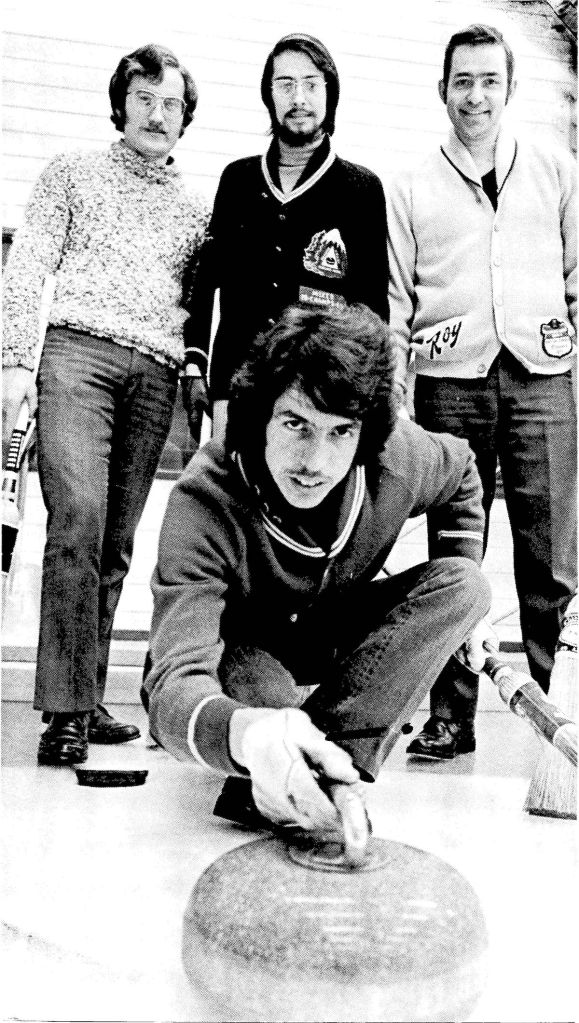
LOCAL ZONE WINNERS way back when, with our corn brooms and cozy sweaters. On the left is the Armchair Mayor, with Bernie Rothenburger in the middle, Roy Hackl right, and skip Daryl Will in front.
CURLING USED TO BE a great sport. Things went wrong along the way.
I confess, I love watching curling. I watched as much of the World Women’s Curling Championship as I could last week, and after the men’s version begins today I’ll be glued to the TV until next weekend so don’t bother calling.
 For many, curling is about the worst spectator sport there is. It’s slow and sometimes tedious. There’s no contact, at least not between players. You’ll never see a referee handing out roughing penalties in curling.
But I love the strategy, and cheer when somebody makes a raise double takeout. I haven’t curled for years but I used to. I was 12 years old when my parents sat me down, both feet in the hacks and showed me how to give a 40-lb. curling rock a shove down the ice using both hands.
Later, I curled competitively, through high school and into my 20s and 30s. Even at university in Seattle, I drove north from the campus every week to the only curling rink in the state and played in a league.
Curling was a joy. But they took it away. Let’s talk about how the game has changed. First, the gear. We used to wear heavy woolen sweaters that had the benefit of keeping you warm in a snow storm on the way to the rink. The slide was just being perfected, and we bought pieces of Teflon and glued the slippery material onto our sliding shoe. OK, so things have improved a lot since then but apparel is about the only advancement worthwhile.
Brooms were developing, too. When I was becoming a curler, the shovel-sized brooms that could double for janitorial purposes were on the way out, and tightly packed, skinny corn brooms were in.
The favourite in the crowd I curled with was the Black Jack. It had inverted straws in the centre to give it more heft, and more noise-making capability. Another brand was the Little Beaver. We’d cut about a foot off the handle to get more leverage; the shorter broomstick also improved balance when we slid from the hack.
It was a beautiful sight, a curling rock rumbling down the ice with two sweepers, one on each side, sliding and gliding in unison, slapping the ice with their corn brooms. Thwap, thwap, thwap.
I remember the first time a Scottish team showed up for a bonspiel in Canada with their push, or brush, brooms. We got a good chuckle over it. They looked silly, for one thing, and awkward as hell. Instead of gracefully sliding along, bent over the rock, sweepers had to skitter beside it, legs splaying out grotesquely in all directions, kind of hopping to keep up.
Besides, we figured, there was no way they could work. The theory behind the corn broom was that it created a vacuum as it was slapped back and forth in front of the rock, making the stone go faster. The theory behind the push broom is that it slightly melts the ice, doing the same thing, and supposedly you can also “carve” the path of the stone to get more or less curl.
Some teams complained about chaff deposited on the ice by corn brooms, but the chaff caused straight ice to become swingy, and it was just part of the game.
Little did we know that our beloved Black Jacks, Little Beavers and Rockmasters were doomed. By the late ‘80s, it was all push brooms; though materials and technologies have changed with time, they look pretty much the same as they always did, glorified Swiffer mops.
The slide has changed, too. In the day, leaving the hack we’d take a big step back, swinging the rock backward at the same time, sometimes as high as our shoulder if we were throwing a fast takeout, and more or less let the rock pull us forward. Nowadays, curlers don’t even lift the rock off the ice, and sort of push themselves from the hack. As they approach the first hog line, they give the stone an extra shove in an effort to get the right weight, rotation and direction. That’s just a bad way to throw a rock — the weight should be determined with the swing, rotation should actually start as the rock comes down onto the ice.
Ironically, a lot of top curlers these days (like Matt Dunstone and Mike McEwan) use an old corn broom during their delivery because it’s the only way they can keep their balance. Others use contraptions that look like pieces of PVC pipe glued together to keep themselves from falling over. How today’s curlers ever make a shot at all is a wonder.
Not that they don’t make some great shots. They have to, given the rule changes. The five-rock rule is supposed to make the game more interesting but it just clutters up the centre of the ice, forcing skips to go out wide and make raises and boomerang shots that are spectacular when they make them, and embarrassing failures the rest of the time.
Today’s skips don’t understand that sitting second shot is better than a guard, so they keep on plunking rocks on the centre line.
And now, there are time limits on games. Not necessarily a bad thing, but teams are allowed time-outs, during which their coach (why do you need a coach in curling?) walks slowly down the ice, chats with the players, and lets them do what they want anyway.
Then there’s the terminology, some of which is quite silly. Curling is basically about draws, takeouts, wicks, rolls and raises. Today, though, it’s about “chasing” an opponent’s stone, about “catchers” and “stuffing it” and “hitting it on the nose.” The worst of the new terms is “the force,” which simply means the team with last rock on an end picks up only a single point.
TSN commentator Vic Rauter, who doesn’t seem to have learned anything at all about curling strategy in his many years on the job, has his own favorite phrases, such as “Count ‘em up! One, two, and three!” Or better yet, “One, two, three and four!”
Rauter does his best to make the game exciting, screaming “Get it past that guard, fellas, get it past that guard! Can they do it, oh they do! Oh my!” as the shooting stone clears the guard by at least a foot.
Often, he simply doesn’t know what the curlers are trying to do with a shot but, luckily, he has colour analysts to help him out. Cathy Gauthier is knowledgable but her upspeak is quite annoying, and Russ Howard is eternally pessimistic, pointing out the most unlikely of scenarios for the next shot. Joanne Courtney, a recent addition, knows more about strategy than any of them.
One more thing. Gone are the days when teams were put together at local curling rinks, tried to win a zone playoff and then a provincial championship and move on to the Brier to go against other teams of players who lived in their own provinces.
Nowadays, teams swap out players like hockey trading cards from what amounts to a national pool of talent. A rink might officially represent a particular province but seldom do all its players live there. It’s becoming cut throat, with prize money and glory the objective, not representing your home town or province. Dunstone, for example, has skipped both Saskatchewan and Manitoba in the Brier but lives in Kamloops. His current “Manitoba” team includes a lead and a second who live in Ontario. Only his third lives in Manitoba. A residency requirement would be in order.
Some Swedish guy was the coach for this year’s Canadian women’s team. What’s up with that?
So, I’ll watch curling today and for the next several days, and I’ll enjoy it. But it ain’t what it used to be.
Mel Rothenburger is a former regular contributor to CFJC-TV and CBC radio, publishes the ArmchairMayor.ca opinion website, and is a recipient of the Jack Webster Foundation Lifetime Achievement Award, and a Webster Foundation Commentator of the Year finalist. He has served as mayor of Kamloops, school board chair and TNRD director, and is a retired daily newspaper editor. He can be reached at mrothenburger@armchairmayor.ca.

 ArmchairMayor.ca
“Negative ice” sometimes happened when the old rink had natural ice; the runs and tilts in the ice surface needed to be figured out or the ice would beat you before the skill of the opposing team could do the job.
In the early 70s, my twin brother Don skipped our high school team and I played 2nd. A fellow named Al played 3rd (vice) and a different Don played lead. We won the Huron/Perth championship and were hailed as minor superheroes by the Principal of the school when he gave the morning announcements over the PA system the next day.
We used ‘artificial or synthetic brooms’ (Rink Rats maybe they were called??) that were unbelievably hard on the hands. Strategy was totally different to what is used today & it drives me crazy watching a pile of rocks being built up on the centre line end after end.
There’s a time for nostalgia. Give me an old rink and a couple of sheets of ice ahead of a pricey new PAC any day. Lots of doctors and medical people would be attracted to ……….. I’ll let somebody else finish that argument, Armchair Mayor.
LikeLike
Those Rink Rats were really hard to use; I believe they were made with a fabric concoction instead of straws, but were the same shape? Thankfully, they didn’t last long.
LikeLike