
ARMCHAIR ARCHIVES – It was a dark and stormy night at the video mart
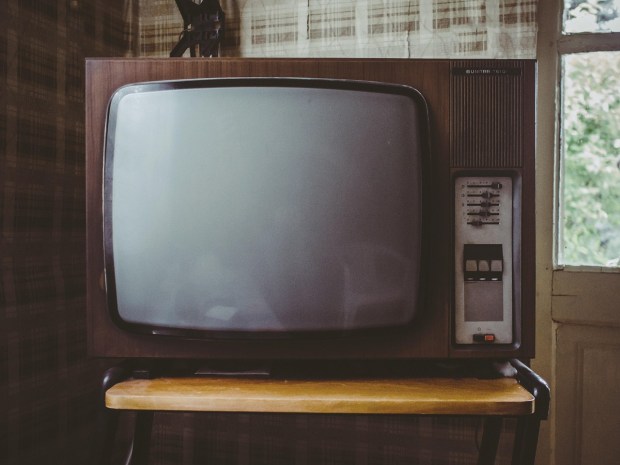
(Image: StockSnap via Pixabay)
In the days before live-streaming TV, people fought over the best movies at the video rental store, or subscribed to “cable,” or bought huge satellite TV dishes that grabbed unscrambled channels out of the air. This column was published in The Kamloops News on Feb. 21, 1986.
LAST SATURDAY NIGHT, when the wind was howling and the snow had been falling for more than 12 hours, it would have made a lot of sense to stay home in front of the fire.
 The streets, most of which remained unplowed as crews fought a losing battle against Mom Nature, should have been deserted.
But down at the video store, it was getting nasty. The parking lot was full, and inside we fought for the few remaining movies of recent vintage. The last copy of Teen Wolf was eagerly snatched up. Why? Because regular TV was lousy, and on Superchannel the lineup included Butch Minds the Baby and This is Spinal Tap.
No, it was either going out into the night in search of something to shove into the VCR or, groan, reading. Kamloops chose the former.
That, and other events of the past few days, bring to the fore the question, “is there life after cable?”
Opinions on that vary. There are three combatants in the war for the hearts and minds of diehard potato heads: video movies, cable, and satellites.
Video is becoming less and less a threat as people discover that it’s a good supplement to regular television, and that a VCR is very handy for taping pay-TV movies that come on in the middle of the night or while you’re at work.
John Masters, a freelance writer who sells a video column to several newspapers, told me from Vancouver this week that 1986 is “the year of the video.” He said the increasing popularity of instructional videos, as well as the fact that movies are almost always available sooner on the video shelves than on pay-TV assures the industry will thrive.
Nonetheless, VCRs and pay-TV can co-exist very nicely.
Not at all the case with cable and satellite. They take no prisoners.
Late last week, a rather interesting case wound up in Kamloops court. Lawyer Peter Jensen acted for a fellow by the name of Gregory Eric Stark, who was in court to answer to charges including that “without lawful excuse, (he) did manufacture devices, to wit: pay TV descramblers, the design of which renders them primarily useful for obtaining the use of telecommunication service to wit pay television … without payment of a lawful charge therefore.”
Stark, who is in the business of servicing business machines, is something of an electronics wizard. After much complicated technical testimony, he was acquitted. Provincial court judge Terry Shupe rejected the contention that Stark was entitled to make use of the pay-TV signal received on his set any way he wanted. Neither did he believed the so-called grey box wasn’t used to descramble pay television.
But in a comprehensive 11-page decision, Shupe found Stark had designed the boxes primarily for enhancing satellite TV reception, not for obtaining cable pay-TV free.
Stark’s acquittal, won on merit as well as the help of some pretty good lawyering by Jensen, didn’t seem to please Kamloops Cablenet manager Jim Forsyth, who vowed to continue pressing charges against people suspected of trying to get away with TV freebies at his company’s expense. He added, with a hint of sour grapes, that at least Stark had had to spend a lot of money to get off.
In any case, there don’t seem to be any major legal precedents here. We will aren’t allowed to use unauthorized pay-TV descramblers, although there were probably more than a few TV watchers cheering for Stark on that basis.
The cable-satellite war continues to be based on those magic little boxes that turn a mass of eye-blowing color into a watchable picture. When two major U.S. movie channels — Cinemax and Home Box Office — recently scrambled their satellite signals, it was a major blow to the satellite TV industry.
At least, that’s how it seemed to Forsyth and a lot of others who had been contemplating switching from pay-TV to cable, but the satellite folks say otherwise. Brian Gallup, owner of Channels Unlimited on Victoria Street, brought in a press release this week in which he took a shot or two at his cable competition.
“Despite a flurry of negative publicity by cable TV interests, home satellite television continues to boom…”
Gallup asserted that “the vast majority” of programmers have no intention of scrambling their satellite signals.
Hearing that I was contemplating writing on the subject, he followed up with a phone call in which he further took exception to the ”gross distortions” of such as Forsyth in claiming satellite dishes will soon be little more than birdbaths.
Forsyth is unphased by such talk, or by Stark’s post-trial suggestion that cable pay-TV is an outmoded technology that will go the way of the horse and buggy.
“It’s kind of humorous in that cable is probably growing faster now than in previous years,” said Forsyth. He maintained that other major satellite channels will scramble soon and that, at any rate, satellite service doesn’t get you several of the major networks. He questioned, in fact, just how many of those dozens of satellite channels are useful to most viewers.
Gallup counters that with around 90 unscrambled channels to pick from, all the movies and stuff that might be featured on a scrambled channel will still be easily available.
Although Gallup insists he’s not in “a mortal struggle” with Cablenet, the debate promises to continue. There will always be satellites and cable. Satellites may find their most faithful market in areas that can’t be reached by the landlines of cablevision. In areas where they compete, it seems to me it will come down, within a few years, to a straight battle of technology and cost: who can offer the best picture and most relevant service the cheapest.
But, hey, that’s their problem. Having a choice is great. Even if, once in a while, it means running down to the video store on a dark and stormy night.
Mel Rothenburger has been writing about Kamloops since 1970. He is a former mayor of Kamloops, former school board chair, former editor of The Kamloops Daily News, and a former director on the Thompson-Nicola Regional District board. He was awarded the Jack Webster Foundation’s lifetime achievement award in 2011 and was a 2019 Commentator of the Year finalist in the Webster Awards. His editorials are published Monday through Thursdays, and Saturdays on CFJC Today, CFJC Midday and CFJC Evening News. Contact him at mrothenburger@armchairmayor.ca.

 ArmchairMayor.ca
In 1986 cable networks and satellite providers were fierce competitors in their respective domains, each operated with oligopolistic tendencies—collusion. In today’s world Cable networks form an oligopoly within their industry due to consolidation and regional dominance— more collusion
Forsyth’s 1986 claim that cable is “growing faster than ever” no longer holds—growth has shifted to broadband. In 2025, cable remains oligopolistic (little competition) within its sector but competes broadly with streaming.
Today, live sports are cable’s lifeline. Once sports fully embrace streaming, cable’s decline will accelerate.
Stark’s acquittal is interesting but I am sure it was the great Lawyering by Peter Jensen one of the best criminal lawyers in BC at that time that convinced Shupe to rule as he did. I remember a student asking Mr. Jensen; “How can you defend someone that you know is guilty?” He responded without hesitation “defending the guilty makes you free”. Next day in class lots of discussion went into that response particularly around guns vs descramblers. Mr. Jensen won for the small guy which in law is rare.
Stark’s acquittal I think hinged on contradictory copyright infringement laws protecting Stark the seller of the device who was not a user. Courts often look at whether the device has “substantial non-infringing uses”. What about guns and descramblers?
The gun lobby’s political clout of millions in campaign contributions and voter mobilization secured a tailored shield. It’s less about understanding and caveat emptor in theory and more about a hard-won statutory buffer. The Gun Lobby “wins” for sellers—big and small—because the system absolves them of downstream harm. A Glock or a mom-and-pop shop dodges liability equally.
Descrambler where big corporations (media ownership and influence) win, but descrambler makers lose—they’re the hunted, not the victors. The “big corporation” triumph, not the device sellers.
LikeLike
Back in the day of 1986, “scanners” were a big ticket item. Rumour has it that most news rooms had at least one scanner to keep up with what was happening on the police, the ambulance and fire department channels. Radio communications were “analog” technology in those days. Now, some first responders have gone to digital encryption and decoding.
When the parking pay stations were first installed, there were all these neat stand-alone units that must be somehow tied to each other. To a radio guy, the first thought that came to mind was that there must be some kind of radio device inside those things so they can talk to each other!
Yep, a bit of a flurry from the powers to be over a guy who claimed he could listen to the pay stations on a Radio Shack short wave radio receiver!
Now, with the “secret” recording inside City Hall by an elected member on council, have we taken a step backwards with regards to what can be done with cellular phones and digital networks? A small antenna set up facing City Hall might raise some eyebrows but what do do with anything that might be received?
LikeLike