
JOHNSON – Thanks to discovery of a huge oil reserve, Antarctica is on edge
RIGHT NOW, there is a construction boom taking place in perhaps the most unlikely part of the world … Antarctica — the coldest, windiest, driest and somehow wettest continent in the world.
 Temperatures can drop to a grisly -89°C. Wind speeds can exceed 200 miles per hour, and during winter, parts of the continent can be submerged in six months of darkness. To travel there, to live there, you have to be brave. There is no question about that.
And yet, surprisingly, the continent has a population of about 5,000 people in the summer and 1,000 in the winter. There are actually towns with bars and shops and even little cinemas … and it’s growing. Construction is reaching an all time high across the continent. Right now, these settlements are mostly populated by scientists, but that might be about to change.
In early 2024 Russian geologists found what looks to be truly massive reserves of oil.
The reserves uncovered contain around 511 billion barrels worth, equating to around 10 times the North Sea’s output over the last 50 years, and more than twice that of all of Saudi Arabia, second in reserves only to the entire region that is the Middle East.
The discovery has put the icy continent on edge.
Since 1961 the countries laying claim to Antarctica have peacefully agreed to preserve the land for scientific research. This treaty dictates that no military bases or oil operations can take place there. But that agreement is set to expire by 2048 and we’re already seeing several of those countries attempt to secure their claims through settlements, construction projects, and even babies.
Are we about to see a scramble for the last continent?
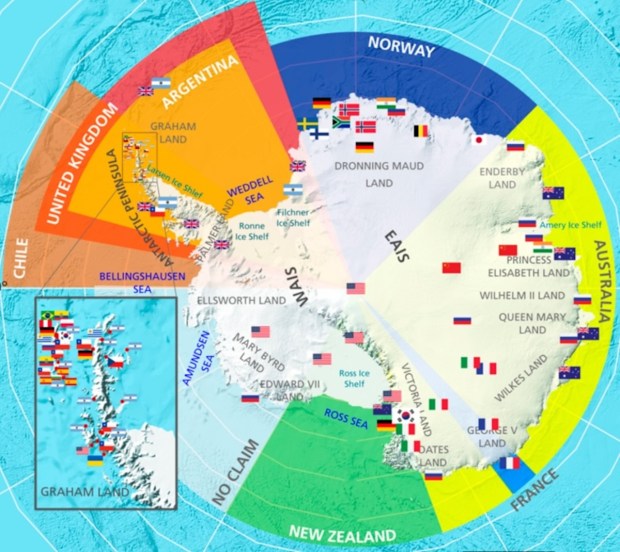
There are now seven countries that want a piece of the pie for themselves: Argentina, Australia, Chile, France, New Zealand, Norway, and the United Kingdom. America has its own research base, but don’t claim land beyond McMurdo Station. It should be noted that while the treaty is recognized internationally, these direct land claims are recognized mainly (and in some cases … only) by the nation concerned and remain contested.
One look at the map above, you may notice a few countries laying claim over the same spot, literally overlapping each other.
Guess where the oil is.
Argentina, the UK and Chile have all marked this spot as their own.
But before we narrow our focus on that, let’s look at the problems with building in Antarctica. This is a place that does not want us there. And yet, the architects and engineers who work down there to construct new buildings, are busier than ever.
Antarctic buildings themselves have to withstand extreme weather conditions. Temperatures can drop very suddenly. Snowfall can often exceed more than a single storey, while wind speeds reach 38 metres a second with gusts of up to 45 metres a second. It is no surprise then that retaining heat is the primary focus of every building.
Then there’s considering what surrounds Antarctica. The Southern Ocean is the most dangerous in the world. This is because it is the only ocean that completely goes around the globe, uninterrupted by land. This creates a swirling mass of water with winds that can reach up to 70 knots causing the largest waves in the world. Hitting an iceberg in that weather is catastrophic and, because of its climate, icebergs can form at any time of the year.
This is a challenge to overcome when considering off shore oil exploration and operations.
In some areas, water currents flow as fast as 150 million cubic metres per second, making it the most voluminous and dangerous current in the world, and that’s in summer. Once supply ships dock, workers only have six months to unload supplies and assemble buildings before winter sets in, as the ship needs to leave as sea ice begins to form and no new ships can come to Antarctica. As well, all flights stop by mid March. After this point of the season, it’s almost impossible for anyone to get onto, or off of the continent.
There has always been comradery between the various bases; all inhabitants on Antarctica have historically seen each other as ‘brother and sister in arms’, and look out for each other, sharing activities and events. Humans find a way in treacherous environments like this to team up and support each other.
Then oil was discovered.
Tension began in the area when news of the Russian discovery of oil hit, Chile alerted its defence forces and held a security meeting at its base in Antarctica. Chile, along with Argentina, have also steadily been building up their bases on the continent.
As a means to shore up their claims to the continent, 11 babies have been born on Antarctica between both these countries, the first back in 1978. There is now a school on site. Chile and Argentina see the Antarctica literally as their back nine, and are building their claim.
The coming decades may very well see even more construction projects take place as the seven countries that want Antarctica race to secure their claim. Whoever wins, this continent is certain to change forever.
Russia, along with China, has been gradually escalating its presence in the region in recent years through various scientific campaigns, but concerns are now being raised that Russia is attempting to assert its influence in the area through prospecting parts of Antarctica for oil and gas and surveying the continent for military purposes, in violation of the Antarctic Treaty.
China has also been expanding its interest in Antarctica. In 1985 China attained ‘consultative status’ within the treaty framework, aligning them at the same structural level as previous initial signatories to the agreement. China since 2009 opened three Antarctic stations, the largest being Qinling, possessing a satellite ground station that will gather signals, telemetry and intelligence on space activities. Although other nations operate greater numbers of stations, China has the fastest growing footprint in Antarctica.
In addition to China’s strategic interest in polar resources, this physical presence and ability to influence Antarctic policy projects global power. In 2013, the CCP stated that “China’s goal of becoming a polar great power is a key component of Beijing’s maritime strategy.” And this includes Antarctica.
Beijing said that these “global commons” are strategically important areas from which it will claim the resources it needs. Without secure access to energy imports, China’s economic projections are otherwise dire. They need resources like found under Antarctic ice, and have positioned themselves to be in position to claim them once the treaty ends.
Although China’s behaviour in the region has been less overtly inflammatory than Russia’s, President Xi’s rhetoric shows that the CCP has long seen the Antarctic as strategically important.
In 2013, Xi stressed the significance of polar exploration as a way to “take advantage of ocean and polar resources.” The Chinese state has also expressed its desire to amend the Antarctic Treaty’s 1991 Protocol on Environmental Protection, which is the document that specifically prohibits mining.
China … as usual … is taking the long view: working gradually and methodically over time to reach its objectives. For that reason, it could be a greater threat to the Antarctic Treaty than Russia.
Russia may be mobilising its activity not only as part of future-proofing its own self-image as a resources superpower, but as a geopolitical device to unsettle its opponents, and to create discord among other nations while doing so.
The problem with using Antarctica as a field in which to perform geopolitical manoeuvrings is that it creates competition between ALL the states involved, thereby increasing the likelihood of an eventual confrontation. Russia’s prospecting – though innocuous – risks initiating a resource scramble, into which any number of nations could be drawn.
Some academic experts believe that the Russian research in the region is a prelude to Russian hydrocarbon development. There is no current evidence of a breach of the Protocol but, on the other hand, Moscow lacks the resources to develop an oil field in the Antarctic on its own, and thus wreck the Antarctic treaty regime.
Unfortunately, Russia has allies who appear ready to cooperate with development. Brazil, India, China, and South Africa are all cooperating with Moscow in one way or another in Antarctica and some suggest that this gives the Kremlin the assistance it needs to expand its presence there.
In a time where Russia is considered a pariah due to its invasion of Ukraine, it may be far less isolated on this issue than on others. As a result, Putin undoubtedly feels confident that he can push forward on the Antarctic, especially as coming into possession of the enormous oil reserves there would change the balance of power significantly in his favor.
Russia and China have already begun blocking attempts by other Antarctic treaty nations to expand marine protected areas in Antarctica in 2022 … so the games have begun.
What’s next? We will have to wait for 2048 to see if the treaty specifically designed to protect the Antarctic is seen only as an impediment, and find out if oil extraction wins the day.
Forecasting ahead from 2024 … it isn’t looking too good.
David Johnson is a Kamloops resident, community volunteer and self described maven of all things Canadian.

 ArmchairMayor.ca
Is there other reliable evidence/information available to corroborate this claim of major discoveries of oil (and perhaps other commodities) under the thick layers of antartica’s ice?
LikeLike
The results and evidentiary documentation was presented to the UK House of Commons Environmental Audit Committee in early May, the appropriate place to announce such a discovery as they wont announce it without study of the findings. There is no question as to the validity of the evidence found, and no question is being raised regarding that.
The discovery is in the Weddell Sea itself, well offshore, and not on land or under permanent ice. Its water year round.
LikeLike
Thanks for the reply David. I did scour the pages of the Financial Times (for which I am a subscriber) but couldn’t find any particulars on this.
LikeLike