
CHARBONNEAU – The Indigenization industry
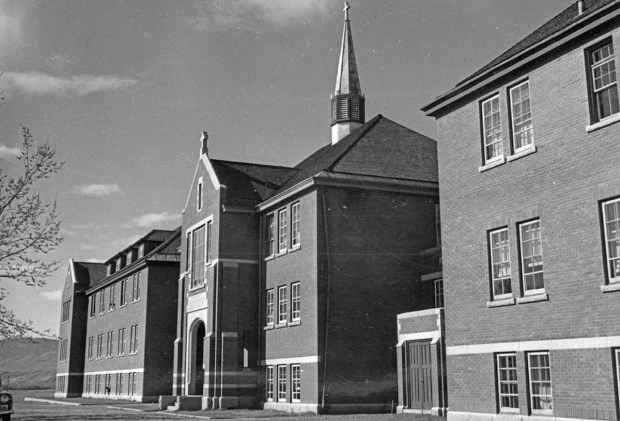
Kamloops Indian Residential School in 1970. (Image: Archives Canada)
IN AN ATTEMPT to be politically correct, corporate Canada is hiring Indigenous people.
Once hired, they become showpieces of their reconciliation efforts.
 Investigative journalist, Michelle Cyca, says: “The result of this widespread effort to rebrand corporate self-interest as progressive benevolence has been yet another failure for Indigenous people.” (Walrus, April, 2024.)
Corporations reflect our collective guilt for all the wrongs done to Indigenous Canadians: the taking of their land, the harm done by the residential schools, the mass removal of children from their families into the child welfare system (sixties scoop), the criminalization of Indigenous language and culture.
Reconciliation in the Canadian context requires some explanation.
The Truth Reconciliation Commission described reconciliation as a process establishing and maintaining respectful relationships between Indigenous and non-Indigenous peoples.
First Peoples Law, a legal advocacy group, is frank: “Reconciliation is Canada’s attempt to legitimize its ongoing colonization project.”
They add that the “legal process of reconciliation includes the need for governments to justify the infringement of Aboriginal and treaty rights. It also includes the requirement to consult, and if necessary, accommodate Indigenous people when government conduct and decisions affect Aboriginal and treaty rights.”
Once Indigenous Canadians are hired they are expected to fit into the corporate culture of the organization and not rock the boat.
The tokenism is not lost on Indigenous scholar Jennifer Adese, author of Aboriginal™: The Cultural and Economic Politics of Recognition. She argues that Canada’s “only apparent solution for the poverty it has engineered is to try to force Indigenous peoples to embrace neoliberalism and neoliberalism’s goal of economic growth.”
The Indigenization process is tricky because corporations must be seen to be impartial: a middle man is required to legitimize the hiring process.
Lucky for them, such a middle man exists. It’s called Our Children’s Medicine.
Our Children’s Medicine (OCM) is a registered charity that employs some Indigenous staff and is governed, in part, by a Toronto-based investment firm called Birch Hill Equity Partners Management.
According to their website, OCM are “Canada’s leading experts at Indigenizing employment processes, sourcing, hiring, onboarding and retaining AMAZING Indigenous talent.”
OCM has defended its work. They say that the interview questions for Indigenous candidates have been developed with “Indigenous Elders, Knowledge Keepers and other members of the community,” without specifying who they are.
Some of the successful applicants placed by OCM have questionable Indigenous status.
In OCM’s YouTube channel, Ernest Matton, also known as Little Brown Bear, is featured as a Métis Elder. After a CBC investigation that raised doubts about his membership with the Métis Nation of Ontario, Matton suddenly retired from Toronto’s Michael Garron Hospital.
And legitimate Indigenous employees are quitting in frustration over the tokenism of their hiring.
Last December, all 12 members of CN Rail’s Indigenous Advisory Council resigned, in a letter that called on the company to “move beyond performative gestures, and commit itself to transformative change led by Indigenous leadership across all lines of business.”
Beyond tokenism, there are some real steps towards reconciliation that can be done: in 2017, Vancouver International Airport signed a 30-year agreement with the Musqueam Indian Band, which includes revenue sharing, employment, educational opportunities, and protections for environmental and archaeological resources.
David Charbonneau is a retired TRU electronics instructor who hosts a blog at http://www.eyeviewkamloops.wordpress.com.

 ArmchairMayor.ca
I agree with David. What would be David’s recommendation for flux?
LikeLike