
CHARBONNEAU – The dirty secret of my Alaska cruise
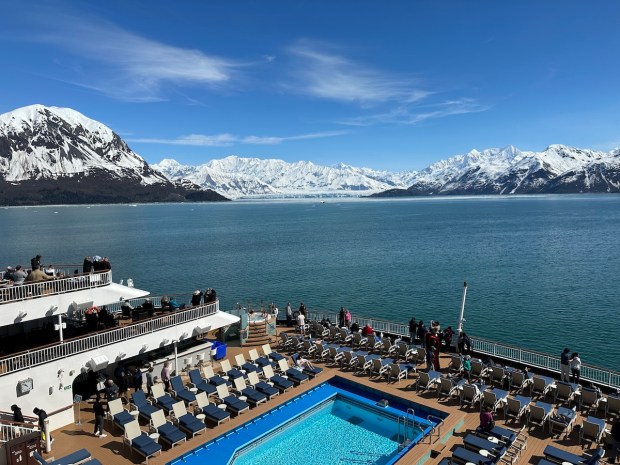
Edging up to the magnificent Hubbard Glacier. (Image: Mel Rothenburger)
I HAD SOME reservations before joining our Alaska cruise last year. Some of my concerns were ethical, some technical.
 How could I justify boarding a luxury ship when so many live in poverty and don’t even have a roof over their heads? It seemed like an exercise in excess, one that I would condemn in the ultra-wealthy who regard the planet as their personal playground.
I justified my ethical concerns by saying that it was an expedition to a unique glacier in Alaska. The Hubbard Glacier is North America’s largest tidewater glacier. It’s 122 km long, stretching all the way into the Yukon.
Our trip to the Hubbard Glacier didn’t disappoint. As our ship approached it through the mist of Disappointment Bay, it appeared as wall of ice, 11 km wide and 100 metres high.
The technical concerns had to do with the disposal of wastewater: greywater (showers, sinks, laundry, and galleys) and sewage (I don’t think this requires further explanation).
Anyone who has gone camping is aware of the problem of what to do with wastewater. You can’t just dump it anywhere.
Well it turns out that at sea, ships can just dump greywater anywhere despite the fact that greywater can still contain pollutants like cleaning chemicals, oils, and food scraps.
Sewage is another matter.
Ships must treat sewage using on-board treatment plants before being discharged, at least 3 nautical miles from shore. These treatment plants must meet specific standards for bacteria and other contaminants.
Alaska is even more stringent. That state requires advanced treatment for sewage from large cruise ships.
Knowing what was done with wastewater was not exactly comforting but at least it was known.
What I didn’t know was a dirty little secret that I just recently learned of: water from fuel scrubbers is mixed in with greywater and dumped in the ocean.
I wasn’t even aware of this third source of wastewater.
Fuel scrubbers use sea water to wash acids, heavy metals and carcinogens from engine exhaust.
An investigation from the Commission for Environmental Co-operation has found evidence of millions of tonnes of contaminated water being dumped along the coast of B.C. from fuel scrubbers.
The commission was created by the U.S.-Canada-Mexico trade agreement.
Canada has regulations for cruise ships that focus on wastewater discharge but no prohibition of fuel scrubbers and the toxic water they produce.
Fuel scrubbers are a relatively recent development. They came into use after the International Maritime Organization (IMO) banned high-sulphur ship fuels in 2020 because of air pollution.
But the ban didn’t mean that ships stopped burning cheaper high-sulphur fuels. Instead, they installed fuel scrubbers which moved the pollutants from the air to the sea.
Data from Environment Canada show that between 2019 and 2022, the number of ships using fuel scrubbers in Canadian waters has increased fourfold.
Environment Canada calculates that in 2022, 88 million tonnes of wash water went overboard along the British Columbia coast. That contained 26 tonnes of heavy metals and 226 kilograms of carcinogenic hydrocarbons.
Now that the dirty secret is out, Canada must do more. Scrubber discharge acidifies sea water, reduces its ability to absorb carbon dioxide and accumulates in the flesh of aquatic animals.
David Charbonneau is a retired TRU electronics instructor who hosts a blog at http://www.eyeviewkamloops.wordpress.com.

 ArmchairMayor.ca
THKS for giving me one more reason to feel guilty about . Our Alaska trip mirrored yours, including the same concerns. For me, it was the wasted food.
We could be reaching a tip point. One Alaskan community is voting to decide whether or not to ban cruise ships of more than 250 passengers on Saturdays. Worldwide, major destinations are applying restrictions of various types.
LikeLike
The other “dirty secret” is water runoff from the roadways go mostly untreated into the waterways. And BTW while I do very occasionally catch a flight they would not pay me enough to ever take a cruise. For ethical reasons.
LikeLike