
JOHNSON – Weekend essay: Why book bans are never a good idea
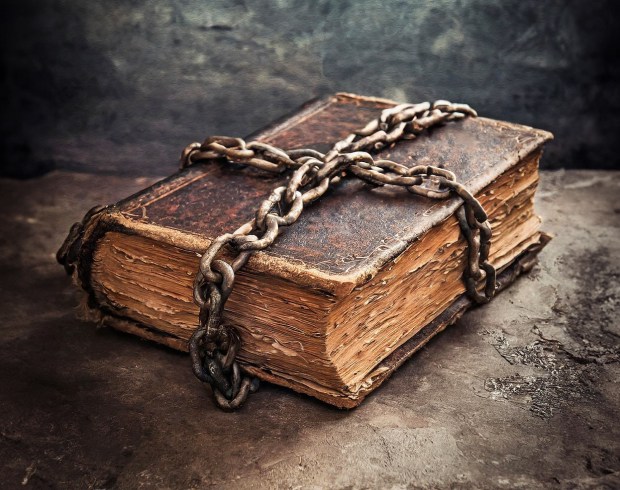
(Image: Square Front, Pixabay.com)
MEL ROTHENBURGER’s editorial a while back, Wokeism reigns with banning of classics from School libraries, opens up a much larger discussion regarding book censorship in schools, as well as community libraries both here, south of the border and elsewhere.
 It’s not as simple as a kneejerk reaction to ‘protect impressionable youth.’ It’s also not just about the ‘woke cancelling’ of literary classics from school shelves.
It’s yet another example of the continuous escalation of political polarization, and the doubling down on enforcing opposing wills upon all of us, and this norm devolving to affect our school and community library shelves:
– one side trying to protect youth from what they perceive as ‘grooming LGBTQIA2S+’,
– and the other side protecting youth from the mention of N words and past racial realities.
The interesting reality is how each side’s argument operates within its own vacuum, yet when either side decides on banning literature, it gets the other side all riled up;
– conservatives ban LGBTQIA2S+ books from libraries, believing that all these books do is groom kids to be gay or trans and blaming wokeism, leaving progressives to scream about how at the same time, we are all living in a society of legally guaranteed gender equality, with a very real need to support youths during difficult years of self determination,
– and progressive groups banning classic literature over real or perceived racial prejudicial harms, that we will discuss later, and conservatives immediately fight back with “but I read that book in school and turned out fine” … well ya, and the LGBTQIA2S+ readers turned out fine as well.
Either way, it’s censorship based on an aberrant preconception of an illusory threat. The threat is that the book is in opposition to their understanding of how the world works, as they exist in it. As watchers, what we see are these objectors running amok, using their warped perspectives as fuel for what they really want: societal control, and they’re doing it through censorship.
This is nothing new.
The word ‘woke’ as used today … may be new to language, but the idea behind wokeism has been around a very long time and actually dates back thousands of years when societies were wanting to paint outsiders’ beliefs or alternate ideals as blasphemous, barbaric or in opposition to historically held belief systems.
The classical example has always been Galileo. His apparent “wokeism” regarding heliocentrism (the sun being the center of the solar system, opposing egocentrism’s long held belief that places the earth at the center), and getting himself “cancelled” by the Catholic Church, forced to stand trial and imprisoned by the Spanish Inquisition.
Today’s problem is far more nuanced and socio-culturally based, and not a black and white argument about the facts of a yet unproven scientific discovery versus religious doctrinal control via silencing of all those not in compliance with the group speak.
Today, our argument revolves around books, movies and politics and the occasional flat earth/ fake moon landing conspiracy belief models. We inevitably end up in conversations based on assumptions, misunderstandings and reinterpretations, that trough feed the pitchforking masses towards retaliation against what logic and truth provide.
… as MAGA lives and breathes. Moving on.
A recent example of using this kind of model would be the long-disproved argument that video games ‘make young people violent.’ All reputable scientific research since the days of Hillary Clinton and Jack Thompson attempting to ban these games have proven conclusively that video games do no such thing.
If a person has a proclivity towards violence, they will be violent.
Everyone else just knows … that it’s just a game.
This isn’t a belief, it’s a tested and peer reviewed fact.
Fascinatingly, Trump and the Republicans a few years ago resurrected the idea of blaming violent video games as the root cause behind school shootings, ignoring completely all documented empirical knowledge. Apparently, it’s now considered woke to even see those in power sidestep the gun control conversation by deferring completely to auto-compliance with every utterance of their MAGA master.
When Trump says, “I think …” in unscripted public comments, his meanderings become the actual, functional truth of a follower; we are watching active mirroring of the church’s response to Galileo. Is it a coincidence that the Spanish Inquisitors also wore red headgear?
Let’s move on to a couple of well-known book bans and their attraction to dissenters.
– conservatives are driven to protect impressionable youth from ideologies like Gender Queer by Maia Kobabe, All Boys Aren’t Blue by George Johnson, or The Bluest Eye by Toni Morrison. These are seen as examples about LGBTQIA2S+ normalization, which is reinterpreted by protestors as indoctrination and breeds the chant: ‘wokeness makes kids gay.’
– or as mentioned before from the progressive front, banning To Kill a Mockingbird by Harper Lee or Huckleberry Finn by Mark Twain, or a long list of other works written in long past generations, because of the utterance of N words, and the fear of perpetuation of racial beliefs and stereotypes in young people’s belief systems.
The idea is: If they can read the N word, they will think they are allowed to use it and believe it. An added argument here revolves around bans of literature that encapsulates individuals’ or populations’ actual histories, as a means for the banning crowd to ‘stand aligned’ with the racial victims of history. The obvious case being African American subjugation and slavery.
If we ban it, that is our way of standing with history’s victims.
Funny, you don’t see Germans or Jews tearing down the remnants of Auschwitz’s buildings, or burying the ovens on display in Dachau, or banning literature based on this history. This is where the argument falls apart.
Of course we don’t allow the Nazi flag to be waved, but we do want the next generation to visit these locations and know about this history. ‘Never again’ means learning about it in context. These books should also be read within their own context, whether it is historical or cultural.
What both sides are doing is trying to ‘protect kids’ from what the protestors themselves fear the most, which is the loss of control of the world around them. They like to focus on kids because they think youth aren’t supposed to know any better and therefore need to be molded like a clay butter dish. Still sounds like the Spanish Inquisition with less blood spilled … even though i’ts just a book.
The real point here to ponder: It is incumbent on us to recognize the line between banning a book, and the impact that this act has on societies and cultures as a whole. It can and does go much further, much deeper, than just emptying a shelf. It blinds today’s youth, and the future’s youth as well as other grown-up library purveyors, from the truth about the past … and more importantly, about their own society, in their own time.
While thinking about that, what the rest of us need to do when we see one of these situations come up, is to just be aware of what side the ban is coming from, and then balance the concern as presented … with the reality regarding what we already know as fact. The facts of history, and the facts of today’s cultural realities.
For example, books don’t make a person gay or trans; this isn’t an argument. One day we as a culture en-masse will realize that LGBTQIA2S+ content does not groom our children to be gay, but actually teaches acceptance of gender-based individualism, through the acquisition of knowledge through a youth’s own personal experience, gained while reading books like this.
Most of today’s society has already figured this out, but a small yet vocal minority still exists and are willing to picket a library and write letters to school boards. History tells us that beliefs can and do in fact change, so how long can we expect it to take for alt gender acceptance?
After the civil rights movement in the southern U.S., the opposition to black integration – racist generation slowly just died away, to the point where almost no one believes that anymore. No one notices a coloured person in any location or involved in any activity where they would have previously experienced prejudices. Although there is still work to be done regarding equality for this population, the work of Martin Luther King Jr. is for the most part complete.
The same will eventually occur regarding gender relations.
One day society will vilify the memory of those picketing drag queen story time, just as now we do large groups of white supremacists who walked in the community parades of the past.
That said, the racial divide is still very much evident in today’s America, therefore showing that these intolerances are still taught in the home, so we can expect the same for gender equality. Multiple generations of time will change this.
Switching to the other side, books alone don’t make a person a racist. Teaching racial history by being clear in the way language was used in the past, does not make the child into a racist … but in fact teaches why racism is bad.
Kneecapping a young person’s access to actually experiencing racism from a previous generation’s book, legislates that it is not a lesson that matters, that they in fact don’t need to learn this for themselves. Instead, through book prohibition, we are just beating it into them that it’s ‘just wrong,’ without providing the environment and opportunity for them to learn it for themselves as a personal value or ethic.
The reality is that if we saw a youth reading from either pile (racially charged or LGBTQIA2S+) and asked them if a book alone would program them to be racist or gay, we would find out that they are in fact smarter than that, and are unlikely to fall into traps as simple as adopting everything they read as literal. In fact, today’s kids are smarter and more aware than us older generations were, at the same age.
Book banners need to give kids more credit than they do, but that would require youth to actually be asked about how they ingest and experience literature of this kind. They would likely volunteer that they do not need to be censored at all.
For the rest of us with today’s youth under our tutelage, the key to deal with this stuff is to take responsibility when presenting this material and engage in the conversations appropriately, in school and at the dinner table, in an age-appropriate manner.
If a book is purporting racism and slavery as a core societal normalcy like in Gone With The Wind, it should be presented to readers as a moment in history in which an idea or belief system like this actually existed. The conversation should be “even though we know this is wrong … let’s talk about why it is wrong.”
Book banning advocates operate under a perception that a teacher … or a parent, can’t be trusted to navigate this fragile subject on their own, so control of problematic materials must be taken away.
Those of us long out of school may have read books like To Kill a Mockingbird, or watched movies like In The Heat Of The Night, or watched Sydney Pottier, Katherine Hepburn and Spencer Tracey in Guess Who’s Coming to Dinner, which taught us how and why to question our relationship with race.
We also grew up with the dichotomy of Mark Twain vs. Alex Haley.
We today have learned by generationally slow lessons why racism is wrong … and we learned this BECAUSE OF cultural media like these books, as well as teachings from our families and personal networks that helped form the backbone of our identity.
More modern media versions of this same lesson came to us via All In The Family and other Norman Lear creations that pushed us to assess where we stood on race issues by putting Archie Bunker in front of us and letting us think about what he stood for, for a few decades.
If we didn’t live it ourselves in our own personal corner of society, we could still learn about it by absorbing media on it, including books.
Banning books stops societal lessons from being passed on generation to generation by way of personal experience with the social material of history, in the context of the past. When books are banned, the lessons that they taught become lost to time, just to be repeated at some point by a future generation, that knows nothing of past sociological lessons.
Even further, works of fiction become the impetus for societal change itself as they actually create the uncomfortable moment that requires self reflection. Harriett Beecher Stowe in 1852 published Uncle Tom’s Cabin, a harsh depiction of life for African American slaves which played a role at that time in helping turn public opinion in favour of abolition.
Obviously, books are not the only examples of lessons learned by historical realities: the Holocaust, the Civil Rights Movement, British Colonialism, American Manifest Destiny, Apartheid, Canadian Residential Schools … and a near endless list of actual historical moments long past and more recent exist in the public consciousness. This knowledge helps future generations retain functional knowledge regarding past injustices.
The point today is our fictional landscape also plays an important role as these books absolutely mirror the social realities of the times, in which they portrait.
Looking at the history of school or library book bannings, we realize that this is not just a 21stcentury phenomenon. In the last century, so many other literary giants have at some point suffered the arrows of those driven to force their will:
– Lord of the Flies by William Golding, because of profanity, passages about sex, and statements defamatory to minorities, god, women and the disabled, or
– The Colour Purple by Alice Walker for troubling ideas about race relations, man’s relationship to god, African history and human sexuality, or
– The Catcher in the Rye by J.D. Salinger, banned originally because it was anti-white therefore “obscene” (actually a comment back then) … or
The Great Gatsby by F. Scott Fitzgerald. Or as mentioned before, To Kill a Mockingbird or Of Mice and Men by John Steinbeck were all banned at some point for profanity and using god’s name in vain. Even The Grapes of Wrath by Steinbeck was once banned and the book burned, as being slanderous towards Californians.
George Orwell’s Animal Farm was banned throughout the communist world. In Russia until Glasnost Reforms, it was seen as ‘dangerously counter-revolutionary.’ Today, you can once again get it in China in a ‘heavily edited form.’ Imagine a book so deeply terrifying to an entire political system that it had to be squashed or literally rewritten. Rumour has it that Animal Farm is banned in North Korea today.
Communist countries aren’t the only ones to have banned Animal Farm. It was also banned in the United Arab Emirates in 2002 not for its political commentary, but because it contained talking pigs, which apparently conflicted with Islamic values regarding the portrayal of animals in literature. Betcha Orwell didn’t see that one coming.
Making the example even more complex, Animal Farm was promoted by the CIA, who even funded the 1954 animated film adaptation of the book as part of its cultural offensive against the Soviet Union. On the other hand, Animal Farm has also been removed from schools in various parts of the United States, like Florida in 1987 when it was pulled from shelves by the Bay County School Board, motivated by a profound misunderstanding of its message that the book was actually promoting Soviet communism, somehow. Even the Soviets themselves had a better read on the subject matter than parts of America!
Adding to Orwell’s controversial books, 1984 was banned because the novel is ‘pro-communist and contains explicit sexual matter,’ as stated in 1977 at a school in Hawk Point, Missouri as it was deemed objectionable by a parent. Once again how someone managed to read that book, and come away thinking it has a pro-communist message … I have absolutely no idea.
In more recent years 1984 the novel that so many around the world had sought to see expunged from the pages of history has experienced a resurgence in popularity and relevance and is now often cited in discussions on privacy surveillance and government control in the digital age.
Even One Flew Over the Cuckoos Nest was originally banned in 1971 for reasons you could imagine, and Lolita by Vladimir Nabokov … I’ll let you Google that one.
Finally, as mentioned earlier, Gone with the Wind by Maragaret Mitchell, although written back in 1936, was banned in 2020 for reasons of racial discrimination. Interestingly, it did not suffer a challenge to its content even once in the intervening 84 years.
Some books on the above list were protested against when they were first published; others have suffered the fluctuations of the go away, come again of popular sensitivities, and yet others like Gone With The Wind, survived unnoticed for decades, but have become recent targets due to protests following the most modern ‘wokeism’ sensibilities.
The point to listing all these is to flag just how wide spread and historic the controversy regarding the written word is, and how it involves such a broad spectrum of works and stories. Many previously banned books are now taught in schools and universities as required reading. Others that were taught historically for generations have only recently been removed from required reading lists.
Controversy in one generation becomes important art in another and vice versa.
What they all have in common, besides being on the top of the lists of the greatest literary works of all time, is that they are all about a journey through the experience of their author’s hand … whether the author actually experienced the subject matter personally or not.
By banning books, we are preventing people from accessing the authors’ take on the subject.
Will most of us feel moments of discomfort reading historic books like this for the first time with our modern 21st century hypersensitivities? You’re darn right. Just wait till you hit the first fully written out N word in an old book … you will stop for a moment and stare at it.
It’s the same feeling experienced today when some people read modern gender diverse books and feel uncomfortable. In both cases, It is not the experience of the reader.
Delving into a subject we are not comfortable with or have opposing belief systems, although hard, still informs our experiences and our interactions with the world. This is the opportunity we offer youth when they read material like this.
When defending books from being banned we should bring up a few titles that kick the door open a bit too hard for mainstream defence; Mein Kampf by Adolf Hitler springs to mind, or The Anarchist Cookbook by William Powell, a book that if found in your hands in certain democratic countries may earn you a prison sentence under anti-terrorism laws.
A more complex example has to be the Satanic Verses by Salman Rushdie, which although findable in a local book store, definitely defendable as a brilliant journey through identity, alienation, rootlessness, brutality, compromise, and conformity … it also famously angered an entire religion.
Perspective … is the key to books of this type, but they are the most extreme example of problematic literature. Generally, the scrutinized books we have already listed are more mundane, and the controversy they elicit is less dire but still problematic to the society they are being debated in, and these are the book bans we should argue against.
Generally, a society that routinely prohibits controversial work is one that will eventually lead itself towards a narrow-minded and intolerant worldview. That’s not “woke”; it’s just history, we’ve done it before. Wave a flag, burn a pile of books, control the media … wear the same clothes … march in lockstep … you know the story.
Fahrenheit 451 by Ray Bradbury, both banned in its day by the Apartheid Government of South Africa as well as some American schools, but also a story literally about the burning of books as a means of societal control through censorship.
Banning books can have other significant consequences. When we prevent people from reading certain books, we are essentially limiting their freedom of thought. Not the writer’s, but the reader’s. Readers must be allowed to be affected by the world the writer has created, without being told this journey is not permitted.
This “cancel” type social behaviour about a book can have a chilling effect on society as a whole, as people may be afraid to express their opinions or ideas for fear of being censored.
Far more telling is when proponents advocate to ban books, yet admit they have not actually read the book, beyond scanning a review or the back of the jacket.
Finally, banning books is usually counterproductive. When we ban books, we often draw more attention to them and create a sense of intrigue and curiosity, which can lead people to seek out the very books that have been banned. Wanna take an unknown release and turn it into a best seller? Ban it.
So, at the end of the day … it doesn’t even work.
In 1939, Librarian Gretchen Knief Schenk was working quietly to get the ban against The Grapes of Wrath overturned. At the risk of losing her job, she stood up against the county supervisors banning the book: “It’s such a vicious and dangerous thing to begin, and is so utterly hopeless and futile. Ideas don’t die because a book is forbidden reading. If Steinbeck has written the truth, that truth will survive.”
That the takeaway.
Ideas persist and often become important historical turning points.
Moments that for all time we can learn from,
as this is how we learn about ourselves.
Standing in the way of that for ill informed reasons serves no one.
David Johnson is a Kamloops resident, community volunteer and self described maven of all things Canadian.

 ArmchairMayor.ca
Thank you for this article, David, the first three books that you mention Gender Queer, All Boys Aren’t Blue, or The Bluest Eye I have not read, the rest were part of my high school curriculum. What Mel and I read in school was never from the point of view of the victim.
For decades, our schoolchildren have been taught a lot of lies: they have been told, year after year, about the heroic tale of Christopher Columbus., a courageous Italian who “discovered” America for the Spanish. The United States even named a national holiday after the explorer. Howard Zinn in his “Peoples History of the United States” writes that by 1515, a population of 250,000 Arawaks, a gentle native people who greeted him with kindness had been decimated, leaving only 50,000 survivors. By 1550, that number was just 500 and, by 1650, the Arawaks were no more. Not sure if any books about him were banned.
Columbus’s men killed Arawaks children to feed their dogs, raped their women and enslaved their men and the legacy of the man Columbus is celebrated ignoring what followed, with some 60 million dead indigenous people in the Americas. You want to take an unknown book and turn it into a bestseller? Ban it or as Hugo Chavez did by presenting Obama the book “Open Veins of Latin America: Five Centuries of the Pillage of a Continent,” by famed Uruguayan journalist Eduardo Galeano, which chronicles South American legacy under European and North American colonialism.
Both Zinn and Galeano write their narrative from the bottom up, throwing out the official narrative. To sell their books many historians and journalists just emphasize the “progressive and admirable” without reference to the whole, the facts of our city’s development for example without looking at their significance, the railways, highways and the mines without looking at the consequences. We also need to look at the negative, not so progressive and admirable events, and place them into the celebration of the whole. I question journalists and writers in what they select as well as how and what needs to be celebrated, and emphasized.
The 50% biological or nature component in human development includes heredity, hormones, chemicals, and neurophysiological mechanisms. We have some control over this through science but that is it. The nurture component consists of environmental factors, operative from birth, that create learned and automated behavior that comes from our reading, parents, teachers’ peers and so on which impacts the nature component. It’s our upbringing that the free will component is our power to make choices to be violent or not.
Let’s look at the extreme and the subtle way we nurture children to grow up. The Nazis aimed at raising children to serve the Führer and many households after the war had a copy of physician Dr. Johanna Haarer book “The German Mother and Her First Child” sold some 1.2 million copies, almost half of them after the end of the war. Dr. Johanna Haarer’s book served Nazis well who wanted children who were tough, unemotional and unempathetic and who had weak attachments to others, and they understood that withholding affection would support that goal. This book continued to be published for decades after WWII.
Later titles included Mother, Tell Me about Adolf Hitler! a fairy-tale-style book that propagated anti-Semitism and anti-Communism in language a child could understand. This was another child-rearing manual. The recommendations from her book, originally published in 1934, were incorporated into a Reich mothers training program designed to inculcate in all German women the proper rules of infant care and motherhood. The three K’s Kinder, Küche, Kirche (Children Kitchen and Church) mantra did not end with WWII.
As of April 1943, at least three million German women had gone through this program. In addition, the book was accorded nearly biblical status in nursery schools and child-care centers. You tell me how likely it is that the children and grandchildren escaped this indoctrination. The inference about the Nazis in Ukraine and EU leadership is not so far fetched as we know that when children grow up and begin to have children themselves, they pass their attachment behavior down to the next generation. In the Baltics, in Ukraine, in other Eastern European countries and the Balkans they are building statues to the Nazi past.
In our own society we were more subtle. One or two companies control the Media outlets and they choose what will be printed. Mel may tell us he was never told what to include in “Kamloops Daily News” but I think he included what they wanted so there was no need to tell him what to include.
Marx’s writings were ignored and not studied due to fear of unionism. Marx is compared to Stalin rather than democratic Socialism. Books such as “Animal Farm”, “One Day in the Life of Ivan Denisovich”, George Orwell’s 1984 were required reading in schools whose intent was to indoctrinate. Hollywood movies and TV was inundated with anti-Soviet propaganda such as “I Spied for the FBI”, “Rocky IV’, “Dr. Strangelove and hundreds of others such as “The Red Tide”, Red Menace”, Red Menace is Real, Red Iceberg and so on. Orwel’s 1984 was as much a critique of capitalism as it was of Communism. Many suggest that Animal Farm was a critique of the upper classes in the UK. Indiana Governor Mitch Daniels banned anything written by Howard Zinn. Other books were banned like Turse’s book about Vietnam “Kill Everything That Moves. “
Yes David “Ideas persist and often become important historical turning points.” However, many in the Woke community don’t want to wait and given the “urgent need” for gender identity services, NHS pledged to establish guidance and set up a new care system for transgender children. Many who are active in promoting Woke need to be included as more and more members are taking a political road to have their voices and agenda heard so the other 90 % are pushing back which results in banning books, burning them i.e. the Koran. Once you start banning books and burning them the next is burning people as was done in the 1940’s.
LikeLike