
IN THE LEDGE – ‘Govt is breathtakingly disconnected from reality’
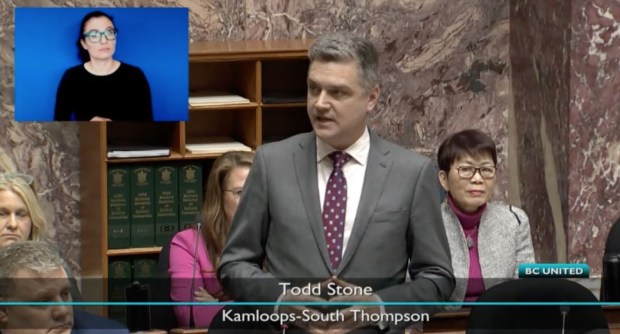
(Image: BC Hansard)
Debate in the B.C. Legislature on Monday, May 6, 2024.
S. Bond: While the Premier’s disastrous decriminalization of crack cocaine, meth and fentanyl continues to cause chaos and harm across our communities, including in in our hospitals, an alarming 81 percent of nurses surveyed report abuse on the job. Over half face physical violence, and 61 percent of them report that they are exposed to illicit drugs in hospitals every single month. Nurses are paying the price for the Premier’s failed policies that endanger them every single day. It is not okay. Why does the Premier refuse to adopt B.C. United’s policy to completely scrap his decriminalization disaster?
Hon. A. Dix: What all members of this House share is a commitment to and support for nurses. That’s why…. And we heard nurses last week. I know the member met with them. I know she knows that I met with them, talking about the importance of nurse ratios — that nurse ratios save lives. British Columbia is leading the world in the development of nurse ratios, and we’re doing it working with nurses.
Nurses proposed a couple of years ago to change the way we did security in hospitals, and we put in place a relational security model that was inspired by the B.C. Nurses Union, the hospital, the police union and others. We continue to work with nurses. The steps that we are taking right now in concert with nurses, who have said they want action…. And we are acting together.
They didn’t want more politicization. They said that very clearly. We are acting together to make nurses safer in hospitals across British Columbia. We will continue to do so.
The Speaker: Member for Prince George–Valemount, supplemental.
S. Bond: Well, I’m not sure what it takes to get the minister to understand that it is not working. The survey was taken just weeks ago. 39 percent of nurses are exposed to weapons. 61 percent are exposed to illicit substances. 50 percent experience physical violence every single month. The NDP’s failed decriminalization policy in our hospitals has been nothing short of an unmitigated disaster. The chaos will continue until this NDP policy is dismantled entirely.
As B.C. Nurses Union president Adriane Gear says that policies “can look good on paper, but they don’t enforce them, and at 3 o’clock in the morning on a Saturday night when you’re working a 50 percent staff, that’s when this stuff blows up.” Every day in this province, nurses face untenable working conditions, because this government has refused to protect them. That is not okay. Why does the Premier stubbornly refuse to put nurses and patients first and adopt B.C. United’s policy to end the NDP’s dangerous decriminalization experiment?
Hon. A. Dix: Precisely what we’re doing is working with nurses every day to make this the best place in the world to be a nurse. That involves the hard work of making change to add nurses to our public health care system, because understaffing impacts it, as everybody knows. Last year, we added more than 6,000 nurses to the B.C. health care system. It means taking steps to make hospitals safer, as the Premier announced now two weeks ago, to ensure that we are keeping our nurses and patients safe — all of them — in our public hospitals across B.C. It means taking action to improve working conditions of nurses and working with nurses to do it.
What I would say to the hon. Member is that what we’ve done — and this is unprecedented — is work side by side with nurses to make things better for nurses in British Columbia, not to see them, as happened too often in the past, as adversaries across a bargaining table, but working together to resolve real issues and make this the best place in the world to be a nurse.
T. Stone: The minister just used the word “unprecedented.” You know what’s unprecedented? 37 percent of nurses are seriously considering leaving nursing or are already making a plan to do so. 37 percent. Why? As the member from Prince George–Valemount just listed off, nurses do not feel safe in their workplace. They don’t believe that this government is doing everything it can to improve working conditions. It’s actually this Premier who decriminalized the open, public use of illicit hard drugs like meth, heroin, fentanyl and crack. It’s the Premier who is the architect of this disaster.
Vancouver police chief Adam Palmer describes the reality under this soft-on-crime Premier: “It’s an intolerable situation. You’ve got open drug use on the sidewalks in different neighbourhoods in Yaletown, in Coal Harbour.” In fact, “it’s all over the city.”
So my question to the Premier is this. When will the Premier restore order and safety, and when will he adopt B.C. United’s policy to end his reckless and dangerous decriminalization experiment once and for all?
Hon. M. Farnworth: I appreciate the question from the member.
I’d like to point out that the changes that we have put in place to deal with open public drug use, as the member was just alluding to, are in fact because of our cooperation, working closely, with police. That’s exactly what we’ve been doing, whether it’s in our health care system, where we work with nurses to address their concerns, whether it’s working with local governments and communities to understand the nature of the problems that they’re seeing in their communities and working with police on the best way to deal with the situation. Because police understand that this is not a criminal issue; it is a health care issue.
Making sure that we’ve got the health care needs in place, making sure that police have the supports that they need — that’s why we asked for the changes to take place, with the exemption at the federal level, so that we do not have to see and the public does not have to see and tolerate open public drug use, which has never, ever been allowed or tolerated or was ever part of decriminalization.
We will continue to work with police…
Interjections.
The Speaker: Shhh.
Hon. M. Farnworth: …work with communities to keep our communities safe.
The Speaker: Member, supplemental.
T. Stone: It is breathtaking just how completely disconnected from reality this government actually is in terms of what’s actually happening on the ground and what we hear described in this chamber. The minister can talk about all the work that he’s doing. Aside from announcements, the results are actually terrible.
Under this government, violent crime is up 37 percent. Homicides are up 72 percent. There has been a 75 percent increase in no-charge assessments. And under this Premier, there’s a reduction in the prison population of 40 percent. These results are absolutely abysmal. Victoria police chief Del Manak warns that the Premier’s decriminalization won’t actually stop the surge in violence: “…random attacks or assaults or stabbings or any of the other violence that we see will continue.”
Eighteen months ago, it was this Premier who promised that people would feel safe in their communities, but the chaos and the violence continues to get worse and worse under his catch-and-release justice system.
So the question is this: what will it take for this soft-on-crime Premier to adopt B.C. United’s policy, to end his reckless decriminalization experiment and stop his failed catch-and-release justice system?
Hon. M. Farnworth: Again, I appreciate the question from the member, and I’d like to point out a couple of things to the member on what he’s talking about.
Yes, Chief Del Manak said it’s not a silver bullet for stopping violence. It is the right approach in terms of decriminalization. He agreed with the changes that the government has been making. As have police, saying this is the right approach to take because it is a health issue, not a criminal matter.
On the issues of violence, that’s why we put in place the ReVOII program, which…. When they sat on this side of the House, they had that program. They cancelled it. They cancelled it.
When it comes to decriminalization, again, we’ve had the words from Chief Manak saying that it is the right approach. I quoted members from the opposition. They don’t like to hear the quotes quoted back about how they support with all their heart.
Well, perhaps they’d like to listen to someone who ran for them and their comments on the changes that we made last Friday. Your former candidate from Richmond in the last election, Richmond city councillor Alexa Loo, agrees that what we’re doing is the right approach, saying the changes are a pretty good balance. “I think it’s a pretty good balance. We aren’t looking to fill prisons with people using drugs, but we are trying to have it not happen in the public eye.”
That’s what people were concerned about. They believe it’s a health issue. They know it’s a health issue, but they shouldn’t have to put out with open drugs use. That’s what the communities wanted. That’s what the police wanted the tools to deal with. That’s what we put in place. And we will continue to do that by working with communities, the police and health experts.
Source: BC Hansard.

 ArmchairMayor.ca
Leave a comment