
CHARBONNEAU – Robots could learn from the lowly flatworm
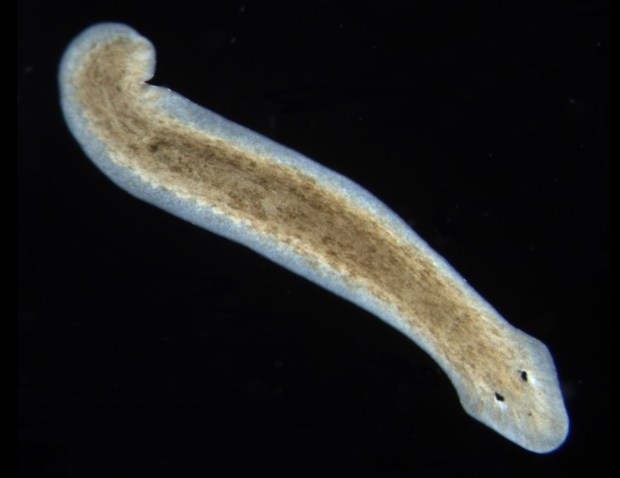
(Image: Wikipedia)
WE CREATE ROBOTS in our own image. Or, in the way we imagine ourselves.
We imagine ourselves as calculating machines with all the processing going on in our brains. Bodies are not where memories exist, they are just a means of locomotion.
 New research demonstrates otherwise. The results could have implications for robot design.
Artificial intelligence has been incorporated in robots with limited results. They are smart in an intellectual way but stupid in understanding simple physical concepts.
Sure, AI robots can churn out sonnets in the style of Shakespeare, but ask them how to walk or to predict how a ball will roll down a hill, and they are clueless.
Researchers have discovered that a lowly flatworm, the planarian, has qualities that could change the perception of ourselves and, as a consequence, robot design.
“The planarian is nobody’s idea of a genius,” says science reporter Rowan Jacobsen. “A flatworm shaped like a comma, it can be found wriggling through the muck of lakes and ponds worldwide. Its pin-size head has a microscopic structure that passes for a brain. Its two eyespots are set close together in a way that makes it look cartoonishly confused. It aspires to nothing more than life as a bottom-feeder (Scientific American, February, 2024).”
But what planarian has mastered is perfect regeneration. Cut it in half, and its head will grow a new tail. And the tail will grow a new head.
A new head. What goes on in the newly grown head? Does the body carry experiences of its former self?
Michael Levin, a biologist at Tufts University in Boston, wanted to know. So he trained flatworms to go for liver puree that he placed in dishes.
Some of the dishes had ridges on the bottom that the flatworms don’t like. Other dishes were smooth bottomed.
Eventually, the flatworms in the ridged dishes learned to overcome their dislike and went for the liver puree; as did the flatworms in the smooth bottomed dishes.
Then Levin cut all the flatworms in two, discarded the heads, and waited for the tails to grow new heads.
Next he placed all the regenerated worms in ridged dishes and dripped liver into the center. Worms that had lived in a smooth dish were reluctant to move. But worms that had lived in rough dishes went for the liver quickly.
Somehow, despite the total loss of their brains, those worms had retained the memory of the liver reward. But how? Where?
The experiment gives new respect for the body as a source of memories.
For their remarkable prowess in manipulating language or playing games with well-defined rules, AI robots struggle to understand the physical world.
Researchers in this new field, called basal cognition, look for the hallmarks of intelligence — learning, memory, problem-solving — outside brains as well as within them.
The consequence for robotics is that basal cognition offers an escape from the trap of assuming that robots must mimic the brain-centric human model.
Robots that are truly made in our image will incorporate basal cognition. They will develop body memories in the way that a child does – by probing and exploring the physical world.
David Charbonneau is a retired TRU electronics instructor who hosts a blog at http://www.eyeviewkamloops.wordpress.com.

 ArmchairMayor.ca
“Sure, AI robots can churn out sonnets in the style of Shakespeare, but ask them how to walk… and they are clueless”.
FYI (as the editorialist seems to be unaware), there’s a bi-legged robot that can perform complex bipedal movement that is beyond the performance of a human.
That robot’s name is Atlas, and is made by Boston Dynamics. Google for yourself. The capabilities of that machine are astounding.
I’m concerned that some editorialists are propagating misinformation, and I would implore them to research their claims first before making them.
LikeLike