
CHARBONNEAU – Dread of drought and the psychology of water shortage
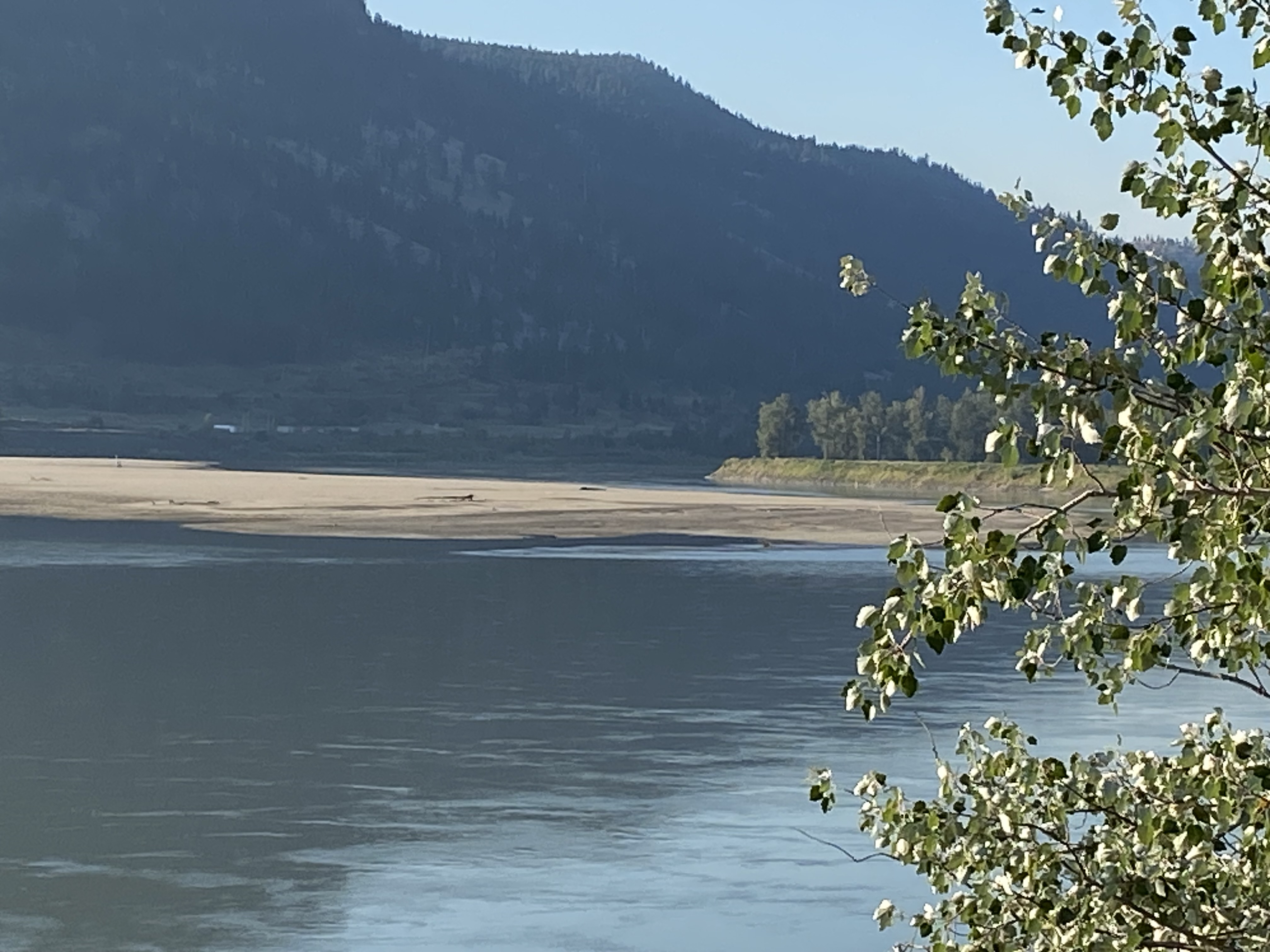
North Thompson River. (Image: Mel Rothenburger.
I WORRY about the drought.
I never used to think much about snowpacks. The reported snowpack levels were about as interesting as the price of pork bellies.
 Now I nervously read the news. A map of snowpack levels released by B.C.’s River Forecast Centre in January is coloured brown, brown, brown.
The province, overall, is only at 66 per cent of normal.
As of March 1, the North Thompson was at 76 per cent of normal and the South Thompson at 90 per cent.
Those levels might be better than average but Kamloopsians have no reason to breathe a collective sigh of relief.
Remember last year when snowpack levels were about the same? That didn’t prevent disastrously low river levels. Warm spring temperatures caused the precious snowpacks to melt all at once. The whole wad of water was shot in weeks, leaving us hot and dry for the summer.
That summer, drought levels for the North and South Thompson basins were at 4 and 5, respectively, for 105 days between June and November.
It was like an extravagant party in which I spend my money on lots of food and drink. Afterwards, my food and money are gone with little left but I had fun. My impulsivity lead me to focus on the present with little regard to the future.
I think of the snowpacks, high above the river valley, as reservoirs of water waiting to release their precious load; to fill the rivers with drinking water for us, for fish to swim in, for dams to fill for generating electricity, for crop irrigation.
The shortage of water leaves me anxious and the psychology of water scarcity is different than our reaction to scarcity of other resources such as food or money.
“The human brain is sensitive to scarcity,” say behavioural analysts Thomas Talhelm of the University of Chicago and Hamidreza Harati of the University of Queensland Business School in Australia.
“The lack of something we consider vital, such as time or food, can powerfully shape our thinking and behaviour. Take money, for example: when people play a game that makes some players abruptly wealthier or poorer, those who lose money start making decisions that result in their being better off now but worse off later,” say Talhelm and Harati (Scientific American, December, 2023).
In studies of people around the world, they found that those in places where water is scarce, people think more about the long term. Even in a lab setting the results are similar. When confronted with water scarcity, people focussed on the future. Worrying about water shortages prompted better planning and less wasteful behaviour —not only with water but with other resources too.
Water has a special place in our thinking. No wonder, since we can go without food for weeks but without water for only a few days.
“Across studies,” add Talhelm and Harati, “our findings suggest that water has a meaningful place in our thinking — one that’s distinct from other important resources, including wealth.
“In fact, humans may have evolved to be keenly sensitive to water access because it’s so critical to us. Humans managed without money for many thousands of years.”
David Charbonneau is a retired TRU electronics instructor who hosts a blog at http://www.eyeviewkamloops.wordpress.com.

 ArmchairMayor.ca
Leave a comment