
ROTHENBURGER – The turbulent era that led to an apology to the Sons of Freedom
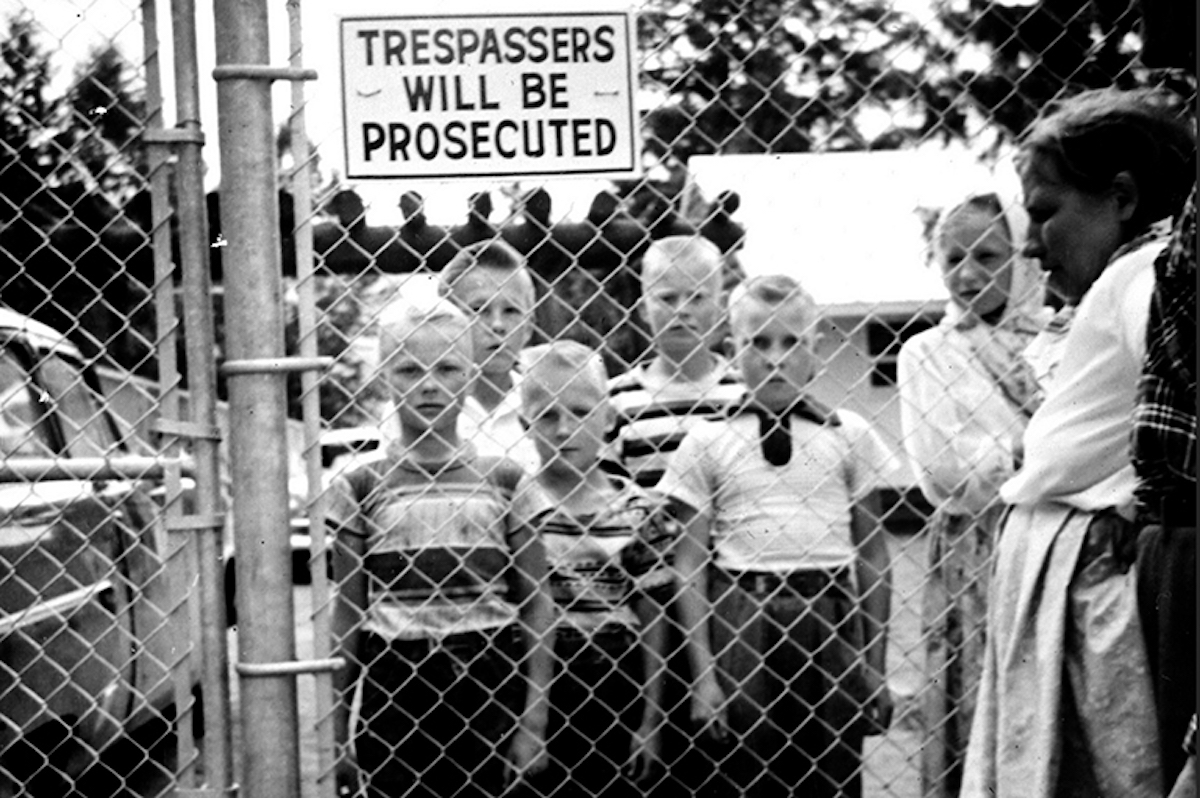
Sons of Freedom children at New Denver. (Image: Royal BC Museum)
THE SONS OF FREEDOM Doukhobor community received an official apology and $10 million this week for the removal of children from their homes in the 1950s.
 Without question, it was a traumatic experience for those kids, a heavy-handed response to a social problem rooted in religious radicalism. At the time, though, attitudes were different. I was the same age as many of those children, and I remember some of the events surrounding it.
Premier David Eby’s apology made reference to the seizure of communal property “for community member infractions including school absenteeism.” That doesn’t even scratch the surface of the story — what the children went through was part of a much larger environment of disorder.
The Sons of Freedom were a small sect of the Doukhobors who mass migrated to Canada beginning in 1898-99, with the financial help of novelist Leo Tolstoy, to flee persecution in Russia.
The Sons of Freedom, or Freedomites, as they were sometimes called, lived a rural, vegetarian, pacifist and communal existence. Over time, most of them moved from Saskatchewan to the Kootenays, establishing communities there, the best known of which is Krestova.
Many of their beliefs clashed with mainstream Canada. As pacifists, they were exempted from military service but they were also against public schools, materialism, registering their land, taking an oath of allegiance and, basically, all government regulation. In protest, they sometimes burned their own money and their own homes, and marched in the nude. Sometimes, they even burned the homes of other Doukhobors.
Mel Rothenburger is a regular contributor to CFJC Today, publishes the ArmchairMayor.ca opinion website, and is a recipient of the Jack Webster Foundation Lifetime Achievement Award. He has served as mayor of Kamloops, school board chair and TNRD director, and is a retired daily newspaper editor. He can be reached at mrothenburger@armchairmayor.ca.

 ArmchairMayor.ca
Mel, like the sophists of the past the present media has become nothing more than a mouth for hire, readers, compilers and communicators that darken understanding. As Noam Chomsky said, “He who controls the media controls the minds of the public.” Control of the media, arts and culture, education and understanding removes opposition, and destroys or distorts the past by omission as you have done in the editorial on the Doukhobors. Omission is a form of censorship.
The Doukhobors came to Canada in pursuit of religious freedom but, within a matter of years, their idiosyncratic set of beliefs and practices would make them the target of the Canadian government. In 1908, after their land in Saskatchewan was confiscated by the government, 6,000 settled on land purchased near Grand Forks and Nelson, in the Kootenay region. There, they established self-sufficient communities with orchards and brickyards and a flourishing jam factory.
In 1929, the group began protesting against the use of tax money to fund the military. They were willing to pay taxes for hospitals and roads but not the military. The government retaliated with mass internment, and family separation. Some were sent to Industrial School for Girls in Vancouver, others to Oakalla Prison in Burnaby, some to prison in New Westminster while later hundreds were sent to the newly-established Piers Island Penitentiary off of Vancouver Island
The nude marches that occurred prior to 1929, by the 1950s, were accompanied by arson and violence as you write. You also write that they were “a small sect” however, you neglect to say that these scenes were not representative of the broader community which your column ignores. You also ignore the fact that whole Doukhobor community was tarred by the same brush in the media. Why?
The society in control of the narrative was imbued with an unshakable sense of superior morality and racism. We see this in the education curriculum (wokeism), the treatment of the Doukhobors, Japanese, Chinese, First Nations, Indo Canadians, Southern Europeans and in many more past and present-day international examples. The narrative in the Media is never from the point of view of the victim but always represents demonization of the victim. Imagine what the media would have done if Assange had exposed Chinese crimes, not the US ones?
Reporting by omission or reporting that the results of government actions as good intentions were due to cultural values of the day ignores constructive criticism and debate. Respectfulness would require asking if the Media is bias and under government orders to present information to suit the government agenda or the political narrative of media owners or the lobby group in the nation.
Yes, you wrote in the column, “public anger and fear influenced the government of the day to take a hardline approach that in some respects went too far.” We create fear and ignore debate which is exactly what governments in the past and presently shun… it is exactly what all forms of zealotry abhor. Debate takes time, patience, courage and an environment free of fear. How this can be established and organised is a matter of debate… But everyone is not welcome and we know this and ignore it!
LikeLike
Mel how exactly were the beliefs of the Sons of Freedom a “social problem rooted in religious radicalism” How burning one’s guns, refusing to go to war, and living a communal life” is radical? Its time we all did that.
Mel how exactly were our “attitudes different” towards the Doukhobors. They left persecution in Russia and got the same when they got to Canada in Saskatchewan and later in BC. The narrative in Canada was “Better that people of non-assimilative . . .race should not come to Canada, but rather that they shall remain of residence in their country of origin, and do their share, as they have in the past, in the preservation and development of the empire”.
The French attempted assimilation (Metis) while the British did not want to assimilate (with the native people) so they abandoned their native wives and children that is why today we have Meti families who go by Smith and Jones as the abandoned children were taken in by the existing Metis.
The Canadian Immigration Act of 1910 quite boldly gave Cabinet power to prohibit immigrants belonging to any race other than from Great Britain unless of course we needed farm labourers as we did in the 1920 to work the fields of Brocklehurst. The immigration Act changed in 1925 to allow some 40 Lutheran families to emmigrate from Yugoslavia, Romania and Hungary. We needed farm labourers to work the fields in Brock when the Chinese ”coolies”, former railway workersd left,.
Ethnicity was a major factor in the Immigration policy not only in Kamloops but also in the rest of Canada well into the 20th century. British virtues, morality, loyalty, and bravery was the character worthy of immigration. However, the immigration policy changed due to labor shortage in the forests, mines and on the farms. The racism remained and terms like “coolie”, ‘chinks”, dago”, “frogs”, hunky”, “krout”, “wop”, and “garlic eaters” were commonly applied by the Establishment, to immigrants from Central, Southern and Eastern Europe
I like you also “remember some of the events surrounding” the rounding up of Doukhobor children. I remember one of my classmates, a Doukhobor who attended L V Rodgers in Nelson was blown up by dynamite that was transported in the back of a friend’s vehicle. The Nelson Daily News (NDN) ran a half page color picture of his body parts stacked on a morgue slab on the front page of the (NDN). I saw this picture and to this day I cannot forget the insensitivity of the press not only to the Doukhobor community but also to the native, Chinese and Japanese communities.
You write what the “children went through was part of a much larger environment of disorder” Yes native children, Chinese Children, Japanese children, Eastern and southern European children were part of this disorder. Stanley, Timothy J. quotes from a Canadian Case Study Children Teachers and Schools “In the History of British Columbia that at the start of the twentieth century, the government of British Columbia, disenfranchised over half of its population and had institutionalized racism in law, education, and the economy”, while the government of Canada, institutionalized racism in its immigration policy.
With the financial help of Leo Tolstoy using funds from his novel “War and Peace” beginning in 1898-99 the Doukhobors migrated to Peru and later to Canada , . Because they could not grow wheat in Peru they moved to marginal lands (poor soil, early snow and late frost) in northern Saskatchewan. Because of WWI and confiscation of their land in Saskatchewan the society split into two, Sons of Freedom and the Orthodox sects. The Sons of Freedom bought new land in the Kootenays where they faced the same issues in BC as in Russia and later in Saskatchewan during WWII.
Yes, you write that “As pacifists, they were exempted from military service but they were also against public schools, materialism, registering their land, taking an oath of allegiance and, basically, all government regulation” These were all promises made upon arrival but broken in the end.
I sent you an attachment maybe you can link it to this comment.
LikeLike
I’d say the Sons of Freedom refusal to abide by any government regulation and protesting by burning houses and possessions (both their own and those of other Doukhobors), as well as schools, and bombing public buildings, transmission towers, bridges, rail lines and post offices, causing tens of millions of dollars in damage, was a social problem rooted in religious radicalism. Attitudes towards the Sons of Freedom at the time were heavily influenced by that turmoil. Attitudes soften in later generations that have the benefit of hindsight and aren’t living with the violent protests that faced society at the time. As I wrote in the column, public anger and fear influenced the government of the day to take a hardline approach that in some respects went too far, such as the apprehension of Sons of Freedom children. The column clearly delineated between Doukhobors as a whole and the Sons of Freedom sect, which your post does not.
LikeLike