
EDITORIAL – Why finding a solution to the illicit-drug crisis remains so elusive
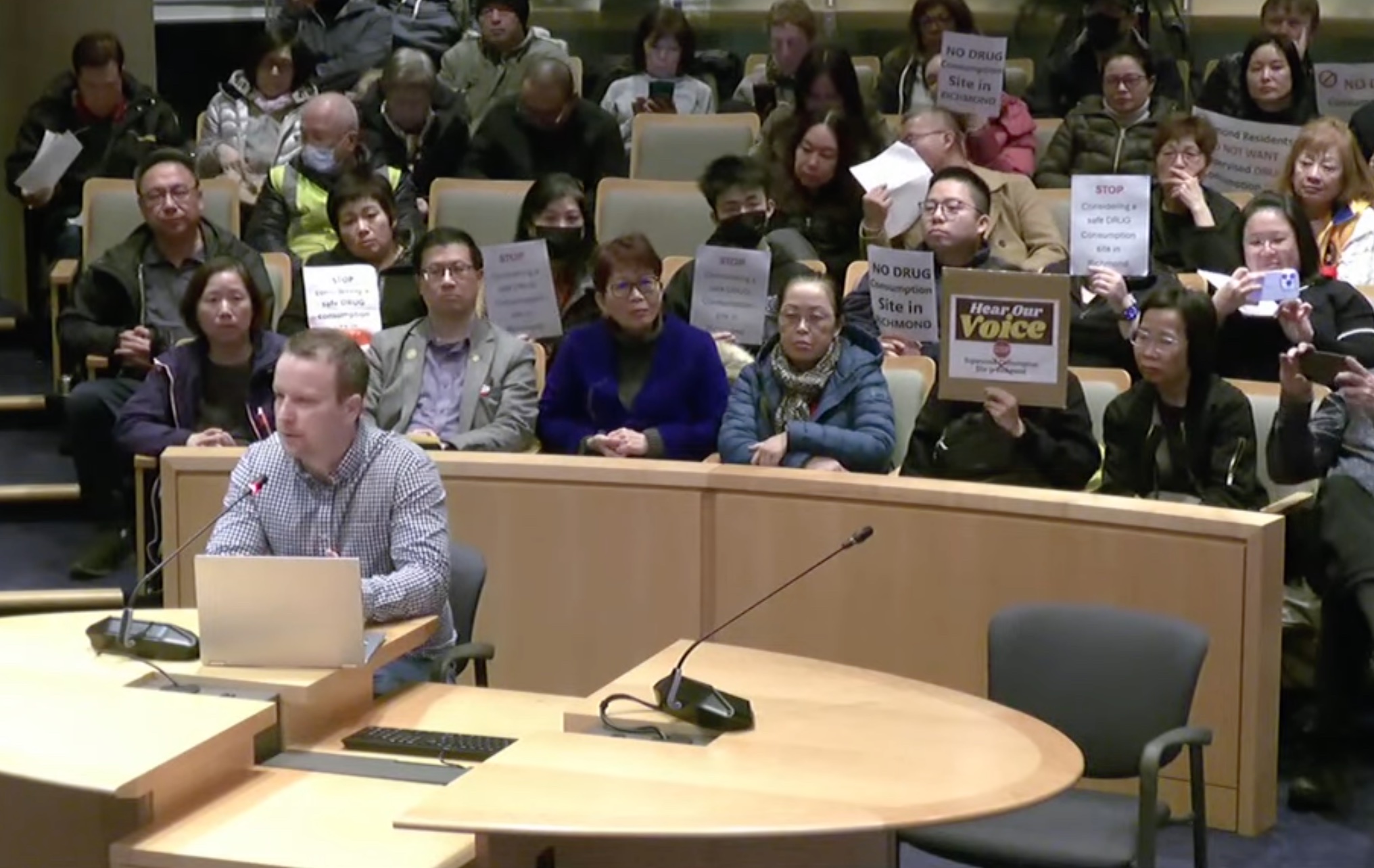
Resident addresses Richmond council at Tuesday night’s meeting. (Image: Screenshot, City of Richmond)
An editorial by Mel Rothenburger.
A MEASURE OF HOW DIVISIVE the issue of illicit drug use is for communities can be found in a sometimes unruly meeting of the Richmond City council that began on Monday and didn’t wrap up until late last night (Feb. 13, 2024).
The purpose of the meeting was to consider applying for a supervised consumption site. Residents crowded council chambers or stood outside to listen. By far most of them were unhappy with the possibility of a consumption site in their city.
Some were certain a consumption site would attract more drug addicts, leading to an increase in crime and public safety issues. They worried about the safety of kids and seniors.
Seventeen thousand signed an online petition opposing the site, which would test drugs and provide a place for safe consumption and to connect with health advisors.
Proponents of the site say it will reduce consumption in back alleys and public parks. The science says supervised consumption sites save lives. But those who fear them see them as a source of social problems and an endangerment.
Mel Rothenburger is a regular contributor to CFJC Today, publishes the ArmchairMayor.ca opinion website, and is a recipient of the Jack Webster Foundation Lifetime Achievement Award. He has served as mayor of Kamloops, school board chair and TNRD director, and is a retired daily newspaper editor. He can be reached at mrothenburger@armchairmayor.ca.

 ArmchairMayor.ca
Any serious attempt to find solutions to drug-related problems in this country should look at the role popular culture has played in shaping those problems. Drug use and glorification of addictive substances is a rich topic, for filmmakers because they can be enticing to thrill seekers, and profitable for film makers so, movies about drugs and drug use have glorified activities and directly contributed to an atmosphere of misinformation which has made it more difficult for families, schools, the health system and the justice system to deal with the problem.
Just ask yourself what do these families and government agencies do to fix the problem They are stuck between the Draconian and Santa Claus policies where the children no longer know who should look and sign their report card. I am reminded of a cartoon I once read where a child asks his teacher “Which parent do you want to sign this report card: my natural father, my stepfather, my mother’s third husband, my real mother: or my natural father’s fourth wife who lives with us.”
What can the schools do when a child in elementary school can’t even write his/her name. What about the health providers whose cure for everything is more drugs with another telephone call. Do we start with death penalty for drug dealers like Mao did in China to eliminate the drug problem or decriminalization like Portugal where they have had some success.
WE HAVE LEGAL AND MORAL RESPONSIBILITY TO KNOW THE FACTS because what we are doing now is not working. The facts are everywhere on our streets. You can’t fix an alcoholic or a drug user with more alcohol and drugs or the drug dealer with leniency.
LikeLike
As time goes forward we are seeing open demonstrations (in the streets of some of our cities) to the failure of supplying free drugs to those folks who are addicted and are facing homelessness and mental health challenges.
More and more, ordinary citizens are realizing these folks are not capable of climbing out of the pit of addiction, homelessness and mental health issues. The call for help is for mandatory treatment and positive steps to actually give value and meaning to their lives.
Isn’t it odd that a fellow who sold used cars recognized this quite a while ago, ran for Mayor and won?
LikeLiked by 1 person
I would like to point out that politicians and harm reduction activists are barriers to safety for the community when it comes to initiatives like what is being proposed in Richmond for consumption sites. This also applies to health officials, like the recent announcement from Miss Fenton. These individuals have a very narrow focus, a narrow mandate, and the needs of the greater communtiy are rarely acknowledged, much less taken into account when decisions on consumption sites are made.
If you object, politicians like Kash Heed will lob accusations of NIMBY at you. But I would invite every supporter of these opium dens to live next to these sites. In fact, it should be a mandatory requirement that the politicians an officials supporting these places, are established in their own neighbourhoods, so they can truly understand the dangers, and see how their constituents and neighbours feel. Raise your child across from an opium den. Show us the way.
LikeLike
If anyone is curious to read about the experiences of one neighbourhood and a “safe injection” site, do search out Derek Finkle and the South Riverdale Community Health Centre in Toronto.
That neighbourhood is suing the injection site. A similar lawsuit was brought upon a Vancouver injection site, and it was forced to close after all the problems it brought to the neighbourhood.
If one of these try to pop up in your neighbourhood, show up like the citizens of Richmond did and tell them to get packing. If they done listen and don’t leave, sue them.
LikeLike
Protonitazepyne is infiltrating the drug supply in Quebec. It looks identical to the little green pills BC is giving out for free. The problem is that it’s 25 times more powerful than fentanyl and comes with a high chance of OD, requiring multiple applications of naloxone – the wonder drug that brings you back from the dead to continue your drug binge unabated.
It’s only a matter of time until stronger drugs come for the captive audience that safe supply evangelists have created. You will not be able to stop this freight train by normalizing drug abuse. Enforcement, treatment and abstinence, in that order, is the only solution. We need to throw drug traffickers in prison and charge them with mass attempted murder and replace the removable dentures of the justice system with real teeth.
LikeLiked by 1 person
For the most part almost everyone will agree with your statements with the exception of the foolish remarks regarding safe supply creating a captive audience. Safe supply is targeted to the already addicted, it’s not creating new addicts. Safe supply is a stop gap measure, it’s not a long term goal to “normalize” drug abuse. Safe supply is Harm Reduction, which is the first pillar in the 4 pillars approach (Harm Reduction, Prevention, Treatment & Enforcement). Yes we need far greater enforcement, yes we need far more treatment options including mandatory, yes we need more reason to abstain from illicit drugs, but most of all we need a plan. You’re absolutely correct that the newer and far more powerful/addictive/deadly street drugs are coming like a “freight train” and it appears the worst has yet to come. Open use and safe supply may be ugly and evil, but they’re a necessary evil at this point as desperate times call for desperate measures.
LikeLike
I use the term captive audience to say that the audience already addicted is permitted to remain addicted. It is increasingly more and more comfortable to maintain a drug addiction in BC, without the pressure for treatment. In fact, I can refuse treatment as long as I like, but still engage the full suite of services, from welfare payments, fire trucks to inject me when I overdose, free opioid handouts and all the rest of it. That sounds like a captive audience to me, as not only do they have no choice but to attend (addicted and that addiction is maintained), they want to attend to the next hit and next new, harder drug. When those drugs hit the streets, they will be ready and eager. If they were in treatment, in psych wards or prisons, they couldn’t be such willing participants.
And while safe supply may cater to those already addicted, diversion impacts others, in addition to maintaining the chaos and crime of addiction and homeless that is inflicted on the community at large.
The normalization of drug use IS the professed goal of decriminalization. You can’t normalize something at the societal, then walk it back afterwards.
Safe supply might work in certain contexts, such as with mandatory treatment. Unfortunately, we’re 90% open drug use, and very little of the rest. That won’t change, because the activists supporting consumption sites will never support compelling someone into treatment. Hence, while normalization and facilitation of drug abuse might not be official policy, it has become the reality.
If you want to make it safer for people to smoke and inject drugs, OK. But if you want to do that without the same priority and attention as getting them off those drugs, you’re really only killing them slowly, along with the community for the rest of us.
I will vote for you Mac if you try for council again.
LikeLike
It’s going to take a miracle to solve this problem. Maybe we’ve been looking for the miracle in the wrong place.
LikeLike
Not an easy or one-size-fits-all solution at all, however this government’s policy seems to start and stop with making it easier for addicts to obtain and use drugs, whether safely or not. This is obviously not working. The end goal, and highest priority, needs to be to get people off drugs and healthy again. There will never be a 100% solution, as there are other mental health and satisfaction-with-current-state issues, however there has been far too much emphasis on so-called “harm reduction”, and not enough on rehabilitation and enforcement. How is making an addict’s issue worse by supplying them with more drugs harm reduction? It is just harm, full stop. Do we supply alcoholics with more alcohol? No, because we know it is bad for them, and does nothing to help them get clean. This past week we read of a 2 year-old in Ottawa found in a public park with a syringe in her mouth. Luckily she was ok. Is this what we have to look forward to here in Kamloops?
one problem is that it seems there is practically zero enforcement or government support against the supply chain of illicit drugs, with dealers and distributors caught red-handed with drugs, cash, and loaded illegal guns, released at the scene on consideration of charges, that we never hear anymore about. Are charges actually laid, or are these scoff-laws just laughing at the legal system. It seems like they are. This needs to change, with immediate consequence to the offenders. Rapid processing through the court system with heavy prison sentences would send an appropriate message to these useless punks. They have had free reign for far too long, and that needs to change.
LikeLiked by 1 person
I think the solution is rather simple and clear. People stop using drugs to sooth their pains and turn to cycling in nature instead. A few details need to be worked out for sure but most importantly a firm, whole-encompassing hand and mind needs to take charge.
LikeLike
There are no solutions. Let’s be real here. There’s an entire entrenched multi-billion dollar industry out here that serves homeless and drug addicts. They will not evaporate quietly. But there are still things we can do.
The science showing supervised consumption improves outcomes is only for the days immediately following the supervision (about 7 days). It does not seem to improve outcomes past that. So really what is the point?
Diversion is also a real problem. A 14 year old overdosed in Ontario via handout opioids that were sold by addicts to purchase their drug of choice. Evidence is piling up to show these handout pills are trickling down into the hands of young people. Our health officials want even more of that out there.
The dangers of drug use extend to the community. A 2 year old baby was taken to emergency in Ottawa after she was found with a used syringe in her mouth while at a playground. That should never happen. But it has, many times, because fools thought it a good idea to let drug addicts shoot up anywhere they please and call it a human right.
Encampments breed disease, crime and danger for those in and near the camps. Encampment dwellers refuse shelter beds, as if they’re entitled to have any say in the matter.
We need to compel treatment, arrest and jail those who disrupt the community with their actions, and force people to get clean. There’s no way you’re supporting a multi-hit per day fentanyl habit in prison. The consumption and possession of illicit drugs must again be enforced. The message must be that it’s bad and dangerous to use drugs, not that it’s OK, and we’ll do everything we can to facilitate their use, and when the 1% of you decide to finally commit to help, we’ll be ready. We will help you get off them, and you’re not going to enjoy it, but for sure we are done tolerating the insanity on our streets. News flash: drug addicts won’t quit if you facilitate and maintain their addictions.
The logic doesn’t hold up. Ban consumption of a glass of wine at the park but not fentanyl injections. Put chewable tobacco behind a counter, but hand out all manner of opioids for free. The sort of bad drugs like tobacco and alcohol are really bad you see, so we shouldn’t allow consumption at bus stops and parks, we need to control those and warn people about consumption. But the really bad drugs, well those we need to make it easier to use and access, anywhere you like in fact. Come on down to the supervised consumption site. Well even have a chat with you while smoking horse tranquilizer.
There should be limits on the number of narcan injections an individual can get. If they exceed that number, they must be taken into custody for their own safety. How many times would you let someone try to jump off a bridge before sending them to the psych ward? If people keep screwing up and falling back in to addiction and crime, send them to prison and get them off the streets. We pay for all of this, so we must have our communities and way of life back for bankrolling this madness.
Every addict on the street comes with a significant cost to society, a near guarantee of criminal activity, and indirectly supports organized crime. If we treated taxpayers with the same reverence as we do addicts, we might all have family doctors, working infrastructure, hospitals that work again, and so many other things to improve our society. Drug addicts are bringing us down every day, and we can’t let that happen any longer.
This silly game of reducing stigma is clearly not going to work. Richmond citizens see through that. There is stigma for a reason. Once you have these facilities in your neighborhood, it goes to pot, and crazy activists will lie and claim everything is fine as crime, assaults and all manner of chaos happens.
It’s time to return to the four pillars approach: forced treatment, prison, shelters with no exceptions to illegal encampments, and arrests for crime with treatment as an alternative to prison time.
LikeLiked by 1 person