
TRU – Economics students make strong showing in Governor’s Challenge
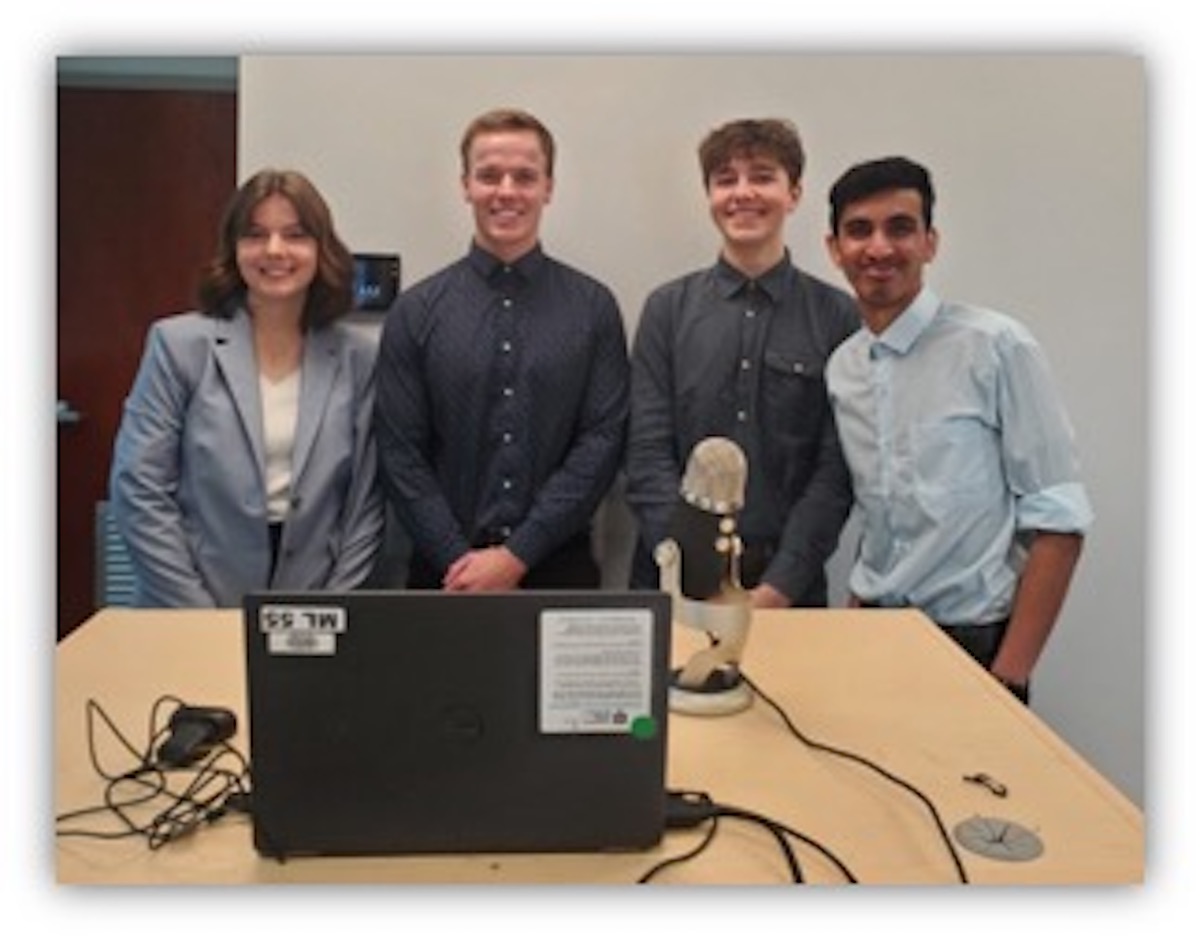
From left to right: Ashley Thomson, Tyson Storvold, Alexander Beck, and Kris Kadaleevanam.
In this year’s Governor’s Challenge, a competition aimed at fostering understanding of monetary policy in Canada’s economy, a team from the economics program at Thompson Rivers University has shown commendable skill and insight.
Alexander Beck, Kris Kadaleevanam, Tyson Storvold, and Ashley Thomson, guided by their supervisors Dr. Stefania Strantza and Dr. Peter Tsigaris, delivered an analysis on the persistence of inflation and inflationary expectations that stood out for its depth and clarity.
Their contribution was further strengthened by the aid of Alaa Awad, Arnold Bundotich, Cali Hutchinson, Garima Mehta, and questions from faculty members of the Department of Economics during their preparation.
The Governor’s Challenge is a rigorous contest where students are tasked with playing the role of advisors to the Bank of Canada’s Governing Council. Numerous university teams across Canada analyzed economic trends and recommended a monetary policy to implement.
The students’ presentation effectively captured the current challenges faced by the Canadian economy, marked by a delicate balance between controlling inflation and managing unemployment.
They offered an analysis of the Canadian economy’s current state, marked by weakened national output and rising unemployment due to the Bank of Canada’s rate hikes to control inflation.
They highlighted the stagnation of real wages and a worrying unemployment-to-job vacancy ratio, supported by a range of leading and lagging indicators. The team pointed out the multifaceted causes of inflationary pressure, including post-lockdown monetary easing, fiscal stimulus, supply chain disruptions, geopolitical tensions, and increased consumer spending.
Their approach was both methodical and innovative, creating confidence intervals using the International Monetary Fund’s (IMF) past forecast errors. These errors made by IMF since 2017 were used by the students to create forecasts of confidence intervals for IMF’s prediction of inflation declining to 2.4% by 2024, a slow GDP growth rate of 1.6%, and a rising unemployment to 6.3%.
“The team exhibited creativity in various aspects, such as the unique calculation of the output gap, the inclusion of confidence intervals on forecasts, and the calculation of the passthrough from inflation to expectations,” wrote the adjudicators from the Bank of Canada.
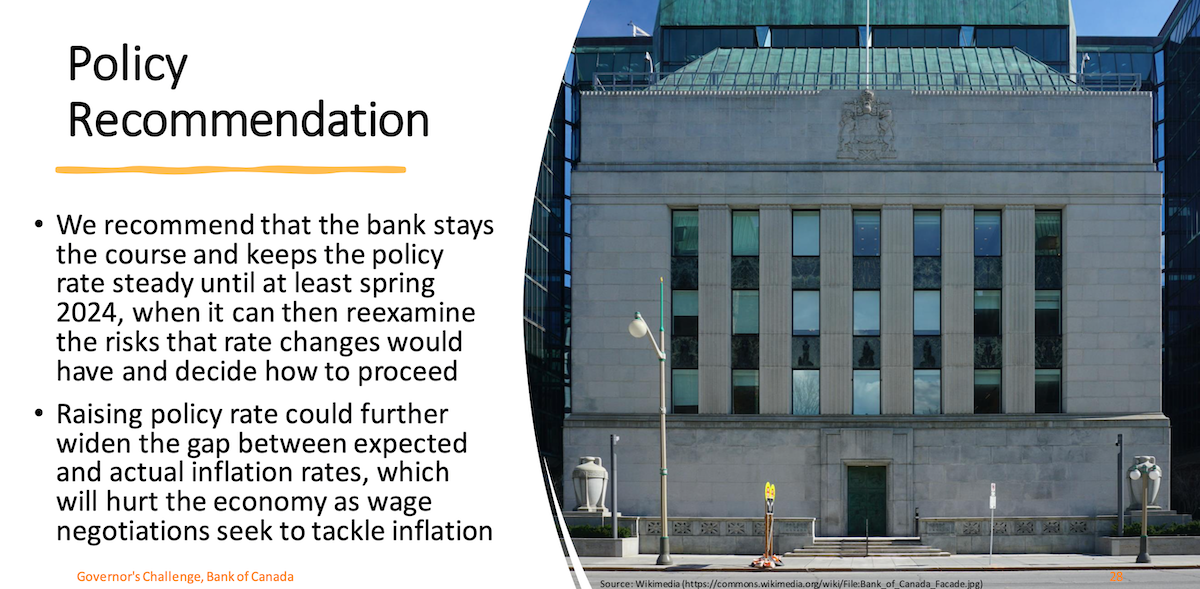
In considering various risks like prolonged recession, international crises, and ongoing supply chain issues, the students recommended a steady monetary policy by the Bank of Canada until at least spring 2024. This recommendation underscores a deep understanding of the delicate balance required in monetary policy to navigate economic uncertainties.
This participation in the Governor’s Challenge is not just about competition; it is an opportunity for real-world application of economic theories and a chance to contribute to discussions on national monetary policy.
— Submitted by Dr. Peter Tsigaris

 ArmchairMayor.ca
We are very proud of our students engaging in understanding the state of our economy and being able to advise the Bank of Canada on monetary policy and interest rate policy.
The students’ presentation can be found at the following link:
https://drive.google.com/file/d/1os8cakMWTEYRyJ4JuG3p3tOHk3q1M3Wl/view?usp=sharing
Their recommendation to keep the interest rate unchanged was followed by the Bank of Canada! See:
https://www.bankofcanada.ca/2023/12/fad-press-release-2023-12-06/
LikeLike