
O’REILLY – The shocking truth about Kamloops’ love affair with automobiles

OVER THE LAST THREE MONTHS, Kamloops’ newly elected council has been going through a rigorous orientation that has included nearly 50 hours of facility tours, education sessions, meetings with directors and, of course, our strategic planning session.
Staff have told us that, due to our topography, our water, sewer and drainage systems are among the most complex in North America, rivalled only by San Francisco.

Coun. Mike O’Reilly.
That got me thinking: if we statistically know this to be true about our water and sewer systems, could it also be true for our transportation network?
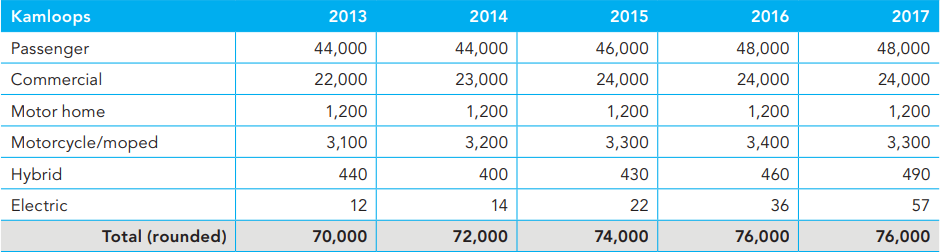
After a little digging and help from city staff, I was able to obtain data on the number of vehicles insured in Kamloops.
Looking more closely at the numbers, we have only 57 electric cars and 460 hybrid cars in the entire city.I believe a transportation network is not just about cars and roads. It includes public transit, cycling and walking. We know that from a strictly environmental point of view, we need to move in the direction of more green alternatives for transportation.
Will everyone in Kamloops suddenly start riding their bikes or taking the bus to work every day?
No.
Is there a portion of the population that is close to making a change from a personal car, truck, van or SUV to another form of transportation?
Yes.
Will everyone in Kamloops switch to a hybrid or electric car in the next five years?
No.
Is there a large portion of people who want to make the switch, but cannot afford it?
Yes.
We need to think about how we can get people to reduce their dependency on the automobile, how we can we get more people using public transit, how we can get more hybrids and electric vehicles in Kamloops and how we can help connect communities so it is easier and safer for people to commute.
While we will always have a need for cars in Kamloops, a big decision that needs to be made is whether we take a carrot or stick approach to convince people to make the transition to a more environmentally friendly mode of transportation.
That will be up to council to wrestle with, but I prefer the carrot approach.
I believe we can get to a greener Kamloops by working together and exploring all the options and opportunities.
Mike O’Reilly is a Kamloops City councillor. Contact him at moreilly@kamloops.ca.

 ArmchairMayor.ca
Great article with good information. Yes, incentives are motivators for many individuals and families. Many of us, especially older folks want to buy an electric vehicle but our financial resources won’t allow it. We are supporting our retirement with investments that took a lifetime to save. However, incentives such as rebates coupled with excellent repayment plans could put many of us into the “owner” category. I believe a look at statistics of the effectiveness of such strategies could start with Fortis BC that offers rebates for upgrading home heating systems to High Efficiency. Certainly they have reliable stats. Emissions of carbon dioxide from new passenger cars have dropped in a number of European countries where a range of taxes, subsidies and other incentives are used to encourage consumers to purchase lower-carbon-dioxide (CO2) emitting vehicles. The number of countries offering incentives for electric vehicles in particular, continues to grow, according to European Environment Agency (EEA) data published today. While it’s important to pursue this goal, I believe Provincial policies need to move in this direction as Municipal budgets are very limited.
LikeLike
Let’s remember all the “carrots” spent in the pointless advertising campaigns regarding water conservation. When the “stick” was used (AKA water meters) the conservation became factual.
“Carrots” work well at re-election time, if one can catch the drift…
LikeLike