
KNOX — The politics of religion, and vice versa
Jack Knox is a former Kamloops journalist who writes for the Victoria Times-Colonist.
COLUMN — It’s Easter week, but the only Christianity making the news is James Lunney’s.
 The Nanaimo-Alberni MP has just quit the Conservative caucus. He says doing so will better allow him to defend his religious freedom against those who want to suppress a “Christian world view” and the “circling trolls” attacking him over a social media message in which he said the theory of evolution should not be taken as fact.
Critics were quick to reply that if Lunney wants to fight for religious freedom, maybe he should start by defending the Muslim women whose niqabs the Conservatives want to remove. After that, the debate descended to the level of 140-character debate you would expect when religion, politics and Twitter are stirred into the same toxic cesspool.
It’s tempting to dive in, to get in a couple of shots on behalf of those of us who were raised in churches that had a lot to say about love thy neighbour but very little about carbon dating, but that wouldn’t be in keeping with the spirit of the lesson, would it?
Better to ponder the question of when a politician’s personal beliefs become the public’s business.
The answer: Always.
“It is clear that any politician or candidate of faith is going to be subjected to the same public scrutiny in coming elections,” Lunney said in his statement.
Sure, but why not? Baptist or Bolshevik, politicians are free to believe what they want (Lunney has questioned both evolution and climate-change science) but once they’re in a position to act in our name, anything that affects their views — whether they be on polygamy, Sharia law, feeding the poor, eating the rich, or chatting with dear old dead mother through the dog like Mackenzie King — should be open to scrutiny.
This stuff matters. While it’s rare for politicians to impose their religious views on others (Stephen Harper has, for example, steadfastly resisted pressure to reopen the abortion debate), it’s not realistic to expect personal conviction to have no influence at all on public policy, whether it be around homelessness, capital punishment or the teaching of evolution in schools.
Pierre Trudeau’s Jesuit education shaped his passion for individualism, as reflected by his Charter of Rights and Freedoms and his suspicion of Quebec nationalists. Likewise, it’s no accident that the father of Canada’s medicare system was the New Democrats’ Tommy Douglas, a Baptist minister and believer in the social gospel.
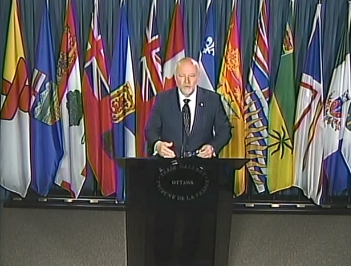
MP James Lunney. (James Lunney website)
Parties themselves have religious roots. The evangelical Calgary Prophetic Bible Institute gave Alberta two premiers, William “Bible Bill” Aberhart and Ernest Manning, whose son Preston founded the Reform party, which eventually morphed into Harper’s version of the Conservatives. The NDP grew out of the Co-operative Commonwealth Federation, whose first leader was Methodist minister J.S. Woodsworth, who envisioned a Kingdom of God “here and now.”
No politician has a corner on faith. In fact, almost all of Canada’s prime ministers have had deep Christian convictions. Liberals Trudeau, Paul Martin and Jean Chrétien and Tories Brian Mulroney and Joe Clark were all devout Catholics. With the exception of Kim Campbell, who was prime minister for about 15 minutes in 1993, Harper is the first Protestant since Lester Pearson in 1968. Lunney’s feelings on questions of science appear to contrast starkly with those of Green party Leader Elizabeth May, who was studying for ordination as an Anglican minister before she was elected the MP for Saanich Gulf Islands. “Christian world view?” Choose your flavour. It’s not as though we have just one.
The footing can get gooey. Look at the mess in Indiana where a new “religious freedom” law would allow businesses, based on personal belief, to refuse to deal with, say, a same-sex couple looking to buy flowers for their wedding. The measure reflects the reality that no matter what public policy says, individual belief can’t be turned on and off with a switch — but then you could say the same of those who felt justified discriminating against blacks in the 1960s. So we now have the bizarre spectacle of U.S. churches boycotting Indiana in opposition to a law drawn up in the name of religious freedom.
Indiana doesn’t show that religion and politics should not mix; it just proves that they inevitably will. In which case, you can argue that politicians don’t just have the right to discuss their beliefs, but the obligation.
© Copyright Times Colonist – See more at: http://www.timescolonist.com/news/local/jack-knox-politicians-beliefs-always-public-s-affair-1.1812060#sthash.1EeVaksa.dpuf

 ArmchairMayor.ca
Leave a comment