
KNOX — Sue Rodriguez finally wins her fight
Jack Knox is a Victoria Times-Colonist columnist who still visits his home town of Kamloops from time to time.
COLUMN — One day during Sue Rodriguez’s challenge of Canada’s assisted-suicide law, something amazing happened.
 As the wheelchair-bound woman rolled out of Victoria’s Bedford Regency Hotel, pedestrians came to a halt. So did passing cars.
Then the clapping began, spontaneously. “It echoed between the building walls on Government Street,” her lawyer, Chris Considine, recalled on Friday. “People recognized the courage of Sue Rodriguez and her fight.”
Svend Robinson has a similar story. The former New Democrat MP remembers accompanying Rodriguez to a Chinese restaurant (“She loved Chinese food”) where other diners broke into applause. Not everyone shared the North Saanich woman’s beliefs, but all saw her bravery.
“She moved people profoundly with her passion and her eloquence and her dignity,” Robinson said, on the phone from Switzerland.
It was impossible to read the Supreme Court of Canada’s assisted-suicide decision Friday without thinking of Rodriguez, who opened the door to this debate more than two decades ago.
In a unanimous ruling, the court threw out the existing ban on doctor-assisted suicide. The judges gave Parliament one year to rewrite the law in a way that recognizes the right of mentally sound, consenting adults who are enduring intolerable, “irremediable” suffering to seek medical help to kill themselves.
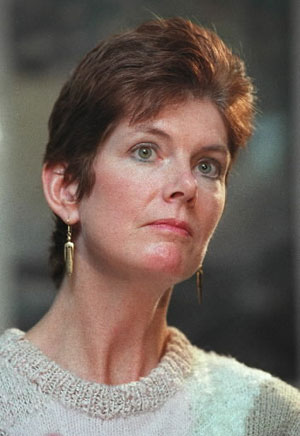
Sue Rodrigues.
In many ways, the ruling mirrored the opinion expressed by the dissenting judges when Rodriguez’s own Supreme Court challenge failed in 1993.
Considine, who has spent the past two decades speaking on physician-assisted suicide to groups across Canada and elsewhere, called the new ruling “wise.”
He has been fighting for this since the day Rodriguez came into his office in 1992, a year after she was diagnosed with amyotrophic lateral sclerosis. Hers was a cause Considine readily embraced, having seen his own grandmother die of ALS — an active, intelligent mind trapped in a broken body.
Rodriguez argued that the ban on physician-assisted suicide denied the option of suicide to people with disabilities.
“Who owns my life?” she famously demanded of a House of Commons subcommittee.
The counter-argument centred on the sanctity of life, the danger of murder masking as suicide and of the need to protect people from themselves in moments of weakness.
Ultimately, the Supreme Court rejected her challenge in a 5-4 vote.
“It was such a heartbreakingly close decision,” said Robinson, who was with her when she learned the verdict.
Disappointing, but both he and she were convinced it was just one step on a journey that would ultimately be completed.
Robinson, who now works in Geneva with the Global Fund to Fight AIDS, Tuberculosis and Malaria, was also at Rodriguez’s side five months later on Feb. 12, 1994, when a yet-to-be-identified physician helped the 43-year-old die of a fatal dose of barbiturates.
Much has changed since the 1993 ruling (which, it should be noted, established the legality of palliative care, in which the drugs that relieve suffering can also hasten the death of terminally ill people).
The legal landscape has slowly shifted. Related cases included that of Langford’s Evelyn Martens, then 73, who in 2004 was acquitted of helping two women — a Vancouver teacher and a former nun in Duncan — kill themselves. That case determined that a person must physically help in a suicide, not just be present, to be guilty.
Other jurisdictions, including Washington and Oregon, now allow doctor-assisted suicide. Their experience eased the court’s concerns about a “slippery slope” in which a permissive law wouldn’t adequately protect vulnerable people.
The Supreme Court judges now believe that with adequate safeguards, it’s possible to let people choose to die with dignity, without horrible pain, Considine said.
“They’re saying ‘We don’t have to protect life at all costs.’ ”
© Copyright Times Colonist

 ArmchairMayor.ca
Leave a comment