
Mount Polley disaster: ‘The dominant contribution to the failure resides in the design’
NEWS/ MOUNT POLLEY — The Mount Polley disaster was caused by a failure in the foundation of the mine’s tailings pond dam, and a design that failed to consider the glacial deposit underneath, an independent review panel concluded Friday.
The panel delivered its report on the breach of the Mount Polley open pit mine’s tailings pond last Aug. 4 that sent millions of cubic meters of contaminated waste into nearby rivers and lakes.
It concluded that the breach resulted from a failure in the foundation of the embankment.
It stated: “The Panel concluded that the dominant contribution to the failure resides in the design. The design did not take into account the complexity of the sub-glacial and pre-glacial geological environment associated with the perimeter embankment foundation.
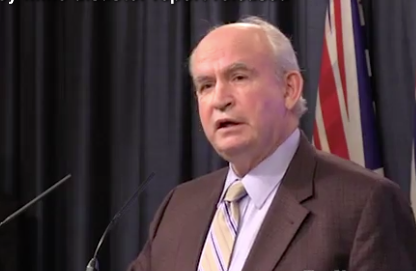
Mines Minister Bill Bennett at media conference Friday.
“As a result, foundation investigations and associated site characterization failed to identify a continuous GLU (glaciolacustrine) layer in the vicinity of the breach and to recognize that it was susceptible to undrained failure when subject to the stresses associated with the embankment.”
The report said “the omissions associated with site characterization may be likened to creating a loaded gun” and that the angle of slope of the dam “pulled the trigger.”
The panel said the failure was triggered by construction of the downstream rockfill zone at a steep slope. The panel concluded that had the downstream slope been flattened, failure would have been avoided. The slope was in the process of being flattened to meet its ultimate design criteria at the time of the accident.
In its report, the panel also concludes that there was no evidence that the failure was due to human intervention or overtopping of the perimeter embankments and that piping and cracking, which is often the cause of the failure of earth dams, was not the cause of the breach.
In regard to regulatory oversight, the panel found that inspections of the tailings storage facility would not have prevented failure.
Minister of Energy and Mines Bill Bennett said the government will act immediately on key recommendations in the report.
“I am relieved to know the cause of the failure at Mount Polley and want to thank the panel for their important work. Now we can devote all of our energy to taking a leadership role in Canada and internationally to learn from this and ensure it never happens again,” he said.
The panel made seven recommendations to improve practice and reduce the potential for future failures. Recognizing that the path to zero failures involves a combination of best available technology (BAT) and best applicable practices (BAP), the panel recommended the following:
To implement BAT using a phased approach:
• For existing tailings impoundments. Rely on best practices for the remaining active life.
• For new tailings facilities. BAT should be actively encouraged for new tailings facilities at existing and proposed mines.
• For closure. BAT principles should be applied to closure of active impoundments so that they are progressively removed from the inventory by attrition.
To improve corporate governance:
• Corporations proposing to operate a tailings storage facility (TSF) should be required to be a member of the Mining Association of Canada (MAC) or be obliged to commit to an equivalent program for tailings management, including the audit function.
To expand corporate design commitments:
• Future permit applications for a new TSF should be based on a bankable feasibility that would have considered all technical, environmental, social and economic aspects of the project in sufficient detail to support an investment decision, which might have an accuracy of +/- 10-15%. More explicitly it should contain the following:
• A detailed evaluation of all potential failure modes and a management scheme for all residual risk.
• Detailed cost/benefit analyses of BAT tailings and closure options so that economic effects can be understood, recognizing that the results of the cost/benefit analyses should not supersede BAT safety considerations.
• A detailed declaration of Quantitative Performance Objectives (QPOs).
To enhance validation of safety and regulation of all phases of a TSF:
• Increase utilization of Independent Tailings Review Boards.
To strengthen current regulatory operations:
• Utilize the recent inspections of TSFs in the province to ascertain whether they may be at risk due to the following potential failure modes and take appropriate actions.
• Filter adequacy.
• Water balance adequacy.
• Undrained shear failure of silt and clay foundations.
• Utilize the concept of Quantitative Performance Objectives to improve regulator evaluation of ongoing facilities.
To improve professional practice:
• Encourage the Association of Professional Engineers and Geoscientists of British Columbia (APEGBC) to develop guidelines that would lead to improved site characterization for tailings dams with respect to the geological, geomorphological, hydrogeological and possibly seismotectonic characteristics.
To improve dam safety guidelines:
• Recognizing the limitations of the current Canadian Dam Association (CDA) guidelines incorporated as a statutory requirement, develop improved guidelines that are tailored to the conditions encountered with TSFs in British Columbia and that emphasize protecting public safety.
“We have been acutely aware of our responsibilities in conducting this investigation,” said panel chair Norbert Morgenstern. “We set out to be thorough, focusing on the technical issues, and to report our findings in an open, transparent and timely manner.”
The full final report, appendices, and supporting information can be found at: http://www.mountpolleyreviewpanel.ca.

 ArmchairMayor.ca
Paragraph 7: [The panel concluded that had the downstream slope been flattened, failure would have been avoided. The slope was in the process of being flattened to meet its ultimate design criteria at the time of the “accident”.]
(Being flattened) is much different from being wide from the beginning as suggested by the original design as the weight is being spread over a larger area.
(In the process) sounds like they were ‘hoping’, hopping works here too, to get it back to original specs (ultimate design criteria) before it broke.
Paragraph 8: [piping and cracking, which is often the cause of the failure of earth dams]
Mr. Morgenstern said mine workers were on the dam some hours WHEN? before the failure and there was no indication of water ‘gushing’ out.”
What caused the BCHydro water level meter at Likely, about 20 km away, to show extra activity at Sunday midnight for about 12 hours until Monday 4, Aug. at noon?
HOW MUCH litres, barrels, gallons, of WATER CAN MOVE BEFORE IT IS GUSHING?
LikeLike