
Mine tourist: Seeing it for yourself helps put Ajax in perspective
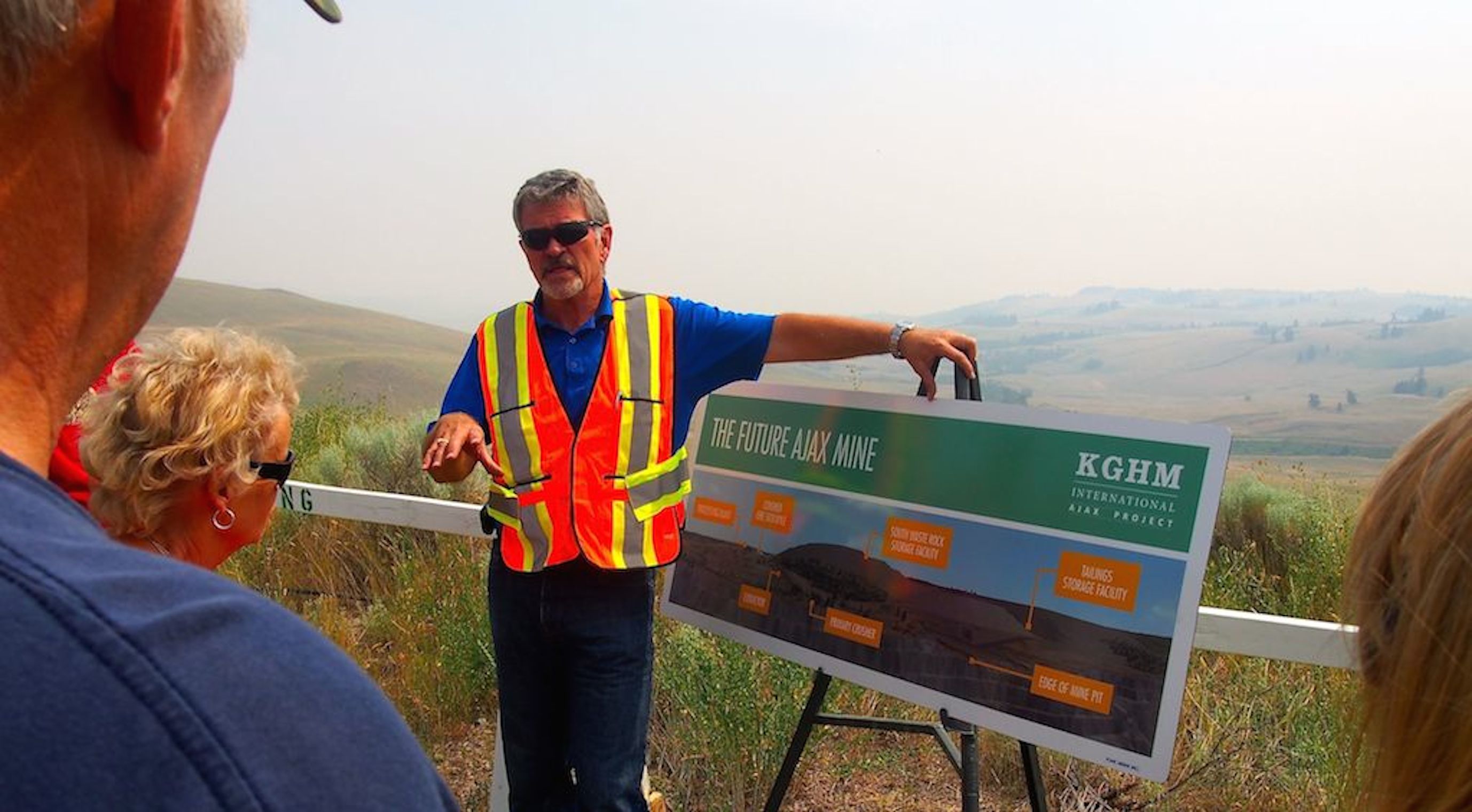
Ajax tour host Kim Behrns talks to residents during visit to minesite Thursday.
Tech’s reclaimed brownfield site dominates foothills east of Jacko Lake
By MIKE YOUDS
Despite wildfire smoke that obscured views and led several people to withdraw, a tour of the revamped Ajax mine plan Thursday helped put the proposed copper/gold operation into perspective historically and geographically.
Maps, models and video animations are useful, but there’s nothing like planting your feet on terra firma to gain a clearer understanding of what remains a highly controversial proposal.
The one-hour KGHM tours have been well attended with the exception of long weekends, said KGHM’s Nicole Trudell, who greets participants atop the Inks Lake underpass. Fortunately, in the current heatwave, the bus is air-conditioned and the tour is fairly brief, just an hour. The bus climbs up the dusty old Tech Resources/Afton haul road to what would be the future KGHM pit, a landscape in which Tech’s brownfield mine site remains prominent despite reclamation.
 Tour leader Kim Behrns said his primary focus at this stage is explaining the new plan, which was substantially altered two months ago with changes provoked by public feedback and enabled by additional property purchases.
As KGHM prepares to submit its environmental assessment application, it’s only reasonable to ask to what extent the changes have answered the frequent criticisms of “too big, too close?”
Behrns noted that Inks Lake, which would have been destroyed with the old plan, would remain intact and available for recreational use. Access to nearby Jacko Lake, a popular fishing spot, would remain. The lake dates back to the early ranchers, who dammed a slough to provide more water for their cattle.
“The whole mine plan is based on the preservation of Jacko Lake and Peterson Creek,” he said.
The old haul road, used by Tech Resources when it operated a smaller-scale mine from 1990-1998, would remain a primary access route to the new operation.
Trans Mountain pipeline, which currently underlies the proposed mine site, would have to be relocated so that it skirts the operation, a move Kinder Morgan is planning in co-operation with KGHM and in conjunction with its proposed expansion project. Part of the existing pipe runs under Jacko Lake, so the plan is to construct an earthen dam to facilitate pipe removal. They would leave the dam across that shallow arm of the lake to serve as a visual buffer between the lake and the mine, Behrns said.
Specifically, key site plan changes include:
• Movement of the processing plant, crushers and temporary ore stockpiles away from the Coquihalla Highway and the city. The mine operation would be roughly 41/2 kilometres distant from Aberdeen neighbourhoods, about twice the distance first proposed.
• A tighter clustering of mine operations to reduce noise and dust from haul trucks.
• A shift from dry tailings stacks, which would have been highly visible from the highway, to using Goose Lake as a more conventional wet tailings pond, 21/2 kilometres distant.
“Peterson Creek runs north of that flag,” Behrns said, pointing across to the reclaimed Tech pit. “So we’re asking to redirect Peterson Creek about a kilometre.”
A tour participant who worked for the Tech operation corrected a common misconception: Tech didn’t move Peterson Creek back in the ‘90s. They only installed culverts to allow haul trucks over it, he noted.
One participant, Bob Cowden, was on his second tour, having seen the former plan. He felt the revamped plan would make a marked difference in terms of public concern, moving the centre of the operation further away.
And what about the enlarged pit many times the scale of the old Ajax? The pit would be 450 metres deep from its high northern side, with lesser drops on its southern rim due to the undulating terrain, Behrns said.
“The ore will be brought out of the pit by trucks and delivered to the crushers,” he continued. Conveyer belts would move the crushed rock, a sand slurry, to the processing plant where the gold and copper are removed.
Mines, of course, are heavy users of water. They are continuing to investigate the possible use of city wastewater. Recycling water would make a lot of sense, Behrns said.
Behrns, who lived on Laurier Drive when Tech operated, predicted that noise and vibration impacts will not be noticeable in the city: “None of us, neither me nor my neighbours, knew anything was going on,” he said. “At night, when it’s in operation, I’m sure you see some light and activity.”
He stressed that every mine operating in the province has to post bonds for future reclamation costs. All waste piles have to be returned to the same type of terrain that originally existed. That includes shaping the waste rock so that it resembles the original and vegetation can take hold.
He also suggested that blasting would go largely unnoticed: “I think if you ever saw these blasts, you’d be disappointed. Basically, it would be a ripple. All we want to do is fracture the rock, collect it up and then crush the rock. It’s not anything near what you might think.
“At this point, we’ve invested $100 million in the project. By the time it goes into production, it will be about a billion dollars.” Construction would create about 1,200 jobs while 500 to 600 people would be employed by the mine at full production, Behrns said, adding that there’s a economic multiplier factor of three to one.
Behrns said the old Ajax site has been used for two movie productions, The Lost Treasure of the Grand Canyon and, just recently, Monster Trucks.
Next stop for the inquisitive mine tourist: A revised version of Tony Brumell’s alternative site tour in contrast with the official KGHM one.

 ArmchairMayor.ca
“He stressed that every mine operating in the province has to post bonds for future reclamation costs. All waste piles have to be returned to the same type of terrain that originally existed. That includes shaping the waste rock so that it resembles the original and vegetation can take hold.”
Totally untrue. With the excuse that there is still some minerals in the ground, the previous owner never did make it so “it resembles the original”.
LikeLike
Thank you for your exquisite description of the tour. I might have to differ with Mr. Behrns on one point, Laurier Drive is not the upper part of Abbey Glen Way, Pacific Way, Regent Crescent, Canongate, or Whitburn. I would suggest that Ajax place monitors checking for water movement, vibrations etc throughout Aberdeen, which would be quite apart from monitors on their own property.
LikeLike