
KGHM touts reworked Ajax plan
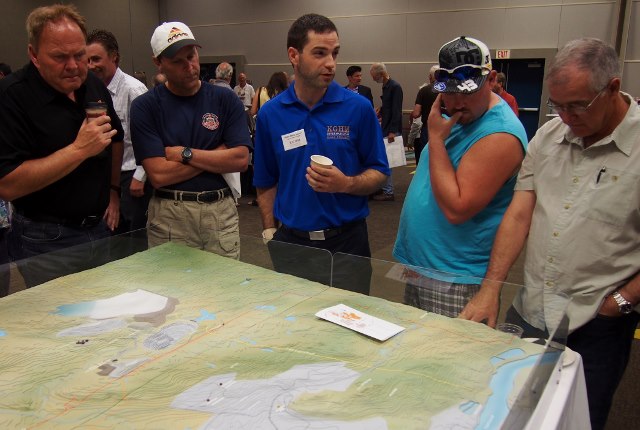
Jean Paul Salley, a KGHM external affairs specialist, discusses details of the mine’s new footprint.
By MIKE YOUDS
Back from the drawing board after reconfiguring its proposed Ajax copper-gold operation, KGHM International laid its new mine plan on the table Tuesday night at the first of three open houses.
Dozens of people circulated from table to table at the Coast Kamloops Hotel and Conference Centre, plying engineers, consultants and company spokespersons with questions about groundwater containment, hauling and air-quality monitoring.
They were greeted by a string of anti-Ajax protesters who waved placards along Rogers Way but steered clear of the hotel and two security guards standing outside. KGHM’s revised plan hasn’t satisfied its critics in the community.
KGHM spokesman Robert Koopmans said the public is seeing the mine’s end-of-life appearance clearly presented for the first time, with its footprint and visual profile moved well back from the Coquihalla Highway and outside municipal boundaries. Proximity to Aberdeen was a major bone of contention, he admitted.
“It reflects the fact that people had concerns,” Koopmans said. “We acknowledge that.”
The previous configuration was designed by Abacus, now the junior partner, when it was the main shareholder, he explained. KGHM had concerns about that initial approach.
New mineral assay data also influenced the change, but that’s not unusual for a new mine as its brought forward for development. Another major change in the plan is adoption of a traditional wet-storage tailings system rather than a dry-storage tailings stack, which will cut dust. They’re still working on containment of the tailings pond.
“We’ll have to definitely work on it,” said mining engineer Piotr Paradisz. “At this point I believe we’re at a very preliminary stage, but we’ll do all the assessments and work on the analysis so that the design is as safe as possible.”
“It will be designed as a zero-discharge facility,” said Clyde Gillespie, manager of project development.
“Synthetic lining will be used in areas where there is deemed to be underlying permeability,” Koopmans said. As well, the main source of dust — giant haul trucks — would be reduced due to a tighter clustering of traffic movement at the new site.
An organic binding agent on road surfaces, spray-misting and vacuum systems would serve to further cut dust, Koopmans said.
John Spagnol, senior air-quality scientist with consultant Stantec, said there are four key changes that would reduce dust: Shorter haul roads; a smaller pit; a smaller storage area moved farther south; and use of larger haul trucks driving slower.
Aside from the redrawn plan, the open houses support an ongoing process of meeting with the community and sharing aspects of the plan, supported by specialist staff, said spokesman Yves Lacasse.
The company has a current complement of 50 and many of them were on hand, circulating among the public.
Lacasse said air quality will always be a public concern with the mine, but suggested that particulate data released by Kamloops Physicians for a Healthy Environment, suggesting the city is already exceeding healthy levels, is not accurate.
He cited contradictory data from the B.C. Lung Association and the Ministry of Environment.
“These are people who are experts in their fields and there seems to be a discrepancy in the information put out by the group of local physicians,” Lacasse said.
“We would welcome the opportunity to bring our experts and sit down with them and talk about areas of expertise. We would welcome that.”
The company hopes to have its environmental assessment completed by spring 2015, which will be followed by a year of review. Construction would begin in 2016 with operation beginning two years later.
“Some people think we’re already mining,” Lacasse said.
They wouldn’t be the ones at the open house.
“I think it’s a very good showing, all well presented,” said David Olds. “They’re well armed with information. Every question I had tonight got answered. To get a really deep understanding of what KGHM is all about is going to take more than just a few showings,” he added.
“I think what this city needs is industry,” said Doug Clemis while viewing a promotional video.
Another open house will be held at the Coast Hotel between 2 and 5 p.m. on Wednesday and a third from 6 to 9 p.m. on Thursday at Knutsford Hall.
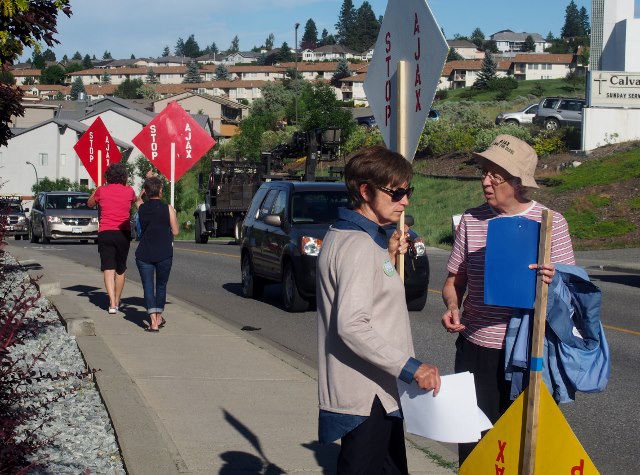
Members of Kamloops Area Preservation Society protest outside Ajax open house Tuesday.
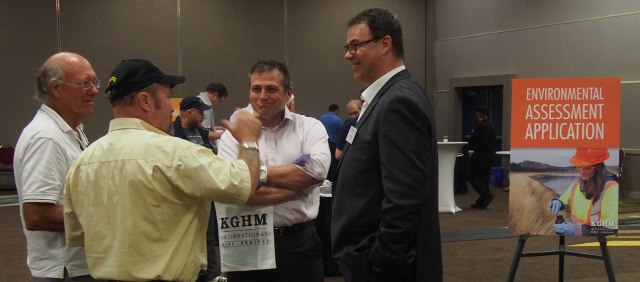
KGHM spokesman Yves Lacasse, right, speaks with members of the public at open house.

 ArmchairMayor.ca
“It reflects the fact that people had concerns,” Koopmans said. “We acknowledge that.”
The previous configuration was designed by Abacus, now the junior partner, when it was the main shareholder, he explained. KGHM had concerns about that initial approach.
FIVE years ago the original waste dump sites in the 12 July 2009 Wardrop Abacus Report indicated a south of the pit location.
Supported by specialist staff, said spokesman Yves Lacasse. Including the published answer of less water required with the (new) locations including the wet storage facility, I still received from the “specialist” people referred to me, “the same” and “more”. Three different answers.
LikeLike
Last year they said they found more ore and would be looking at expanding the pit.
Not even a month ago, “Uhl said, the ultimate circle of the enlarged historic Ajax pit will not change from the original plan. Mine walls will be steeper, however.”(http://www.kamloopsthisweek.com/ajax-mine-footprint-to-be-moved-south-of-city/)
Now “John Spagnol, senior air-quality scientist with consultant Stantec, said there are four key changes that would reduce dust: Shorter haul roads; A SMALLER PIT; a smaller storage area moved farther south; and use of larger haul trucks driving slower.”
First it was bigger, then it was the same with steeper walls, and now it’s smaller? Are they just putting them all out there to see how the public reacts?
It’s interesting that somehow everyone missed the mine life shrinking from 23 years to 20 years, and that if you reduce the number of trucks, that reduces the number of drivers needed, but funnily enough the jobs numbers have stayed the same.
This company keeps saying they want a conversation based on facts. Unfortunately, they can’t seem to keep their “facts” straight.
LikeLike
Lacasse says we aren’t exceeding healthy levels of PM2.5. The BC annual standard is 8, last year we were at 8.9. The BC Planning goal is 6!
Not to mention that there is no safe health threshold for PM2.5:
“PM2.5 is one of the most important outdoor air pollutants in B.C. from a human health
perspective. PM2.5 exposure is linked to a range of health impacts including inflammation of the airways, more frequent use of medications, increased emergency room visits, hospitalizations and premature mortality. No safe health thresholds have been identified.” – http://www.bcairquality.ca/reports/pdfs/pm25-implement-guide.pdf (pg 2)
LikeLike
“These are people who are experts in their fields and there seems to be a discrepancy in the information put out by the group of local physicians,” Lacasse said.
What Lacasse didn’t care to say is the margin of error for the equipment used to monitor and gather important data has a margin of error of plus/minus 25% which equates to guess work. The hard fact remains that any industrial activity does emit. The more activity the more emissions. Zero-harm and zero-discharge are totally bogus claims. Where is the will to diversify our economy? That is close to zero.
LikeLike