
Beattie students hold street side ‘study session’

Beattie and South Kamloops secondary students study
together on the sidewalk on Thursday, hoping to make a statement a protest.
By MIKE YOUDS
They were seated on the sidewalk, but it wasn’t a sit-in that students staged today (Thursday) across the street from Beattie School of the Arts at John Peterson campus.
“It’s not a sit-in,” one protested. “I don’t know why they called it that.”
A more appropriate description would be “study session.” Textbooks open, students from Beattie and South Kamloops secondary were studying together for provincial exams they must take next week.
“We’re not protesting. We’re making a statement. This is cram time.”
In an ordinary school year, the scene would have played out countless times across the street. Instead, on Day Three of what could be a long, bitter strike stretching into the heat of summer, the students opted for neutral territory — studying within view of picket lines and the school district administration office.
“Students from every school are welcome, but right now it’s just two of us,” said Megan Fryatt, a Grade 10 Beattie student, as more students arrived. The act of mutual support was the idea of four friends from Beattie who used Facebook to spread the word after discussing it on Saturday.
“We were sitting on top of my mountain,” said Shealyn Chesley-Steves, who has a favourite spot for inspiration near her Knutsford home. “We started thinking about how the union has an opinion and the government has an opinion but no one is considering the students.”
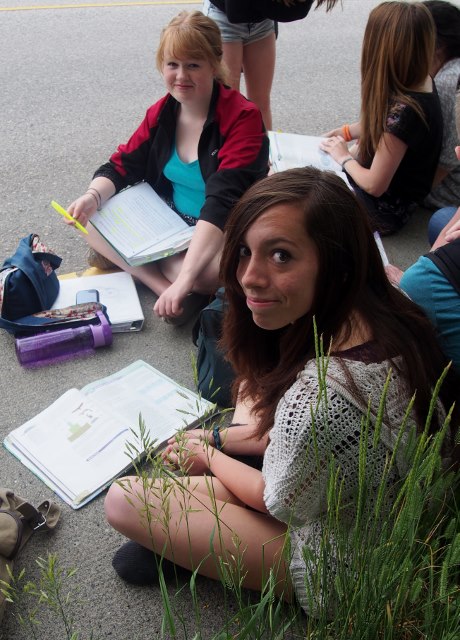
Lilja-Iris Long and Shealyn Chesley-Steves were among a group of four friends who invited all students to a study gathering on Thursday.
More specifically, they feel overlooked at a vitally important time in the life of a secondary student. The usual pressure of exams is intensified by the absence of their key support system: Teachers. Through lost classroom time over the past three weeks of the labour dispute, they’re feeling disadvantaged going into exams.
“We have a really, really, really, really good science teacher,” Megan said. But they missed instruction on the final chapter. “That’s why we’re here to help each other because the teachers can’t help us.”
“Teachers help, believe it or not,” another added with a hint of cynicism.
Robert Kennedy, a French immersion student at South Kamloops, stood up to offer a more ardent stand. “I support the teachers 100 per cent and the government honestly needs to get its act together along with (union negotiators).”
He experiences first hand the problems with class size and composition, taking classes with as many as 32 others of varied needs.
“I myself am special needs and they simply can’t handle it.”
Across the street — walking an invisible line between profession and parenting, stood Jacob Reiser’s mother, a teacher. She wasn’t sure of the value of the group studying, but their concerns are close to home.
“It’s frustrating for all of us,” said Pamela Clark, a tear welling up as she looked up the street at the kids. “We all wish we could be in there with the students, too. We all need a settlement, but it has to include class size and composition. We didn’t stand up for it enough last time.”
There are diverse needs across the provincial school system that cannot be met because of a profound lack of classroom support workers, said Jill Emery, a Beattie secondary math teacher. Classroom assistants, in some cases, are only available for part of the day, which isn’t effective.
Beattie has one of the highest percentages of special-needs students in the district, but those needs are varied and complex. In Vancouver, special needs might describe a classroom half full of ESL students, Emery said.
“Half your class doesn’t know what you’re talking about.” “That’s why it’s important, because of diversity, and that’s why class composition is more important than class size,” Clark added.

 ArmchairMayor.ca
Leave a comment