
Anti-spam law has businesses worried
NEWS — Beware the spam.
Canada’s new anti-spam law, designed to minimize unsolicited commercial electronic messages, comes into effect July 1 and some Kamloops businesses aren’t sure what to do about it.
 The new law carries fines of up to $1 million for individuals and up to $10 million for companies for sending unwanted emails, texts or other electronic messages. That has companies and organizations sending out notices to people on their mailing lists asking for confirmation that they want to continue getting newsletters or notices of new products.
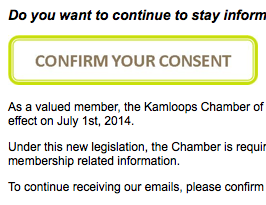
One of those groups is the Kamloops Chamber of Commerce. It sent an email this week to recipients of its newsletters, asking people to click on a “Confirm Your Consent” e-button. The message says the chamber is required to obtain such consent under the new legislation.
Chamber executive director Deb McClelland said Friday that while there’s been plenty of advance notice about the new law, many companies haven’t figured out yet how it applies to them. “We’ve been telling people for quite awhile but, let’s face it, when the deadline looms that’s when people start paying attention.
“People are really questioning, ‘does this affect me in my business?'”
She said the new regulations — called CASL for Canada’s Anti-Spam Law — are complex, and the confusion is compounded by the fact different authorities are giving different answers.
The chamber will host a workshop on the issue Thursday, June 26.
Simply Computing, which sends out weekly product offers to its customers, is one local company that’s making sure it isn’t in conflict with the anti-spam law. It emailed a notice this week asking customers to confirm their wish to continue receiving newsletters by signing up again with their contact information.
The federal government’s website says the law prohibits sending of a commercial electronic message unless the person who receives it has consented. It says a message promoting a product or service that encourages the recipient to purchase it would quality as a commercial electronic message, or CEM.
Canadian Chamber of Commerce president Perrin Beatty wrote in April 2013 that the chamber was concerned that businesses could incur significant compliance costs and possible financial risks for inadvertently not complying with the new law.
While Beatty said spam is invasive and unsolicited bulk email plagues economies around the world, the law could cost Canadian companies millions of dollars.
Lawyer Lisa Chamzuk was quoted in the Vancouver Sun as saying the Canadian law has a catch 22. “After July 1, 2014 there will be restrictions on the extent to which you can send electronic messages, including electronic messages that are designed to ask for consent to send commercial electronic messages.”
She said, “What companies can do now is go out and essentially clean their marketing database and get as many of those folks to agree before the act goes into force that they can receive emails after the act goes into force.”

 ArmchairMayor.ca
Leave a comment