
British Columbians willing to pay more tax to stop development of ALR, research shows
EDITOR’S NOTE — Prof. Peter Tsigaris writes for The Armchair Mayor News on issues of importance. This week, B.C. Agriculture Minister Norm Letnick promised a B.C.-wide consultation before controversial changes to the Agricultural Land Reserve are implemented.
By DR. PETER TSIGARIS
In 2008, I along with three colleagues from Thompson Rivers University published a research paper exploring the factors underlying public support and willingness to pay to preserve the agricultural land reserve (ALR) in British Columbia (Androkovich et. al., 2008).

Dr. Peter Tsigaris.
The ALR was established in 1973 to safeguard the province’s most productive agriculture land from other developments. The objective of the ALR was to preserve agriculture land for farm use and to establish and maintain family farm businesses (Land Commission Act, section 7). Currently, the ALR encompasses 4.76 million hectares (Agriculture Land Commission).
We distributed a survey to elicit peoples’ preferences towards preservation across the province. The response rate was 30 percent, which is typical. After analyzing 267 surveys we found that British Columbians’ place equal importance on the following motives for preventing development on the agriculture reserve in British Columbia: “to ensure that local food production is maintained,” “the economic importance of British Columbia’s agriculture sector,” and “to protect the environment.”
The first two motives, namely food security and encouraging farm businesses, are the key goals of the Commission. The reason “protect the environment” as an equally important motive for preventing development of the agriculture land reserve was initially a surprise to us.
However, this result makes sense when one considers that most of the reserve, outside the Lower Mainland, is still in the form of natural capital. Natural capital provides many valuable ecosystem services including food, fresh water, wildlife habitat, biodiversity, carbon storage and sequestration, soil conservation and erosion control, pollination, benefits from protected areas and parks for recreational opportunities.

Figure 1: ALR.
As a result of our study, we recommended that the government of British Columbia consider modifying the mandate of the Agriculture Land Commission to incorporate also environmental benefits arising from the expansion and/or preservation of the reserve.
Moreover, the survey allowed us to place a value on the preservation of the Agriculture Land Reserve. Before asking for willingness to pay to preserve the reserve, we described that there will be pressure for development of the ALR due to population growth and hence the need for additional housing units.
We asked the respondents to imagine that the government would continue to support the ALR and that the new developments would be in areas that are more expensive to service (water, roads, etc) and that the government would have to raise additional tax revenue to pay for the higher costs. We then asked the respondents the following question:
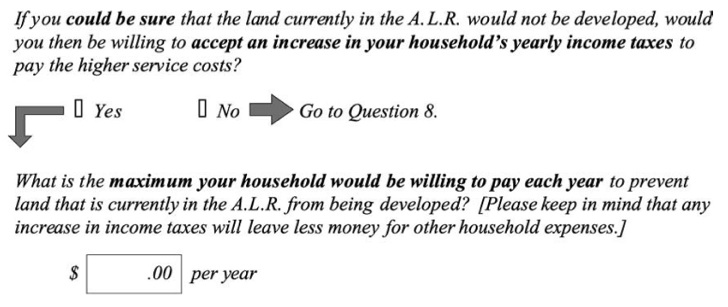
Fig. 2: Survey question.
We found that 67 percent of respondents were willing to accept some increase in their yearly income taxes. We (conservatively) estimated province-wide willingness to pay to equal $91 million per year ($54 per household).
Recently, the government of BC has introduced Bill 24. This proposed amendment to the Act divides the reserve into two zones. Zone 1 is composed of Vancouver Island, the South Coast and the Okanagan, while Zone 2 is composed of the Interior, the North and the Kootenay.
Zone 1 will retain the existing priorities. Zone 2 will no longer maintain the objective of preserving the land for farm use and encouraging and maintaining farm businesses. The Bill will consider also the land for “economic, cultural and social values,” “regional planning objectives,” and any “other prescribed considerations” as requested by Cabinet.
Zone 2 contains 90 percent of provincial ALR lands. Hence, most of the ALR will not be prioritized for its original purpose.
Farm groups want more consultation (Shaw, 2014). West Coast Environmental Law is concerned with Bill 24. Our research findings indicate that more public discussion needs to take place before changes are made. People surveyed want to preserve the A.L.R. not only for food security and the encouragement and maintenance of farm businesses, but also for the environmental benefits it provides.
References:
Androkovich, R., Desjardins, I., Tarzwell, G., & Tsigaris, P. (2008). Land preservation in British Columbia: an empirical analysis of the factors underlying public support and willingness to pay. Journal of agricultural and applied economics, 40(03), 999-1013.
Shaw R., “Farm group reverses support for ALR bill.” Vancouver Sun, April 22, 2014, retrieved from: http://www.vancouversun.com/Farm+group+reverses+support+bill/9761258/story.html.
West Coast Environmental Law, Bill 24 – Agricultural Land Commission Amendment Act: Undermining BC’s Food Security, 2014, retrieved from http://wcel.org/resources/environmental-law-alert/bill-24-agricultural-land-commission-amendment-act-undermining.

 ArmchairMayor.ca
Leave a comment