
Horses deserve a lot better than we give them
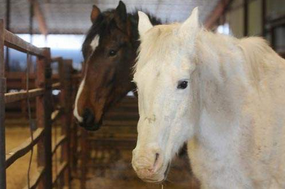
Two of the wild horses at Kamloops stockyard in 2011. (Daily News file photo)
ARMCHAIR MAYOR SAYS — Today’s front-page headline in The Kamloops Daily News, Protest Focuses on Horse Slaughter , has stirred up a surprising number of unsympathetic and insensitive comments about the killing of horses for meat.
The story is about a protest planned for Saturday in Westwold (people are supposed to meet at the elementary school at 11 a.m.) against the reopening of a slaughterhouse that slaughters and processes horses. The issue is certainly not new in our area.
Back in 2011, 22 wild horses that had been rounded up were hauled to the Kamloops stockyards for auction, the expectation being they’d be slaughtered for meat. That started a continent-wide protest — two of the horses were saved by the animal-welfare group Critteraid.
I wrote quite a bit about it at the time and can’t express my personal abhorrence toward slaughtering horses any better now than I did then. What follows is an Armchair Mayor column I wrote on the issue at the time. I think it still applies.
Horses Deserve Better Than We Give
The Kamloops Daily News
Feb. 12, 2011
By MEL ROTHENBURGER
The Boys are there to meet me when I enter their paddock around quarter to seven each morning.
Tanner nickers softly and nuzzles my hand, knowing his treat of pellets is on the way, an appetizer before the main course of hay. He tends to get a little ribby in winter, and needs more calories, whereas Bradley – also known affectionately as ol’ Barrel Butt – is an easy keeper.
They’ve been together for 15 years, and we call them The Boys.
“Move,” I tell Tanner, “or I’ll put you up for auction.”
That’s a new one I tried this week, a poor joke, but maybe he understood me, since he trotted over to his grain bin to wait impatiently for me to bring the supplement.
We don’t ride them much anymore, but I can’t imagine consigning these beloved family members to the slaughterhouse. Yet tens of thousands of stable horses, race horses, cow horses, pleasure horses and wild horses end up there every year when their “usefulness” is over.
Twenty-some feral horses went on auction at the stockyards this week, every one of them likely going to the horse-meat export market. Some people think this is terrible, others reason that wild horses need to be thinned out to protect grazing land and that this is as humane a way of doing it as any.
From what I’ve been reading of the horse-slaughter business, I beg to differ with the latter view.
Horse meat isn’t very popular in most of Canada, but the export market to Europe and Asia is big. And, since the slaughter of horses for meat was made illegal in the U.S., horses from that country are simply shipped north to a half-dozen Canadian slaughterhouses that process them.
They’re typically bought at auctions like the one in Kamloops. So-called “kill buyers” pay cheap money for them – a couple of hundred bucks apiece – and ship them for slaughter. At the other end of the food chain, the meat sells for as much as $30 a pound.
Horses are usually killed at slaughter with something called a captive bolt pistol that fires a four-inch nail at the horse’s head. Videos posted on the Internet – I don’t recommend them for family viewing – show panicked horses being prodded into killing pens that are too big and too slippery, where they try to avoid the weapon being pointed at them.
The operator often has to use the pistol several times before the animal is rendered unconscious.
Some day, when age and illness overtakes them, I’ll have to make a dreaded decision about one or other of The Boys. I’ll call a vet to come and do what’s necessary at home, where familiar surroundings and kind hands will allow them to leave this world without fear, panic or pain.
Horses are prey animals that survive on the instinct to escape dicey situations. One can only imagine the trauma of those last days before slaughter. No horse lover would put them through it.
Some people point out that we slaughter cattle, pigs and other livestock, but horses are different – in our culture, at least, they are a part of our families just as dogs and cats are.
They work hard for us, give us pleasure, and are among the most noble creatures on earth. A horse – wild or tame – joyfully galloping in full flight across a snow-covered field or summer grassland is the very essence of freedom.
There’s an obvious answer – give the many horse-rescue groups a chance to find homes for them before they’re auctioned for slaughter.
They certainly deserve better than we’re giving them.

 ArmchairMayor.ca
Citizens need to know of the significant environmental impact of horse slaughter.
Video of the now thankfully defunct Natural Valley horse slaughter plant in SK. They were dumping 130,000 litres of horse blood monthly in local water sources and fields. They had 16 million gallons sitting in a retaining pond upstream from the Qu’Appelle River.
Reports from the also defunct plant in Kaufman, TX (US horse slaughter shut down when the EU banned import due to unregulated toxins), relate horse blood and even tissue bubbling up from drains and out of taps.
Why is horse blood a much greater concern than that of cattle or other animals? A horse carries twice as much blood in his system as a cow of the same weight. Thus, twice as much for disposal.
Because twice as much blood circulates through muscle meat, the incidence of injurious and even lethal toxins routinely administered to equines, is passed on to human consumers. Horses are full of phenylbutazone, vaccines, hormones, steroids, etc. Just one dose of phenylbutazone, known as “bute,” bars a horse from human consumption for life. Yet EVERY race horse and most sport and pleasure horses receive this common anti-inflammatory.
A study conducted by the National Institutes of Health proved the existence of bute in every Thoroughbred. It is actually administered as a preventative before races. Yet over 50% of race horses are slaughtered. Another common drug, furacin, can be found as a salve in nearly every barn. Furacin, too, is on the list of lifetime banned substances. One dose disqualifies the horse from the food chain. Yet we know thousands of horses are going to slaughter after having this salve used on scrapes and cuts.
Back to the environment. Most Canadians choose to not eat horses. They’re our friends, our workmates, our companions. However, the presence of a slaughter plant in the community endangers our health with both an abundance of blood. Blood which contains drugs with high toxicity levels to humans. Once it leaches into groundwater or is taken up by vegetables in a field, the lethal toxins enter our bodies. We’re ingesting horse drugs, whether we like it or not.
LikeLike
The latest Western Producer article on meat export to the EU mentions that before any of those exports take place, producers will have to clean up their act and quit using Ractopamine in pigs and growth hormones in cattle. If the Europeans wont accept these drugs in their meat why is the meat good enough for North Americans. It fails to mention drugs that are in horsemeat. Dog food companies do not use horsemeat in their product so it really seems strange that our government officials and the CFIA think it is perfectly fine to export the drug contaminated product for unsuspecting Europeans to feed their families. The CFIA’s own site lists over 40 drugs that are never to be given to horses destined for slaughter and another 20 or more including wormer that require a six month period for the drug to leave their system. If the CFIA followed their own rules every horse in the country would no longer be eligible for slaughter. Only some of the wild horses and those raised specifically for slaughter would truthfully be drug free.
Horse slaughter is a dirty business especially now when it is so easy to mix cheap meat in with the more expensive beef to make even greater profits.
LikeLike
Dear Theresa,
Thank you for caring about the horses, and for attempting to provide information.
As per AVMA guidelines, the penetrating captive bolt is indeed used for euthanasia by some vets.
Here is the comprehensive guide on veterinary euthanasia:
Click to access AVMA_euthanasia.pdf
You’re correct about NON penetrating captive bolt placement for stunning being more forward than I indicated. In humane euthanasia with a PENETRATING bolt, the placement is slightly different. Horses’ brains are located slightly farther back in the skull than a cow’s.
It’s important the public understands horses aren’t killed in the stun box.
I’ve heard too many people say, “Well, at least it’s over quickly.” As I said in my first comment, the horse is only stunned for 30 seconds (often after multiple blows), then butchered while conscious. Pro-slaughter has used the excuse too long that what happens in the stun box “is no different than having your vet do it.”
This how pro-slaughter slants truth. The penetrating captive bolt is a humane method, when: the horse is in friendly surroundings, sedated, properly restrained and surrounded by kind people. The penetrating bolt is illegal for use in slaughter.
Pro-slaughter perpetuates the lie that the horse is actually killed in the stun box. This makes slaughter seem more humane. When in fact, the horror is just beginning.
The NON-penetrating captive bolt is engineered strictly for stunning, and doesn’t work properly on horses. Period.
It’s incorrect that “some of the Canadian plants have moved to using a gun instead of the captive bolt because…” Slaughter plants have used the ineffective .22 bullet to stun horses for years. If you’ll kindly go back a little farther in the Canadian Horse Defense Coalition’s work, you’ll find their video Feb. 2010, showing the Bouvry plant in AB using bullets. http://www.youtube.com/watch?v=6FhZK1QF8yo
CBC did an investigative special on this. Complaints came from plant workers, who said CFIA inspectors hid in the back as bullets zinged all over the plant. Horse advocates found heads in the gut pile with bullet holes in the cheeks, eyes and nostrils.
While the Canadian Horse Defense Coalition does tremendous work to educate the public and end horse slaughter, they are not responsible for plants choosing one stun method over the other. The CHDC’s stance has always been to end slaughter, not seek reform. “Reform” of assembly line slaughter methods is a pro-slaughter stance. Horse advocates work towards its end.
On a positive note: it was a CHDC investigation that ultimately closed the plant in SK.
Viandes Richelieu has also used .22 bullets for years, as you can see from the many minutes of horrific video filmed there (also available on the CHDC site). The workers fire, the horse slides then gets back up, the worker takes his sweet time reloading. He shoots the horse inaccurately and repeatedly, as the poor animal struggles.
The point, again, is that horse slaughter cannot be carried out humanely with ANY tools, in any fashion. Horse advocates seek its end, not its reform.
Thank you for caring enough to attempt correcting my information. I would like to refer readers to http://www.defendhorsescanada.org for accurate information about horse slaughter, as well as petitions to support Bill C-322 to end this atrocity.
LikeLike
Thank you for caring about this Horrible Industry and what torture it is inflicting upon horses. It is almost unbelievable to me that this is happening in Canada. I wish it was unbelievable but it is happening and we as Canadians need to stop it. We are becoming desensitized to the suffering we are inflicting in the name of greed and money for few. This is not the road we want to go down… I feel it is like a test of some sort, “will they do anything about this?”…if not, what horrible thing can be done next in the name of quick cash at any cost of suffering. This is so sick. Horses are not meat animals, stop the Slaughter! Support Bill C-322 by contacting your M.P. and asking them to support this bill. Doesn’t anyone who has power care what the Canadian peoples values are, or what we want and don’t want in our country?
LikeLike
To askbaba – while some of the information you shared is correct, some of it is not.
Vets DO NOT use a captive bolt to euthanize a horse! Euthanasia is by lethal injection of the drug Phenabarbitol, often after a sedative has been given to ensure the horse is relaxed and passes peacfully. A captive bolt is NOT intended to kill the horse as you correctly state but to render them unconsious so that they are not aware of having their throat cut and being bled out. Horses have almost twice as much blood as cattle and therefore require a longer time to bleed out. Time, which in a business where time is money, is often not given to them to be completely bled out before the dismemberment process begins, thus horses are being butchered while still alive.
The spot for effectively using a captive bolt is on the forhead above and between the eyes, NOT behind the ears, however a horses head is different from cattle’s and that is why a captive bolt, even if successfully applied is not always effective in rendering a horse unconscious on the first try. Some of the Canadian plants have moved to using a gun instead of the captive bolt because of the expose that the Canadian Horse Defence Coalition did with the undercover film showing horses being stunned up to eleven times before being rendered unconsious.
Thank you for being a passsionate voice for the horse, but please ensure that what you share is correct. This is very much like a war and any misinformation is not helpful, we need everyone wanting to end horse slaughter to be well armed with the truth, as the truth will indeed always rise to the top and set us free.
Anyone wanting to learn more can indeed contact http://defendhorsescanada.org/ to get more facts and ensure that what they are saying is accurate.
LikeLike
Hi Mel, thanks very much for your heartfelt commentary, and for loving your horses so much.
I just wanted to correct some misinformation. Horses are not “killed” with a captive bolt, nor is the non-penetrating variety used in slaughter plants a euthanasia tool.
Horses are repeatedly bludgeoned with a blunt bolt which does not pierce the skin’s surface, or they are stunned with repeated bullets from a .22 (squirrel gun).
The penetrating variety of bolt you describe is illegal in slaughter plants, as it pushes possibly infected brain matter into the spinal fluid, and therefore into the meat. This is important to know, because horses are legally required to have a fully functioning circulatory system while being bled. Their hearts are pumping. Even more significantly: they are fully conscious. This was proven in a recent study by Hanover University.
Equines awaken 30 seconds after stun with excruciating headaches, to experience dismemberment. Slaughter workers are pressured to contain, stun, hoist and bleed out in two minutes or less. This is absolutely impossible, and we have video of horses writhing while being disemboweled and amputated.
Though factory farm raising and assembly line slaughter is certainly not humane for any creature, the same study at Hanover U, proved that the captive bolt does indeed stun cattle properly. Just as the stun chutes are designed to contain their bodies, this tool contacts the vulnerable spot on their skulls, usually with the first hit. Nor do cattle toss their heads at impossible angles, as any horse lover has surely experienced even in a calm situation with an unwanted bridle.
When vets use the penetrating captive bolt (which you described accurately) for euthanasia, the horse has already been heavily sedated and is held by people who love her. She is fed treats, and offers no resistance. Her head is lowered, her lips drooping. The one shot to the vulnerable spot at the top of her head, always kills her.
Contrast this to a terrified horse who has traveled in a truck with strange equines, been tortured with a 5000 volt prod, now flailing in blood and urine while a grinning psychopath yells and bludgeons her repeatedly. All witness reports and videos demonstrate the killer cannot even reach the vulnerable spot behind the ears, let alone commit to a clean stun. Horses are bludgeoned up to eleven times, slipping and screaming.
Thanks again for your caring commentary. For more information about horse slaughter, including full videos of what is radically censored on Youtube, please visit http://www.defendhorsescanada.org
Petitions for Bill C-322 to end horse slaughter may also be downloaded there.
LikeLike