
In defence of those who work at Royal Inland Hospital
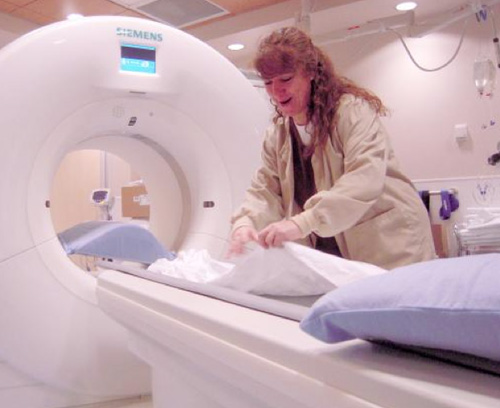
CT Technologist Tina Rybachuk prepares the scanner bed at RIH for the next patient. The scanner is used about 50 times per day. (Daily News photo)
We get a lot of letters to the editor about Royal Inland Hospital. The ones most of us remember are from people who have had a bad experience there.
They’re from people who didn’t get a parking space quickly enough, or a bed quickly enough. Or maybe they had to deal with a health-care professional who was having a bad day and didn’t seem to care enough.
We also get a lot of letters in defence of RIH. These are the people whose pain has been relieved, whose worries have been eased, and, often, whose lives have been saved.
They know firsthand what it takes to help people in medical distress day after day. They take it personally when someone criticizes those to whom they owe a debt of gratitude.
There are many things wrong with health care in this country, and a lot that needs fixing at RIH. But I wonder if the critics would be so quick to condemn if they went into the emergency ward waiting room or, even better, into the emergency ward itself, or to any of the various departments that diagnose illness and then do their best to treat it.
And just listen. Because there, they could hear real-life stories of people who desperately need, and receive, timely and professional help.
In the next bed, a man might be asking a doctor, “How long have I got?” after being diagnosed with lung cancer.
They might overhear the consultations between nurses and doctors of various disciplines as they map out a course of action for each patient.
They could admire the calm efficiency with which ER personnel respond to a PA heads up that a trauma patient involved in a motorcycle crash will arrive in an ambulance in 10 minutes.
They might be saddened by the acknowledgement of a patient that her disease is progressive and that she will be in pain until the day she dies.
In ambulatory care, they might be impressed with the gentleness and good cheer of health-care staff whose job it is to administer tests that are often uncomfortable, embarrassing and frightening for the patient.
And they might think, “These people are damn good at what they do.”
Then they might think about what it takes to work in that kind of a place. To watch patients trying to be brave, to listen to them confiding about life’s woes because, on that day, they have someone they can talk to and who will listen.
It’s a calling that can be answered by few because those who are in it must constantly balance successes with failures, focus on the good and somehow set aside the bad.
Those who are the beneficiaries are grateful for the rest of their lives, and they won’t allow anyone who questions the dedication and caring service of those who provide it to go unchallenged.
Health-care givers should keep that in mind whenever they see a letter of complaint, and the complainers should remember that those who work in the system are just as frustrated as anyone when something doesn’t go the way it should.
After all, on any given day at RIH, there are a million things that go right and never get noticed — it’s the one thing that goes sideways that too often gets remembered.

 ArmchairMayor.ca
Leave a comment