
Big oil, big pipes — Would the end of growth be such a bad thing?
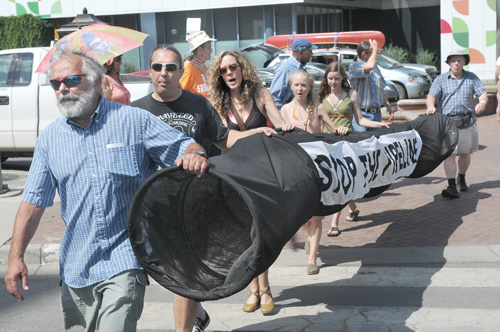
Protesters against Enbridge project rally in Kamloops. (Daily News photo)
While we seldom look past the gas-bar marquees (a litre of regular is priced at $1.23.9 in Kamloops as this is written) to the details of oil-industry machinations and their impact on the global economy, they became a local news story last week.
A few dozen people rallied to protest Enbridge’s Northern Gateway pipeline project that would take tar sands product across northern B.C. to Kitimat and from there by tanker to Asia and the U.S..
The route is a long way from Kamloops, but the environmental importance of it was driven home in a follow-up story about a study headed up by TRU professor Shane Rollans that calculates there’s an 87 per cent chance of a tanker spill in our fragile coastal waterways sometime during the next 50 years, should the pipeline go ahead.
If you were to ask columnist Rafe Mair, his answer would be that the percentage is low — he’s convinced there’s 100 per cent certainty of a spill, and probably within a much shorter timeframe.
Those who oppose pipelines and oil tankers generally take the view that it’s all about greed. If only oil magnates weren’t so greedy, our environment would be safer.
True, but greed is simply the motivator for risk-takers to fulfill our voracious appetite for oil. As Gordon Gekko (played by Michael Douglas) indelicately put it in his famous line from the 1987 film Wall Street, “Greed, for lack of a better word, is good. Greed is right. Greed works.”
I’ve been reading a fascinating book by former CIBC World Markets chief economist Jeff Rubin that came out earlier this year. It’s called The End of Growth and suggests our problem isn’t lack of oil, but lack of cheap oil.
The availability of “easy” oil is running out. There’s plenty left in hard-to-get places — such as offshore, the Arctic, and Alberta’s tar sands — but it’s a high-stakes game. Rubin concludes that, in the not-too-distant future, we won’t be able to afford to extract the oil that’s left.
And if we think we can simply replace oil with other forms of energy, forget it — we’re nowhere close to finding those answers.
A couple of nights ago, I got to the part of the book that discusses Enbridge. While the Northern Gateway project has plenty of hurdles left, it received a big boost when U.S. President Barack Obama put off a decision on the Keystone pipeline that would run from the tar sands south to the Gulf of Mexico.
“When supertankers are navigating the narrow inlet into Kitimat,” Rubin writes, “I wonder if the environmental lobby will regret that Keystone didn’t find an acceptable route through the network of highways and byways that already exists from Montana to Texas.”
Rubin’s book outlines a convincing argument linking the price of oil to our boom-and-bust world economic cycles, but he questions the traditional wisdom that a bust will always be followed by a boom.
He goes so far as to suggest that the only sure thing that can save our environment from destruction is for economic growth to end due to soaring oil costs; further, that the end of growth might not be such a bad thing.
“Maybe we all need to slow down and take a moment to breathe,” he says.
That sort of talk is akin to treason in economic-development circles, but it’s a topic for another day.

 ArmchairMayor.ca
Leave a comment