
Toad explosion turns out to be Anaxyrus boreas
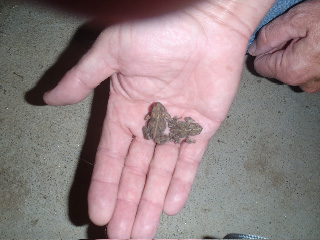
A couple of Mel's little critters, showing the white stripe typical of the Western toad.
Why did the frog cross the road? To get to Mel’s place.
We’ve been overrun with small frogs — toads, actually — the last couple of weeks. We have to be careful not to step on them in the yard and on the driveway.
They especially like to accumulate on the cool cement at our basement door by the dozens during the evening. One night I hauled a bunch of them out of the way to safety, but neglected to shut the basement door. When I went back inside I found one of them in the TV room watching Dancing with the Stars. Seriously.
So, I consulted Anne Neave, who coordinates the Nature Kamloops column for The Daily News, who, in turn, consulted Rick Howie. He replied with the following:
Hi Anne: feel free to pass this on to Mel. His description of bumpy toads suggests that these are Western Toads (Anaxyrus boreas) and not Spadefoots. They are actually listed as a species of conservation concern under the Species at Risk Act.
Western Toads spend most of their lives in the terrestrial environment. They go to ponds in the spring to breed and the toadlets leave the ponds by late July and move upland for the rest of the year. They forage until the weather cools and then they look for a good place to hibernate for the winter. They don’t go back to the ponds to hibernate.
So they will look for crevices and cracks around relatively warm places like house foundations to get the last bit of warmth before the cold hits. They may think that there could be food in such places before they settle in for the winter.
Toads will move from 1-2 KM from breeding sites to suitable hibernating locations. Hard to imagine those little guys going that far but they have been radio-tracked to prove it.
I don’t know how small Mel means when he says that. Those that emerged this year may only be 2 cm long or less. If they are bigger than that, they are likely older individuals that can get quite large with a body length up to 14 cm as they age.
Why he has noticed more this year than other years I am not sure. If they are really just juveniles, perhaps they had a good breeding year and a relatively late emergence. I saw a small one near Jacko Lake about a week ago and it was barely larger than emergent size which I would have expected to occur back in July.
Toads taste bad and have toxic secretions that reduce the palatability for coyotes, but herons and other birds will take them. Mortality of juveniles is normally quite high and they are favourite prey of Garter Snakes when they are small. Offhand, I can’t suggest a quick alternative to Mel’s basement for them to hibernate successfully. They usually like holes under roots, mammal burrows, depressions under logs, crevices in rocks that may lead to spots to hibernate and so forth. They are harmless around the house and it is nice to see that there are good numbers around. Now, we just need a good spot for them to overwinter.
So, I sent Rick the picture, which you see with this post, and he replied that “they are Western Toads for sure.”
Now I feel extra responsibility for the little critters’ welfare knowing they are an at-risk species. I don’t know if others in the area have experienced the recent population explosion as well, or whether they just happen to like our place. Maybe they like to watch cable.

 ArmchairMayor.ca
Leave a comment