
Why must we put boundaries on human compassion?
Thirty or so people gathered in an Aberdeen home Thursday night to celebrate a seven-year relationship with a small town on the other side of the world.
To me, they represent the wisdom and the joy of doing good work outside our own country.
Some people insist it’s philosophically wrong to send money and resources across the ocean when there’s so much need right here.
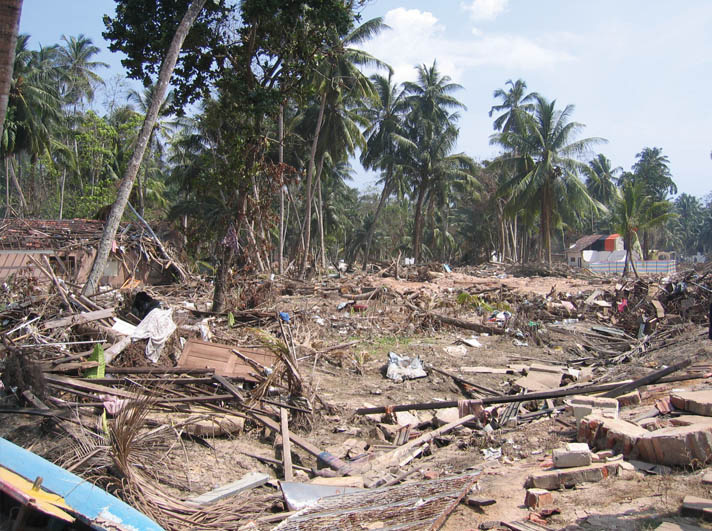
TSUNAMI of 2004 destroyed many communities in Sri Lanka. A dedicated group of Kamloops heroes has been helping rebuild one of them every since.
They say the $4 billion sent from Canada to other countries every year would be better spent in our own backyard. They would have us believe giving to foreign countries only makes them dependent on our generosity.
Charity, they say, begins at home — let the rest look after themselves.
But only the myopic insist on hoarding our altruism. Anyone who thinks that way would have experienced a paradigm shift had they sat in the living room of Sherry and Nihal Maligaspe on Thursday and listened to the stories of our city’s enduring connection to the coastal town of Tangalle in Sri Lanka.
They would have seen the tears — tears of affection and gratitude — of those who turned a natural disaster into an international story of friendship.
And they would have admired the courage of the two Sri Lankan guests — Ruwan and Anil — and the spirit of giving and kinship of the local citizens who have worked with them steadfastly since early 2005 to rebuild that community.
People like Terry Shupe, revered by the children there for the toys he makes for them, who chairs the Kamloops-Tangalle Friendship Committee.
People like Wayne McRann, who first identified Tangalle as a place in need of this community’s help. And Raelene Shea, who came to love the people of Tangalle so much that she now lives and works there.
And Nandy Spolia, who tirelessly raises donations.
They’re among a core group of a dozen who refuse to abandon their commitment to a town of 15,000 that can only be reached via a 22-hour airline trip and a seven-hour drive.
They’ve built houses, worked on a skills-training centre, brought computers, developed education programs, and raised money for new municipal equipment.
When Kamloops reached out to Tangalle after the Tsunami that devastated the community along with much of southeast Asia on Boxing Day in 2004, the place was a mess. Many lives were taken, the fishing industry was virtually destroyed, homes and businesses lost.
It was a community with little in the way of amenities to begin with — a small library with few books, a public beach with no facilities. Its garbage-disposal system depended largely on the packs of three-legged dogs (who have a habit of getting run over because they sleep on the roads) that rummaged through the piles of waste left on the streets. Sewage ran in open ditches.
Tangalle remains in need, but it’s much changed since that horrific day when the ocean turned on its people. Long after the NGOs that flocked there after the tsunami have left, the heroic group on the Kamloops committee remains. Tangalle has little to offer in return but friendship, and that’s more than enough.
So, please, you who say our ability to love and to give somehow has limits, and that those limits should be our own borders, save it for your own beggarly ears.

 ArmchairMayor.ca
Leave a comment