
Sweet irony in Valleyview traffic slowdown
There’s sweet irony in the lineups of cars caused by construction work on the Valleyview bike/pedestrian overpass.
Forty years too late, the City is trying to jump the asphalt-concrete barrier between Valleyview and downtown Kamloops caused by the bypass that was supposed to solve so many local traffic problems.
The isolation of Valleyview is symptomatic of our worship of the automobile and a trend that goes back to what’s known to long-time residents simply as “amalgamation.”
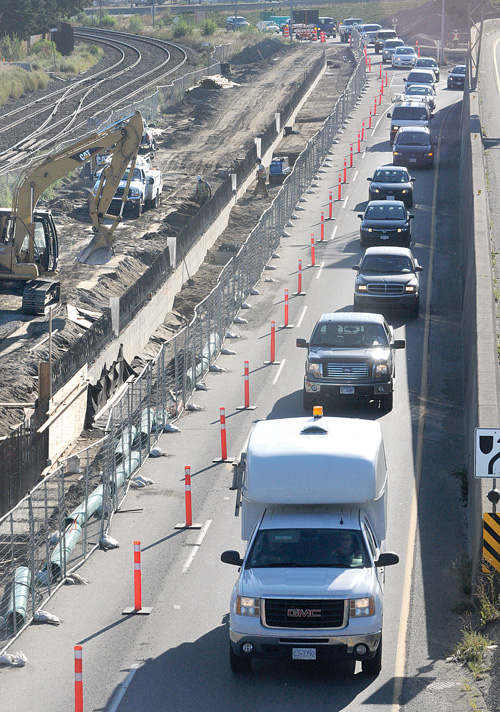
Patience is a virtue these days as traffic crawls through construction area for the new Valleyview bike/pedestrian overpass. (Keith Anderson photo, The Daily News)
In 1973, the NDP government of the day decreed that Kamloops (a city created by an earlier amalgamation of independent municipalities across the river from each other), Valleyview, Brocklehurst, Dufferin, Westsyde and Barnhartvale be merged into one big city.
With new retail development focused on the South Shore and neighbouring Sahali, we became a blacktop town as major traffic corridors were upgraded and widened.
The need to move vehicles efficiently from bedroom communities to retail areas and major employers like the pulp mill meant pedestrians and bicycles had to take a back seat.
It has not been without cost. While our downtown core remains relatively healthy, it suffers from the one-way traffic system put into place to move automobiles through it rather than to it.
Seymour Street, which is where I work, does its job as an auto mover but is distinctly unfriendly to bicycles and foot traffic.
Good city planners will tell you that successful cities and neighbourhoods are designed for cohabitation by all manner of transportation and uses. Ideally, people should be able to walk from their homes to shop, work and recreate.
In Kamloops and in many other cities, people drive rather than walk from one store to the next. Our town is one of many that has given in to the temptation of going big with everything — big suburbs, big stores and shopping centres, big parking lots. Our newest residential areas are designed like jigsaw puzzles that even their homeowners can get lost in.
Eleven years ago, then-Vancouver mayor Philip Owen visited Kamloops on a break from a Rocky Mountaineer trip and went away singularly unimpressed.
“In Kamloops, you get in your car, you go to Chapters, there’s four acres of asphalt, then you get in your car and you drive to Overwaitea, because that’s two blocks down. There’s Burger King, A&W, the big box retailers, and so on, scattered all over the bloody place. Beautiful hills, a beautiful view, asphalt, independently built concrete buildings that aren’t connected in any way for pedestrians or public transit and a downtown that’s dying.”
I took him to task at the time, inviting him to come for a properly guided tour of our city, but there was some truth to what he had to say when it comes to the emphasis on the almighty automobile.
So while calls from the anti-parkaders to stop building parking stalls and start making people walk, bike or ride the transit aren’t a practical overnight solution, the situation in Valleyview reminds us that we need a two-pronged approach: deal with the parking problem we’ve got and, at the same time, wean ourselves away from our addiction to fossil fuels.
Maybe, if the parkade-at-the-park is ultimately defeated, it will send a wakeup call that we’ve got to rethink our priorities.

 ArmchairMayor.ca
Leave a comment