
Well-intended laws can cause bad behaviour
By MEL ROTHENBURGER/ The Armchair Mayor
Listening to the two sides of the Dallas fence issue present their cases to City council this week, one would think they were living in different cities, if not universes.
According to Curtis Schlosser, backed up by neighbour Randy Durante, the public riverfront access at the end of Urban Road is a magnet for drug dealers, thieves, dirt bikers and rowdies.
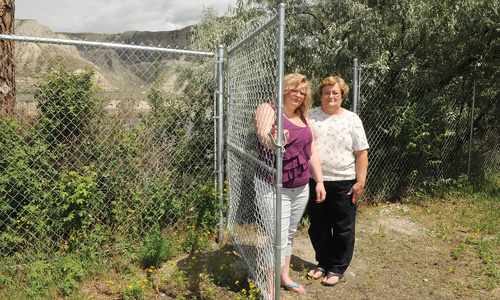
Meghan Watson, left and Mary Lee Potestio with the offending fence. (Daily News photo)
Not so, insisted resident Mary Lee Potestio — she’s never had to call police in the 35 years she’s lived there. It’s a quiet neighbourhood with few problems.
The issue is a fence and gate erected by Schlosser to keep people from the beach at night — an illegal barrier that council had earlier ruled must be removed.
The stories told by Schlosser and Potestio were so wildly at odds that one is tempted to think somebody was guilding the truth. More likely, the truth — as is often the case — lies somewhere in between. (Part of that truth amounts to eight police reports in a 12-month period.)
The looks on the faces of council members as they listened to the two combatants ranged from deadpan to bemused.
But aside from the curious entertainment value of watching Schlosser — a well-spoken fellow who sounded genuinely aggrieved — and Postestio — a feisty sort who professed to being “insulted” and “angry” at the claims of Schlosser — duke it out, verbally at least, this seemed to be a case in which a well-intended law has resulted in some bad behaviour.
By provincial statute, a lane must be reserved every 200 meters, in urban areas, by which the public can get to the water. In rural areas, it’s every 400 meters.
The provision is aimed at preventing precious waterfront from becoming the preserve of those well-enough off to build their houses fronting the water.
According to development and engineering services director David Trawin, these accesses aren’t marked, some have been taken over by neighbouring property owners for lawn, and some are even unsafe.
In Dallas, there are five of them; in all of Kamloops, there are about a hundred. Many were carved out of subdivision plans and quite a few are simply impractical for public use.
They’re usually about 20 metres wide and are designated as roadway. The City uses some for storm sewers.
Trawin says they get more public use in Westsyde, less in Brocklehurst; Dallas is tough because of the steep drop to the river.
If council was of a mind, it could just close them all off, as it could have done with the one at Urban Road, then nobody would get into arguments over them. The alternative is to inventory them, protect the good ones and close the bad ones.
Trawin says in the years he’s been in Kamloops, disputes over access have arisen with only three of them despite their often impractical placement.
Meanwhile, despite council’s decision this week, the issue remains unresolved, at least to the unanimous satisfaction of the antagonists. The City has on the books a mediation process for resolving such neighbourhood disputes, but it’s seldom used.
So it’s now Trawin’s job to wade in — Solomon-like — and try to work something out that will bring at least some sense of peace to all concerned.

 ArmchairMayor.ca
Leave a comment