
Finding enough seats for all candidates is challenging
Those who organize election debates have a right to invite anyone they wish. There’s no law that says otherwise.
There’s also no law that says a candidate can’t complain about it, nor that a candidate can’t tell a forum sponsor, “No, thanks, I’m not coming.”
Under normal circumstances, candidates thrive on organized debates. This week, though, TV7 finds itself in the unusual situation of having a shortage of candidates for an April 29 televised federal-election debate.
Inviting all the local candidates to take part — as we’ve done for the April 27 media-sponsored forum at the TRU Grand Hall — is the normal and fair thing to do. (And all of them will be at that one.)
But sometimes fairness and practicality don’t coincide. It would have been fair, for example, of the broadcast consortium to have Green Party leader Elizabeth May in the federal leaders’ debate, but they couldn’t invite everyone. There are, I believe, 18 registered parties eligible to run candidates in this federal election.
The resources of national broadcasters, not to mention the patience of voters and viewers, have their limits. So, rather than endure a debate that includes the Animal Alliance Environment Voters Party of Canada, the Rhinoceros Party, and the Marxist-Leninist Party, restrictions were reasonable.
Here at home, there are five candidates. CFJC news director Doug Collins defends his decision not to include Donovan Cavers of the Greens and Chris Kempling of the Christian Heritage Party in a televised forum.
He wrote on the station’s website that only about 25 minutes is available for an edition of the Midday show featuring the candidates. Since neither the Greens nor Christian Heritage has any MPs, their local candidates were excluded.
Setting guidelines is tricky. If the rule is that a party must have elected at least one Member of Parliament, how is a party supposed to elect its first MP without getting exposure to its policies and ideas?
The opportunity to be matched against opponents in a live or electronic setting is essential for third-party candidates. It can make or break them.
TV7 now finds itself in a rather awkward position — in a show of solidarity with Cavers and Kempling, Cathy McLeod refuses to take part in the Midday program. And Kempling, as of Wednesday, is boycotting a profile piece the station had planned to do on him.
“I realize it limits my exposure, but they weren’t going to allow discussion of policy issues anyway,” he says.
So what’s left for the local TV debate is a conversation between the NDP’s Michael Crawford and the Liberals’ Murray Todd. Crawford, as in the previous two campaigns, is easily the best debater on the slate, while Todd is new to campaigning.
Without the other candidates, it might not be all that illuminating.
But there’s another interesting angle to this. Some pundits insist the order of finish in this riding could actually put the Greens ahead of the Liberals.
Cavers ran only a thousand votes behind the Liberal candidate in 2008, and has been conducting a good campaign, especially given he has no budget. He was off the starting blocks early, earning himself good media coverage.
If he really does have a shot at a third-place finish, it further complicates the wisdom that parties with elected MPs should be favoured over those without.
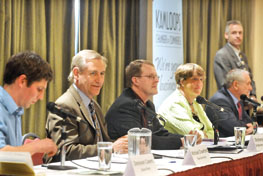
All candidates were in attendance at chamber of commerce forum this week. Keith Anderson photo.

 ArmchairMayor.ca
Leave a comment