
The day the buffalo fell off the truck
Mohamed Ali Khalaf introduces himself simply as Mohamed Ali, “but not the boxer; my muscles are weak.”
Thin as a stick, in his late 20s, he’s a poet, story teller, a travel guide and, he jokes frequently, a future president of Egypt.
A brilliant student who was expected to become a doctor, he instead got his degree in tourism and is now the go-to guide guy in the land of the Pharaohs.
For two weeks in November, he is charged with showing three dozen mostly-Kamloops tourists around Egypt, cramming as much history and as many temples and ruins as he possibly can into each 12-hour day.
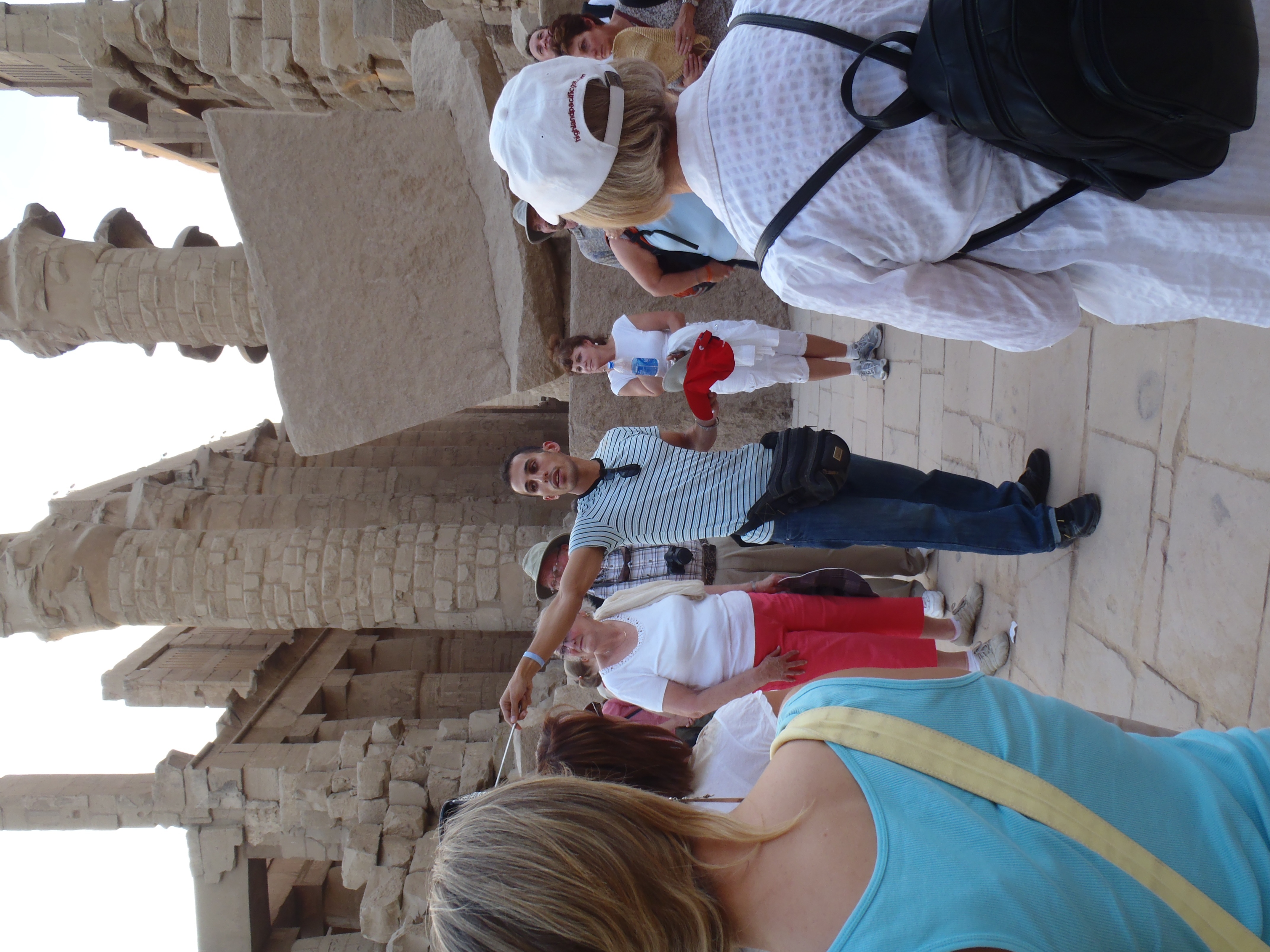
Mohamed Ali describes history of Karnak temple near Luxor to Kamloops group.
Tuesday, Nov. 2, 9 a.m. — Camel owners at the Great Pyramid are trying to negotiate higher tips from customers who’ve taken 20-minute rides on the gentle beasts. Be firm, Mohamed has warned his wards — no more than one American dollar is necessary. The camel guys are but the first example of the advanced hucksterism at Egyptian tourism sites over the next 14 days.
Members of the group soon adopt a saying — “running the gauntlet.” At the exit of every tourist site is a conveniently located bazaar through which one must pass. Vendors surround each tourist, draping cheap scarves on their shoulders, displaying knockoff papyrus paintings, and showing them shirts and galabeyas (the dress-like garment worn by Egyptian men).
“Good price, no hassles!” the vendors insist as they block the way.
Tuesday, Nov. 9, 4 a.m. — On the road to Abu Simbel, one of the greatest of Egyptian temples in southern Egypt, Mohamed Ali is bundled up against the “chilly” 17C morning, pulling his hoodie tight over his head. He explains that the soldier in the front seat with the AK-47 is there to help out just in case we get a flat tire or have an engine breakdown. “Egypt is as safe as heaven,” he assures the B.C. contingent.
I read not long ago that all Egyptians share one common trait — a passionate pride in being Egyptian. Mohamed Ali is no exception, though he recognizes that Egypt — already thousands of years old — is a work in progress.
During an overnight train ride from Aswan to Cairo he speaks candidly — and apolitically — about the need for improved health care, recycling, transportation infrastructure, and assistance for those who live in rural (in Egypt, that means desert) areas.
Thursday, Nov. 11, 9:30 a.m. — There’s a screeching of brakes as a chain-reaction smash-up brings freeway traffic to a sudden halt. A buffalo riding in a small pickup truck is thrown off the side, but Mohamed Ali goes to investigate and returns with the news that “he’s OK.” Indeed, the buffalo is somehow hoisted back on the truck and looks none the worse for wear. Not so with several vehicles.
Maybe when Mohamed Ali becomes president he can do something about crazy Egyptian drivers who tailgate at 100 km/h and don’t bother to turn on their headlights at night. Egyptian cars seem to all have a minimum of one crumpled fender and at least one missing tail light and head light.
Note to self: Kamloops drivers would feel right at home.
Saturday, Nov. 13, 5 p.m. — Baharya is a decrepit little town in an oasis a couple of hundred kilometers from Cairo in the western desert. Empty tin cans, plastic bottles and other refuse are everywhere. Instead of collecting garbage, people burn it in the streets. This is a place that looks forgotten. (Wayne McRann and Developing World Connections, where are you?) Yet small children have big smiles and greetings of “Hallo!” for visitors, and even older adults offer a friendly wave. Mohamed explains there is virtually no crime in Baharya.
This is Mohamed Ali’s Egypt in 14 days — unparalleled history, spectacular monuments, filthy streets, tourist bazaars abuzz with con men, public washrooms you must pay five Egyptian pounds or an American dollar to use, crazy traffic, and people who would literally give you the clothes off their back if you needed them.
When it comes time to part, there are many handshakes, hugs and tears shared with this young man who has bonded with a group of strangers he affectionately calls his “Canadian heroes.”
Mohamed Ali has never been out of Egypt. Some day, he says, he wants to come to Canada. When he does come, he’ll have 30 or so Kamloopsians competing to return his hospitality.
mrothenburger@kamloopsnews.ca

 ArmchairMayor.ca
Leave a comment